!!
Glossary of Terms
Active: Uses electrical power.
Amplifier: An electronic device that increases the current of a signal, providing power to the loudspeakers (i.e. power amplifier, inte-
grated amplifier, receiver).
Barrier Strip: A row of speaker connectors with screw-type locking mechanisms.
Bass: The range of audio frequencies below 160Hz, characterized by low pitch.
Crossover: An electronic circuit that divides an audio signal into different frequency ranges.
Distortion: Any deviation from the original signal, caused by any type of equipment.
Driver: The moving part of a loudspeaker which radiates energy.
Dynamics: Variations in loudness of sound.
Frequency: A rate of vibration which corresponds to musical pitch in the audio band, expressed in Hertz (Hz).
Full Range: A signal encompassing the entire frequency spectrum, not filtered above or below a certain frequency.
Hertz (Hz): A unit of equal to one cycle per second, used to measure the frequency of a signal or sound.
High-Pass Filter: A filter that passes only frequencies above a certain lower limit; electronically removes low frequencies from a full
range signal.
Impedance: A measure of the total opposition to current flow in an alternating current circuit, described in ohms.
In Phase: The polarity of an audio signal when connected as follows: (+) to (+) and (-) to (-).
Integrated Amplifier: Has preamplifier and amplifier built into one chassis.
Interconnect Cable: A length of shielded wire with plugs at both ends for feeding signals from one electronic device to another.
L.F.E.: “Low Frequency Effects”; an RCA output for connection to a subwoofer.
Line-Level Connection: Low level RCA/phono type connection.
Load: A term used to describe the impedance which a speaker presents to an amplifier.
Low-Pass Filter: A filter that passes only frequencies below a certain upper limit; electronically removes high frequencies from a full
range signal.
Main Speakers: Front L & R channel speakers, sometimes referred to as satellites.
Main-In: A line-level RCA input on the back of a receiver, integrated amplifier or power amplifier.
Midrange: The frequency span of the middle of the audio range, roughly 160Hz - 1300Hz. Also used to describe the driver which
reproduces these frequencies.
Ohm: A unit of electrical resistance; that which opposes an electric current in a conductor. In audio, a measure of the load presented
by a device to an electrical source.
Out-of-Phase: The polarity of an audio signal when connected as follows: (+) to (-) and (-) to (+).
Passive: Uses no electrical power.
Phase: An expression of the relative polarities of two identical signals.
Power Handling: The ability of a loudspeaker to operate without distortion when given varying amounts of power.
Preamplifier: An electronic device that selects sources and passes line-level signal to amplifier.
Pre-Out: A line-level RCA output on the back of a receiver, integrated amplifier or preamplifier.
Receiver: Has preamplifier, amplifier and tuner built into one chassis.
Satellite: Front L & R speakers when used with a subwoofer. Referred to as “main speakers”.
Sensitivity: A ratio of how much of the input electrical power is converted into acoustic power, measured in decibels.
Signal: The series of continually changing electrical voltages that correspond to variations in the loudness of the original sound.
Speaker-Level Connection: The connection between a loudspeaker and an amplifier.
Sub Out: An RCA output for connection to a subwoofer.
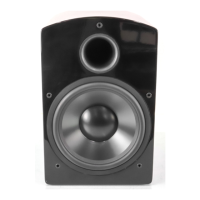
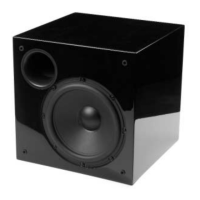
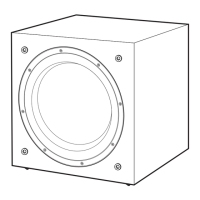
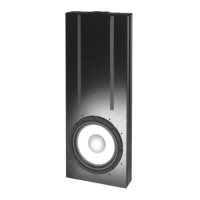
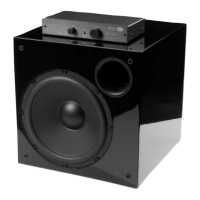
Subwoofer: A driver designed to operate over the low bass portion of the audio range. Also refers to a system consisting of a woofer
and its enclosure which are physically separate from the upper range loudspeakers.
Surround Speakers: Speakers located in the side or rear for surround channel effects.
Treble: The upper part of the frequency spectrum, consisting of frequencies above about 1300Hz.
Tweeter: A small driver designed to reproduce high frequencies.
Watt: A measure of electrical power, combining the voltage with the electrical current required to drive the loudspeaker.
Weight: Low frequencies below 50Hz.
Woofer: A driver designed to operate over the bass portion of the audio range.
14
14


 To Next Page