Need help?
Do you have a question about the Nibe AMS 10-8 and is the answer not in the manual?
Recording essential installation details like serial number and date.
Guidelines for safe operation, handling, and supervision of the appliance.
Explanation of symbols and product markings for user comprehension.
Location and importance of product identification numbers for support.
Highlights key features and advantages of the AMS 10 heat pump.
Detailed explanation of how the air/water heat pump operates.
How to interact with and control the AMS 10 system.
Routine checks and maintenance procedures for the AMS 10.
Guidance on diagnosing and resolving common operational issues.
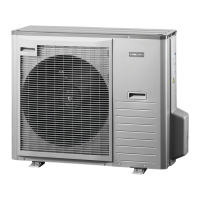
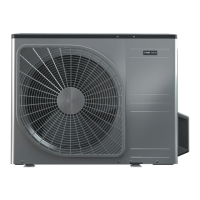
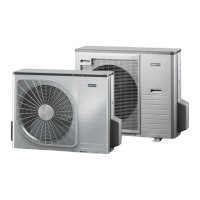
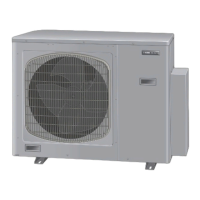
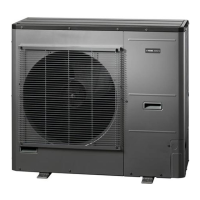
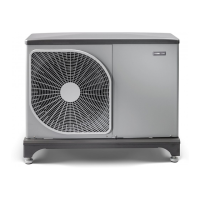
The NIBE AMS 10 is an air/water heat pump system designed for heating and hot water production, particularly suited for Nordic climates. It operates by utilizing outdoor air as its primary energy source. The AMS 10 is intended to be connected with a SPLIT box HBS 05 and an indoor module (VVM) or control module (SMO), forming a complete heating system for residential use.
The AMS 10 heat pump system works by converting the energy from outdoor air into heat for your home. This process involves three main circuits: the brine circuit, the refrigerant circuit, and the heating medium circuit.
Brine Circuit (Outdoor Air Intake): Outdoor air is drawn into the heat pump by a fan. This air then passes through an evaporator, where it releases its heat energy to a refrigerant. As the air transfers its heat, its temperature drops, and the cooled air is then expelled from the heat pump.
Refrigerant Circuit: A refrigerant, a gas with a very low boiling point, circulates in a closed system within the heat pump. In the evaporator, the refrigerant absorbs heat energy from the outdoor air and begins to boil, turning into a gas. This gas is then routed to an electrically powered compressor. The compressor increases the pressure of the gas, which significantly raises its temperature (e.g., from 5 °C to approximately 80 °C). From the compressor, the hot, high-pressure gas moves to a heat exchanger, known as the condenser. Here, it releases its heat energy to the house's heating system, cooling down and condensing back into a liquid. The refrigerant then passes through an expansion valve, where its pressure drops, returning it to its original temperature and completing the cycle. This process repeats continuously to extract heat from the outdoor air.
Heating Medium Circuit: The heat energy generated by the refrigerant in the condenser is transferred to the climate system's water, referred to as the heating medium. This water is heated to a specific supply temperature (e.g., 55 °C) and then circulates in a closed system throughout the house. The heating medium transports this heat to the house's water heater and radiators or heating coils, providing both domestic hot water and space heating.
The AMS 10 is designed to efficiently heat hot water even at high outdoor temperatures and deliver substantial heating capacity to the system when outdoor temperatures are low.
The AMS 10 heat pump offers several features designed for optimal performance and user comfort:
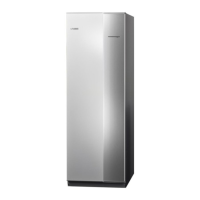
Intelligent Control: The system is controlled via the SPLIT box HBS 05, which connects to either a NIBE VVM indoor module with intelligent control or a NIBE SMO control module. These modules provide optimal control over the heat pump's operation, allowing for precise adjustments to maintain desired indoor temperatures and hot water availability. The installation engineer will configure the initial settings during installation to ensure the heat pump operates optimally within your specific system.
Efficient Twin Rotary Compressor: The AMS 10 is equipped with an efficient twin rotary compressor, capable of operating effectively at outdoor temperatures as low as -20 °C, making it suitable for cold climates.
Automatic Fan Capacity Regulation: The heat pump features automatic capacity regulation for its fan, optimizing airflow and energy transfer.
Silent Operation Function: For situations where noise levels are a concern, the AMS 10 includes a "silent mode" function. This feature allows you to schedule periods during which the heat pump operates at a quieter noise level. It's important to note that using silent mode for extended periods may reduce the heat pump's maximum output.
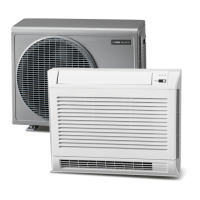
System Versatility: The AMS 10, in combination with the SPLIT box HBS 05, is designed to integrate with various NIBE indoor modules and control modules, offering a wide range of system solutions and accessories to meet diverse heating and hot water needs.
Energy Saving Tips: To optimize energy consumption, users are advised to fully open thermostat valves in most rooms (except those intentionally kept cooler, like bedrooms). Thermostats can restrict flow, causing the heat pump to work harder and consume more electricity. Additionally, adjusting or reducing heating settings in external control systems can contribute to energy savings. Monitoring the accommodation's energy meter regularly can help track and manage power consumption. For new builds, it's important to note that higher energy consumption may occur during the initial drying-out period (about a year), after which the heating curve and thermostat settings may need readjustment for lower temperature requirements.
Maintaining the AMS 10 involves a few regular checks to ensure its longevity and efficient operation:
Regular Checks of Condensation Hose and Pipe Connections: The SPLIT box requires minimal maintenance. However, it is crucial to regularly check the condensation hose to ensure that condensation can drain properly. Any suspicion of leakage in the pipe connections on the AMS 10 should also be investigated promptly. Insufficient oversight in these areas can lead to serious damage not covered by the guarantee.
Checking Grilles and Bottom Panel: Throughout the year, regularly inspect the inlet grille to ensure it is not obstructed by leaves, snow, or other debris. During windy conditions or snowfall, be particularly vigilant as grilles can become blocked. Additionally, verify that the three drain holes in the bottom panel are clear of dirt and leaves.
Condensation Drainage: Regularly confirm that condensation is correctly routed away through the condensation pipe. If assistance is needed with this, contact your installer.
Keeping Free of Snow and Ice: It is essential to prevent snow from accumulating and covering the grilles and drain holes on the AMS 10. Regularly clear snow and ice from around the unit to ensure proper airflow and drainage.
Cleaning the Outer Casing: The outer casing can be cleaned with a damp cloth if necessary. When cleaning, take care not to scratch the heat pump. Avoid spraying water directly into the grilles or sides of the unit to prevent water from penetrating the AMS 10. Also, ensure that the AMS 10 does not come into contact with alkaline cleaning agents.
Troubleshooting Basic Actions: In case of disturbances in comfort or system issues, basic actions include ensuring that the airflow to AMS 10 is not blocked by foreign objects and checking for any external damage to the unit. The AMS 10 communicates all alarms to the indoor module/control module (VVM / SMO).
Addressing Ice Build-up and Water Accumulation: If ice builds up in the fan, grille, or fan cone, or if a large amount of water is observed below the AMS 10, it is recommended to contact your installer for assistance. For water accumulation, specifically check that the water drainage via the condensation pipe (KVR 10) is functioning correctly.
Work behind covers secured by screws should only be performed by, or under the supervision of, a qualified installation engineer. If the supply cable is damaged, it must be replaced only by NIBE, its service representative, or a similar authorized person to prevent hazards and damage.


 To Next Page


 General