EasyManua.ls Logo

NIKKORMAT FT2 - Getting the Right Exposure

NIKKORMAT FT2
32 pages
Print Icon
To Next Page IconTo Next Page
To Previous Page IconTo Previous Page
Loading...
A
number
of
different
shutter
speed-aperture
combina-
tions
will
usually
result
in
the
same
exposure.
The
"best
"
one
depends
on
the
results
desired.
use
f
ast
shutter
speeds
to
"freeze" motion
or slow
ones
to
create
deliberate
blur.
Small
apertures
give
grearer
depth
of field,
large
ones
let
tlre
subjecl
sta;d
out
against
an
out-of-focus
background
(see,,Depth
of
Field,"
p.19.).
Centering
the Needle
:
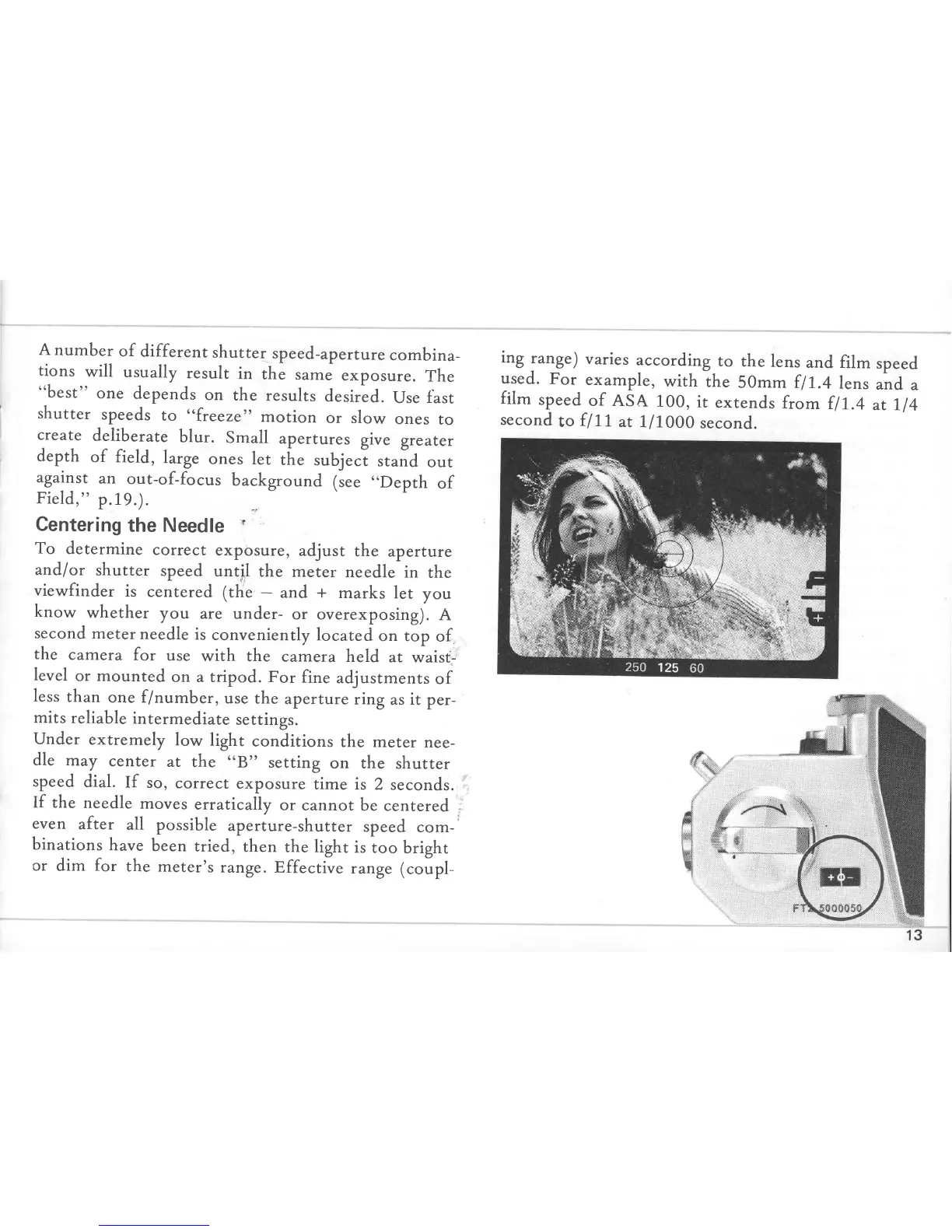
To
determine
correct
exposure,
adjust
the
aperture
and/or
shutter
speed
until
the meter
ne
edle in
the
viewfinder
is
centered
(the
-
and
+
marks
let
you
know
whether
you
are under-
or
overexposing).
A
second
meter
needle
is
conveniently
\ocated
on top
of
the
camera
for
use
with
the
camera
held
at waist-
level
or
mounted
on a tripod. For
fine
adjustments
of
less
than
one f/number,
use
the
aperture
ring
as
it
per-
mits
reliable
intermediate
settings.
under
extremely
low
light
conditions
the meter
nee-
dle
may
center
at
the
(68"
setting
on the
shutter
speed
dial.
If
so,
correct
exposure
time is
z
seconds.
If
the
needle
moves
erratic
ally
or
cannot
be
centered
j
even
after
all
possible
aperture-shutter
speed
com-
binations
have
been
tried,
then
the
light
is
too
bright
or
dim for
the meter's
range.
Effective
range
(coupl-
ing
range)
varies
according
to
the
lens
and film
speed
used.
For
example,
with
the
50mm flt.+
lens
""a
a
film
speed
of RsR
100,
it
extends
from
ilt.q
at Ll4
second
to
f
l11.
at
1/1000
second.