230
Technical Notes—Optional Accessories
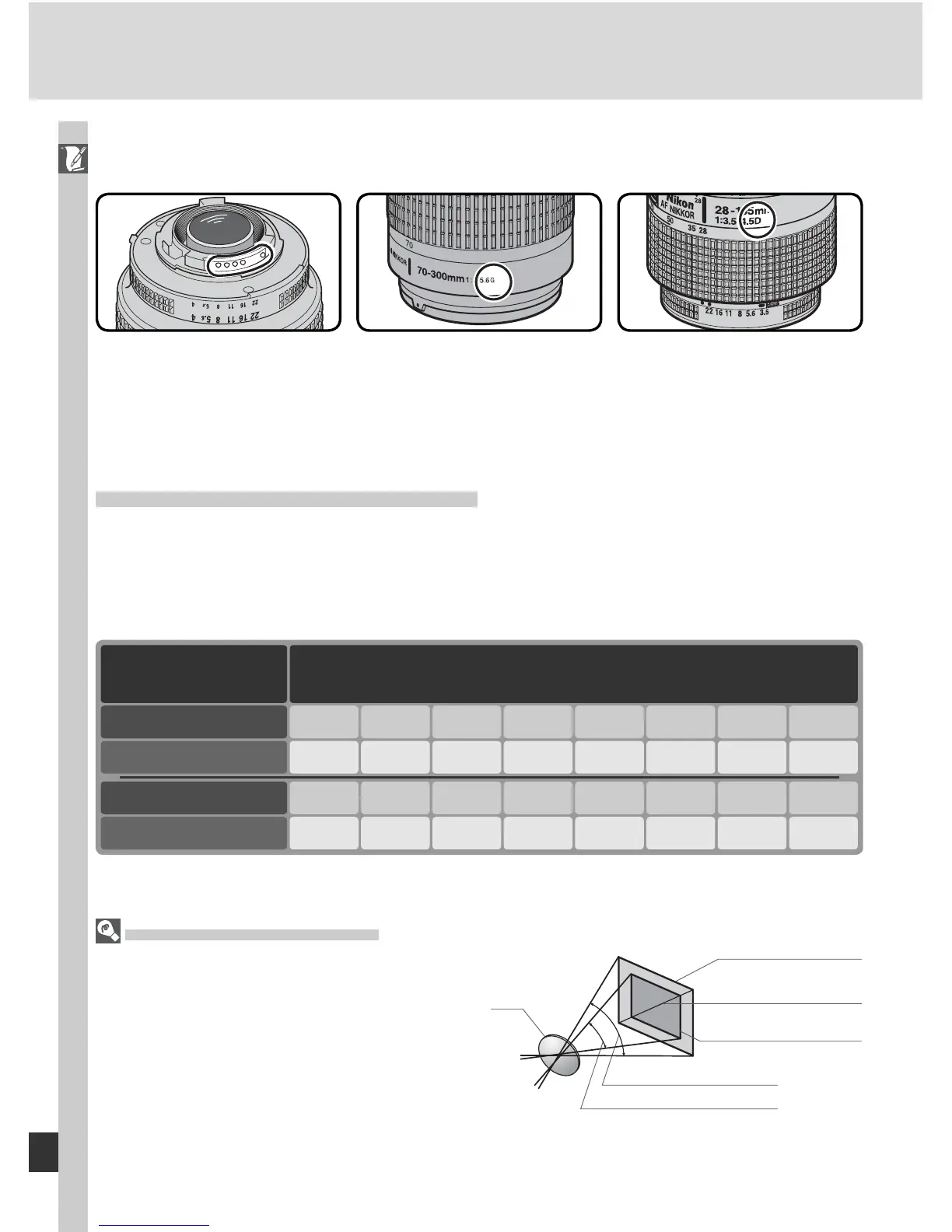
CPU lenses can be iden ti fi ed by the presence of CPU contacts. Type G lenses
are marked with a “G” on the lens barrel, type D lenses with a “D.”
Type G lenses are not equipped with a lens aperture ring. Unlike other CPU
lenses, there is no need to lock the aperture ring at the minimum aperture
setting (maximum f/-number) when using a type G lens.
Picture Angle and Focal Length
A 35-mm cam era has a di ag o nal pic ture angle ap prox i mate ly one-and-a-
half times that of the D2H. When cal cu lat ing the focal length of the lenses
for the D2H in 35-mm format, you will therefore need to mul ti ply the focal
length of the lens by 1.5, as shown in the following table:
CPU lens Type G lens Type D lens
Picture angle
Approximate focal length (mm) in 35-mm format
(modifi ed for picture angle)
35-mm fi lm camera 20 24 28 35 50 60 8517
D2H 30 36 42 52.5 75 90 127.525.5
35-mm fi lm camera 135 180 200 300 400 500 600105
D2H 202.5 270 300 450 600 750 900157.5
Cal cu lat ing Picture Angle
The size of the area exposed by a 35-mm
camera is 36 × 24 mm. The size of the
area exposed by the D2H, in contrast,
is 23.3 ×15.5 mm. As a result, the picture
angle of photographs taken with the D2H
differs from the picture angle for 35-mm
cameras, even when the focal length of
the lens and the distance to the subject
are the same.
Picture size (D2H)
Picture size (35-mm format)
Lens
Picture diagonal
Picture angle (35-mm format)
Picture angle (D2H)
(36 mm × 24 mm)
(23.3 mm × 15.5 mm)



 To Next Page