TECHNICAL INFORMATION
------
-
----
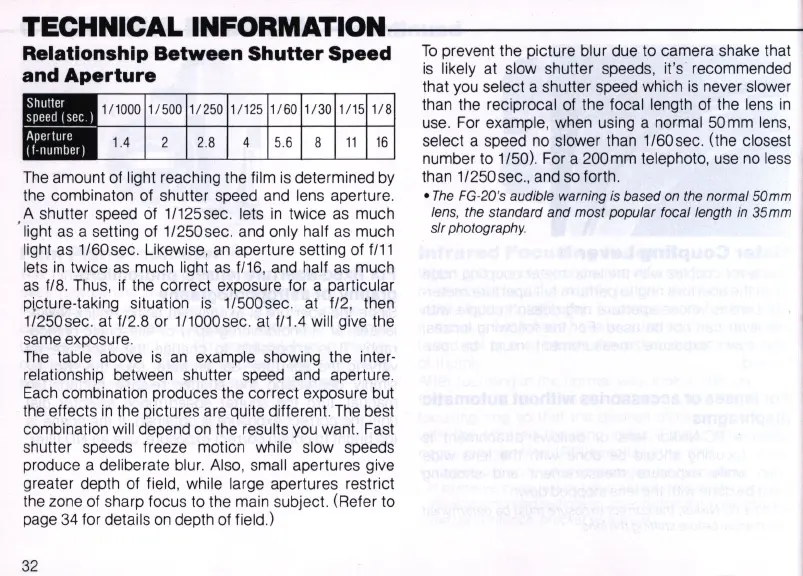
Relationship
Between
ShuHer
Speed
and
Aperture
/
250
1/
125
1/
60
1/
30
2.8 4 5.6 8
The
amount of light reaching the film
is
determined
by
the combinaton of shutter speed
and
lens aperture.
A shutter speed of 1/125sec. lets
in
twice
as
much
' light
as
a setting of 1I250sec. and only half
as
much
light
as
1/60sec. Likewise,
an
aperture setting of
f/11
lets
in
twice
as
much light
as
f/16 , and half
as
much
as
f/8. Thus, if the correct exposure for a particular
plcture-taking situation
is
1/500sec.
at
f/2, then
1/250sec. at fl2.8
or
1I1000sec.
at
f/1.4 will give the
same exposure.
The
table above
is
an
example showing the inter-
relationship between shutter speed
and
aperture.
Each
combination produces the correct exposure but
the effects
in
the pictures are quite different.
The
best
combination will depend
on
the results
you
want. Fast
shutter speeds freeze motion while slow speeds
produce a deliberate blur. Also, small apertures give
greater depth of field , while large apertures restrict
the zone of sharp focus to the main subject. (Refer to
page
34
for details
on
depth
of
field.)
32
To
prevent the picture blur due to camera shake that
is
likely
at
slow shutter speeds, it's' recommended
that you select a shutter speed which is never slower
than the reciprocal of the focal length of the lens
in
use.
For
example, when
us
i
ng
a normal 50mm
lens
,
select a speed no slower than
1/60sec. (the closest
number to
1/50). For a 200mm telephoto,
use
no
less
than 1I250sec.,
and
so
forth.
•
The
FG-20
's
audible warning is based
on
the
normal50mm
lens,
the standard and most popular toeallength
in
35mm
sir photography.


 To Next Page