EasyManua.ls Logo

Nikon Nikkormar FT3 - Infrared Photography; Silver-Oxide Battery

Nikon Nikkormar FT3
32 pages
Print Icon
To Next Page IconTo Next Page
To Previous Page IconTo Previous Page
Loading...
INFRARED PHOTOGRAPHY
----
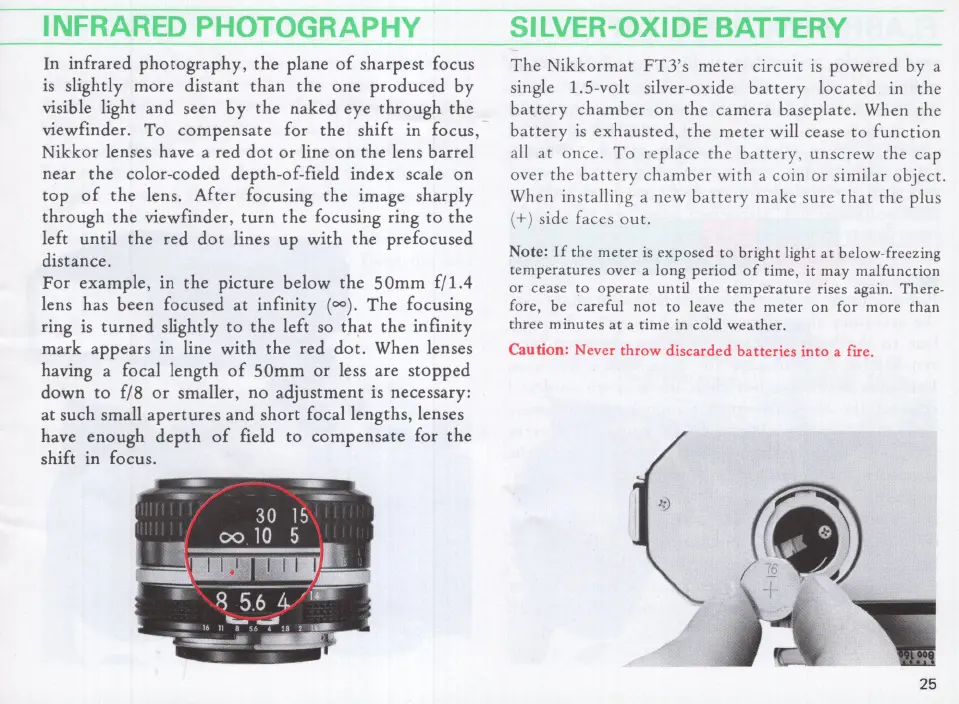
In
infrared
photography,
the
plane
of
sharpest
focus
is
slightly
more
distant
than
the
one
produced
by
visible light
and
seen
by
the
naked
eye
through
the
viewfinder.
To
compensate
for
the
shift
in focus,
Nikkor
lenses have a red
dot
or
line
on
the
lens
barrel
near
the
color-coded
depth-of-field
index
scale
on
top
of
the
lens.
After
focusing
the
image
sharply
through
the
viewfinder,
turn
the
focusing ring
to
the
left
until
the
red
dot
lines
up
with
the
prefocused
distance.
For
example,
in
the
picture
below
the
SOmm
f/1.4
lens has
been
focused
at
infinity
(00).
The
focusing
ring
is
turned
slightly
to
the
left
so
that
the
infinity
mark
appears
in line
with
the
red
dot.
When lenses
having a focal length
of
SOmm
or
less are
stopped
down
to
f/8
or
smaller,
no
adjustment
is necessary:
at
such small
apertures
and
short
focal lengths, lenses
have
enough
depth
of
field
to
compensate
for
the
shift
in
focus.
SilVER-OXIDE BATTERY
The
Nikkormat
FT3's
meter
circuit
is
powered
by a
single 1.S-volt silver-oxide
battery
located
in
the
battery
chamber
on
the camera baseplate. When
the
battery
is
exhausted,
the
meter
will cease
to
function
all
at
once.
To
replace the
battery,
unscrew
the cap
over the
battery
chamber
with a coin
or
similar object.
When installing a new
battery
make sure
that
the plus
(+) side faces
out.
Note:
If
the
meter
is
exposed
to
bright
light
at
below·freezing
temperatures
over a
long
period
of
time, it may
malfunction
or
cease
to
operate
until
the
tempe
:
rature
rises again.
There·
fore, be
careful
not
to
leave
the
meter
on
for
more
than
three
minutes
at
a
time
in
cold
weather.
Caution:
Never
throw
discarded
batteries
into
a fire.
25

Related product manuals