26
Shifting the Front Derailleur below). For example, you can select a gear which
will make pedaling easier on a hill (make a downshift) in one of two ways: shift
the chain down the gear “steps” to a smaller gear at the front, or up the gear
“steps” to a larger gear at the rear. So, at the rear gear cluster, what is called a
downshift looks like an upshift. The way to keep things straight is to remember
that shifting the chain in towards the centerline of the bike is for accelerating
and climbing and is called a downshift. Moving the chain out or away from the
centerline of the bike is for speed and is called an upshift.
Whether upshifting or downshifting, the bicycle derailleur system design
requires that the drive chain be moving forward and be under at least some
tension. A derailleur will shift only if you are pedaling forward.
CAUTION: Never move the shifter while pedaling backward, nor
pedal backwards immediately after having moved the shifter. This
could jam the chain and cause serious damage to the bicycle.
b. Shifting the Rear Derailleur
The rear derailleur is controlled by the right shifter.
The function of the rear derailleur is to move the drive chain from one gear
sprocket to another. The smaller sprockets on the gear cluster produce higher
gear ratios. Pedaling in the higher gears requires greater pedaling effort, but
takes you a greater distance with each revolution of the pedal cranks. The larger
sprockets produce lower gear ratios. Using them requires less pedaling effort,
but takes you a shorter distance with each pedal crank revolution. Moving the
chain from a smaller sprocket of the gear cluster to a larger sprocket results in a
downshift. Moving the chain from a larger sprocket to a smaller sprocket results
in an upshift. In order for the derailleur to move the chain from one sprocket to
another, the rider must be pedaling forward.
c. Shifting the Front Derailleur:
The front derailleur, which is controlled by the left shifter, shifts the chain
between the larger and smaller chainrings. Shifting the chain onto a smaller
chainring makes pedaling easier (a downshift). Shifting to a larger chainring
makes pedaling harder (an upshift).
d. Which gear should I be in?
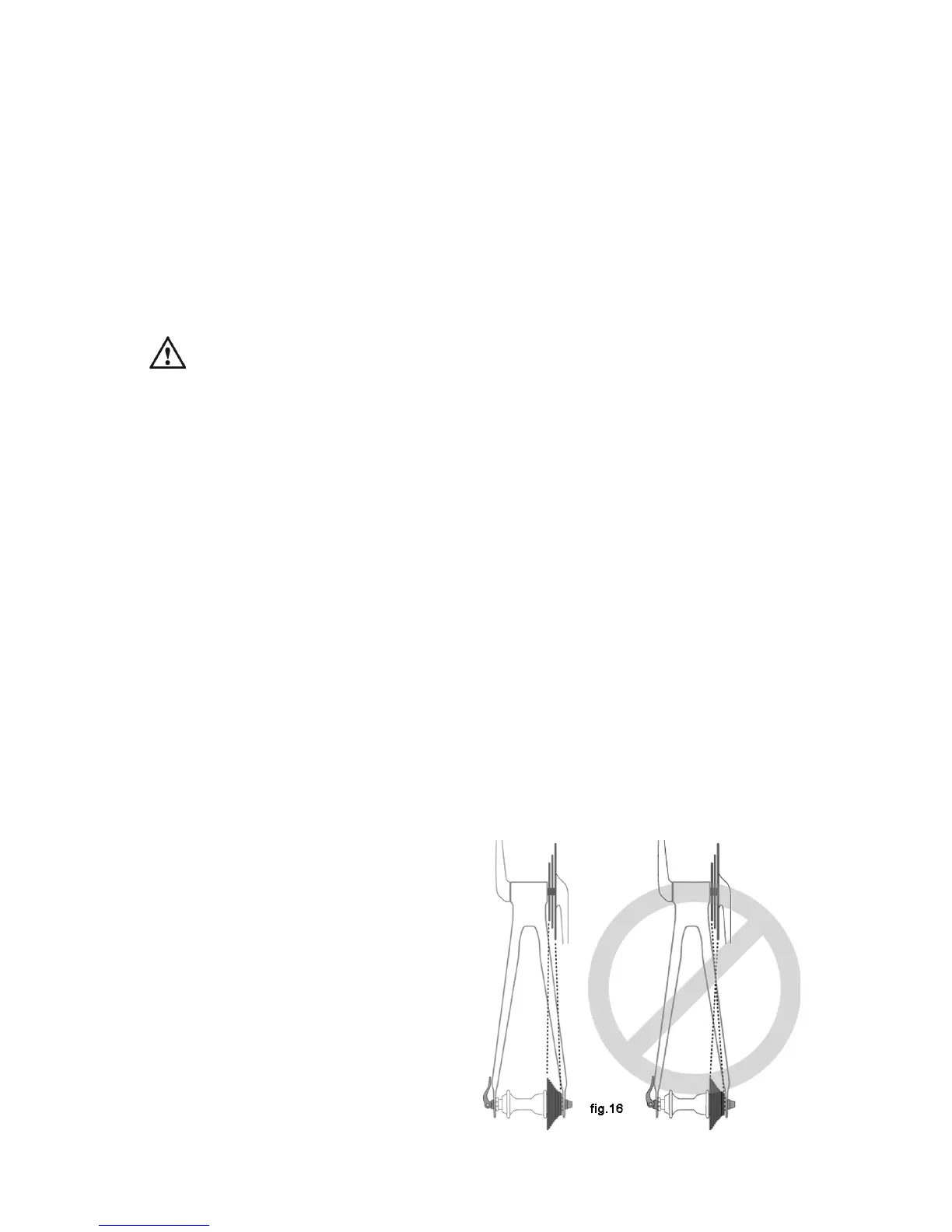
The combination of largest rear
and smallest front gears (g. 16) is
for the steepest hills. The smallest
rear and largest front combination
is for the greatest speed. It is not
necessary to shift gears in sequence.
Instead, nd the “starting gear” which
is right for your level of ability — a
gear which is hard enough for quick
acceleration but easy enough to let
you start from a stop without wobbling
— and experiment with upshifting
and downshifting to get a feel for the
different gear combinations. At rst,



 To Next Page