108
- Explosive gases may collect near the ground. Locate the
battery charger as high as possible above ground level.
- Do not proceed to any maintenance operation by
yourself. Any check, disassembling or fixing has to be
performed exclusively by a qualified person.
- Do not open body casing. There are no user-serviceable
parts inside.
- Do not place the battery charger above or stand the
battery charger on top of the battery.
- The battery terminal not connected to the chassis has
to be connected first. The other connection is to be
made to the chassis, remote from the battery and fuel
line. The battery charger is then to be connected to the
supply mains. After charging, disconnect the battery
charger from the supply mains. Then remove the
chassis connection and then the battery connection.
SAFETY INSTRUCTIONS REGARDING BATTERIES
- WARNING: Risk of explosive gas mixtures. Working
in the vicinity of a lead-acid battery is dangerous.
Batteries generate explosive gases during normal
battery operation. For this reason, it is of utmost
importance that each time, before using your
battery charger, you read this manual and follow the
instructions exactly.
- Thanks to check that your batteries can be
recharged with this charger. To know this, refer to the
manufacturer's instruction manual of the battery.
- Make sure that the initial charging rate does not
exceed the battery manufacturer's requirement.
13
COMMENT EFFECTUER LE DÉMARRAGE DE SECOURS DE VOTRE
VÉHICULE
NOUS VOUS RECOMMANDONS FORTEMENT DE VÉRIFIER QUE LA
TENSION DE LA BATTERIE DE VOTRE VÉHICULE EST DE 12 V AVANT
DE DÉMARRER. SI ELLE EST INFÉRIEURE À 2 V OU SUPÉRIEURE À
12,6 V, LE VÉHICULE NE PEUT ÊTRE DÉMARRÉ À L’AIDE DE L’APPAREIL.
MISE EN GARDE : Lorsque vous utilisez cet appareil pour démarrer, assurez-vous que
les connexions positives et négatives sont correctes, sinon la batterie peut exploser.
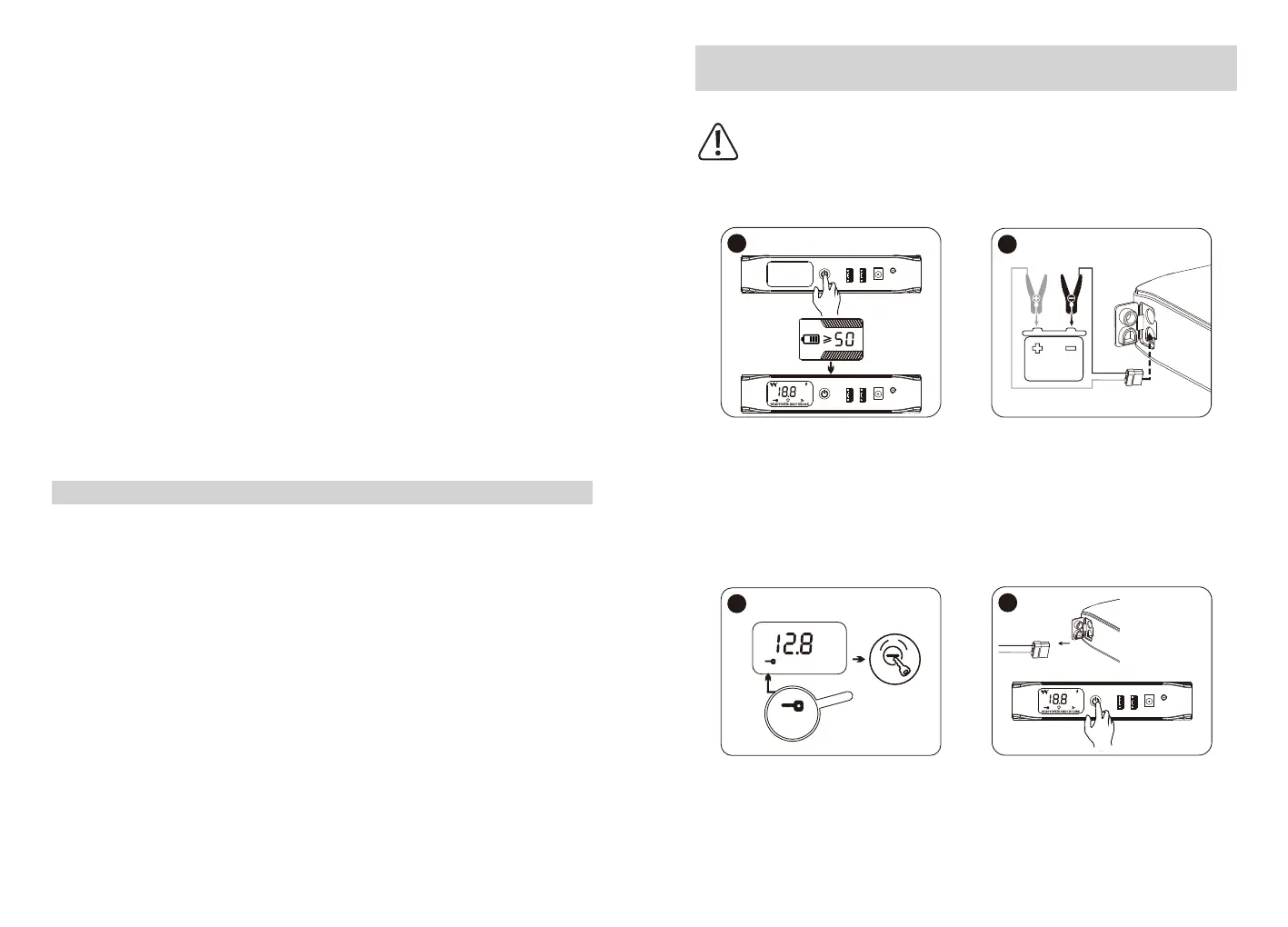
1
V
%
%
3 secondes
2
Appuyez pendant 3 secondes sur le
commutateur d’alimentation (
4
) pour allumer
l’appareil. Assurez-vous que le niveau de la
batterie est supérieur à 50 %.
Suivez les étapes ci-dessous avant de
procéder au démarrage de secours, sinon
vous pouvez causer un danger :
1. Branchez le câble de démarrage (
8
) sur le
port de démarrage de secours (
1
) de l’appareil.
2. Branchez la pince rouge (+) sur la borne
positive (+) de la batterie.
3. Branchez la pince noire (-) sur la partie
métallique du moteur (masse négative) ou
sur la borne négative de la batterie.
3
READY
V
READY
LCD
OFF START
ON
4
V
%
3 secondes
DÉSACTIVÉ
Une fois le branchement terminé, « READY »
s’affiche sur l’écran LCD pour indiquer que
le système est prêt pour le démarrage de
secours. Démarrez le véhicule, pendant
5 secondes au plus.
Lorsque vous avez démarré le véhicule,
retirez d’abord le câble de démarrage de
secours (
8
) sur la batterie automobile, puis
appuyez longuement sur le commutateur
d’alimentation (
4
) pour arrêter l’appareil.



 To Next Page