
 Need help?
Do you have a question about the Nordyne FG7SA-045C-23A and is the answer not in the manual?
Crucial warnings regarding fire and explosion risks, emphasizing safe installation and storage practices.
Instructions on immediate actions to take upon smelling gas to prevent severe consequences.
Key safety information for furnace installation, service, and operation to prevent injury or death.
Importance of unobstructed airflow for combustion and maintaining safe clearances from combustibles.
Warnings related to Proposition 65, mobile home installation, flood damage, and air filter usage.
Guidelines for safe gas supply and piping installation, emphasizing professional compliance and avoiding DIY modifications.
Crucial warning about needing a licensed technician for LP gas conversion to prevent hazards.
Requirements for annual inspection of the furnace and its venting system for safe operation.
Step-by-step procedure for safely shutting down the furnace for maintenance or service.
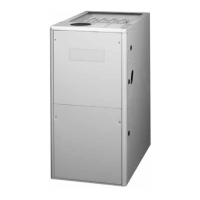
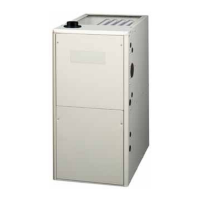
Overview of furnace components, highlighting the gas valve as the primary user interface.
Explanation of Category I and Category IV furnace venting systems based on AFUE rating and condensate.
Guidance on selecting the correct thermostat for single-stage, two-stage, and modulating furnaces.
Critical importance of adequate and clean combustion air to prevent dangerous carbon monoxide.
Detailed instructions for safely starting the furnace, including filter, vent, and gas valve checks.
Procedure for safely shutting down the furnace for service or maintenance by turning off gas and electric.
Recommendations for annual HVAC technician inspections and monthly filter checks for furnace maintenance.
Table outlining recommended inspection and maintenance tasks for the furnace throughout the year.
Guidance on observing burner operation and flame characteristics for proper furnace function.
Safety inspections and checks required for furnaces installed in new construction environments.
Homeowner checks for furnace deterioration, ductwork security, and connections.
Steps to check for common furnace operational problems before contacting a technician.
Diagram and component list for the SA/SK 80+ Upflow/Horizontal Gas Furnace.
Diagram and component list for the SK 80+ Downflow Gas Furnace.
Diagram and component list for the SC 92.1% Upflow/Horizontal Gas Furnace.
Diagram and component list for the SL 92.1% Downflow Gas Furnace.
Diagram and component list for the TA 80+ Upflow/Horizontal Gas Furnace.
Diagram and component list for the TK 80+ Downflow Gas Furnace.
Diagram and component list for the TC 95.1% Upflow/Horizontal Gas Furnace.
Diagram and component list for the TL 95.1% Downflow Gas Furnace.
Diagram and component list for the MQ 97%+ Upflow/Horizontal Gas Furnace.
This document serves as a comprehensive user manual for a range of gas furnaces, encompassing single-stage, two-stage, and modulating models, with varying Annual Fuel Utilization Efficiency (AFUE) ratings. The primary function of these devices is to provide safe and dependable home comfort through heating. The manual emphasizes the importance of proper installation, regular maintenance, and adherence to safety procedures to ensure the longevity and safe operation of the furnace.
The gas furnaces described in this manual are designed to convert fuel gas into usable heating energy for residential spaces. They operate without a pilot light, utilizing an automatic ignition device to light the burner. The range includes 80+ AFUE high-efficiency furnaces (models *SA/*TA Upflow/Horizontal and *SK/*TK Downflow), 92.1% AFUE condensing furnaces (models *SC Upflow/Horizontal and *SL Downflow), 95.1% AFUE condensing furnaces (models *TC Upflow/Horizontal and *TL Downflow), and 97%+ AFUE modulating furnaces (model *MQ Upflow/Horizontal).
The core components of these furnaces include a blower assembly, burner assembly, gas valve, igniter, and a furnace control board, among others. The venting system is crucial for expelling combustion products safely. Category I furnaces, typically with an AFUE rating of about 80%, are vented through a metal vent or masonry chimney, relying on a natural upward draft. Category IV furnaces, with AFUE ratings over 90%, are vented through plastic PVC pipe and produce liquid condensate that must be properly drained.
The control of these furnaces varies by model. Single-stage furnaces (SA, SK, SC & SL models) are designed to be controlled by a conventional single-stage thermostat. Two-stage furnaces (TA, TK, TC & TL models) perform best with a conventional two-stage thermostat, though they can also be controlled by a single-stage thermostat. Modulating furnaces (MQ models) require an iQ thermostat for proper operation and are not compatible with conventional thermostats.
The manual provides clear instructions for both starting up and shutting down the furnace. To start the furnace, users are guided through a sequence that includes ensuring the filter is clean, verifying the vent system, setting the thermostat to the lowest setting, closing the manual gas valve, turning off electrical power, setting the gas valve switch to OFF, waiting 5 minutes, setting the gas valve switch to ON, turning on electrical power, opening the manual gas valve, and finally, raising the thermostat to initiate ignition. If burners fail to ignite, a licensed HVAC technician should be contacted.
For shutting down the furnace, the process involves setting the thermostat to the lowest setting, closing the manual gas valve, turning off electrical power, opening the burner compartment door, and setting the gas valve switch to OFF. The manual illustrates three types of gas valves (single-stage, two-stage, and modulating) to help users identify their specific valve type and operate it correctly.
A critical safety feature highlighted is the "WHAT TO DO IF YOU SMELL GAS" protocol, which instructs users not to light any appliance, touch electrical switches, use phones in the building, and to immediately evacuate and contact the gas supplier or fire department from a neighbor's phone.
Regular maintenance is emphasized as essential for safe and dependable operation. The manual recommends an annual inspection of the furnace and its venting system by a licensed HVAC technician. A detailed maintenance table outlines suggested inspections and their frequency, including monthly, beginning of heating season, and end of heating season checks.
Key maintenance items include:
The manual also addresses specific considerations for new construction, recommending that the filter be replaced or cleaned, and the furnace inspected and cleaned by a licensed HVAC technician before occupancy. Ductwork should also be inspected and cleaned if it contains construction debris.
Crucially, the manual warns against reducing the supply of fresh air to the furnace, as this can lead to the production of dangerous levels of carbon monoxide. It also advises against storing certain common household chemicals (e.g., permanent wave solutions, chlorinated cleaners, pool chemicals, refrigerants, cleaning solvents, paints, glues) near the furnace, as their vapors can cause heat exchanger corrosion. For furnaces installed in small rooms or closets, it is vital that wall or door openings for combustion air remain unobstructed.
The troubleshooting section provides a checklist for users if the furnace fails to operate, including checking thermostat settings, blower compartment doors, circuit breakers/fuses, manual gas shutoff, and filter cleanliness. If these steps do not resolve the issue, contacting a licensed HVAC technician is recommended.
 General
| Brand | Nordyne |
|---|---|
| Model Number | FG7SA-045C-23A |
| Category | Furnace |
| Fuel Type | Natural Gas |
| Input BTU/h | 45000 |
| Output BTU/h | 36000 |
| Efficiency | 80% |
| Blower Type | Multi-Speed |
| Voltage | 115V |
| Maximum External Static Pressure | 0.5 in. W.C. |
| Gas Connection Size | 1/2 inch |


 To Next Page