9
D
D
A
A
C
C
a
a
n
n
d
d
H
H
e
e
a
a
d
d
p
p
h
h
o
o
n
n
e
e
A
A
m
m
p
p
U
U
s
s
e
e
r
r
G
G
u
u
i
i
d
d
e
e
Introduction
Modern CD-ripping software is capable of recording bit-perfect digital music data (16 bit/44.1kHz) from audio CDs and
storing it as files on the computer’s hard drive. In addition to CD-quality music, some online sites now offer 24 bit/96kHz
music files. Thanks to larger and increasingly economical hard-disk capacity, consumers can store the highest quality
music files on their computers or iPod. However, extracting truly superior sound from an iPod poses problems, as we shall
see below.
Analog versus Digital Output
Most modern external soundcards intended for use with computers, classified as Client Mode devices, are relatively
simple. Examples of these are the NuForce uDAC-2, Icon-2, Icon HDP, etc. Such devices are under the control of the host
computer in that, by command, they process/convert the digital data to an analog signal as it is being sent by the
computer.
Inasmuch as the iPod operates in client mode as well, some type of host device must request that the digital audio data
be sent to it for conversion back to an analog signal. In other words, the iPod must be told to send the digital data to the
receiving device. It will not do so on its own. Such a host device must have an operating system not unlike that of a
computer. Generally speaking, it need not be as complex. This is how the Icon iDo extracts digital audio data from an iPod.
Once the digital audio data is sent to the iDo, it converts that data back to into an analog signal. Note that this same
process takes place within the iPod itself when it is operated as a stand-alone audio playback device. The iDo is able to go
to greater lengths because it has a larger chassis for additional circuitry, and is therefore able to perform the DAC process
in a more precise way. At present, the only way to achieve high performance D-to-A conversion is through some larger,
external device, e.g., iDo.
In order to realize even better performance parameters than those the iDo provides, larger DAC devices must be
employed. For these applications, the user can take advantage of the iDo's coaxial-S/PDIF digital output. Bypassing the
iDo’s DAC stage, the signal can be sent to an external high-end DAC of the user's choice, e.g., as a sub-section within an
A/V receiver or preamp/processor. In more advanced two-channel audio systems, that device may be a stand-alone
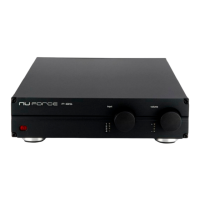
outboard DAC component, e.g., the NuForce DAC-9, which offers very high-precision playback for the most refined audio
systems.
Finally, the iDo offers a high-performance, audiophile-quality headphone amplifier stage. While many devices are able to
drive headphones or earphones somewhat adequately, true high performance requires special attention to the amplifier
circuitry. The iDo's headphone output extracts musical details and bass performance from recordings that may have
previously sounded thin, muffled or distorted. When offered by other manufacturers, this feature alone can cost as much
as the complete iDo.
We thank you for your investment in the NuForce Icon iDo. We’ve every confidence that you will find it to be an
exceptional product.


 To Next Page
 Loading...