2
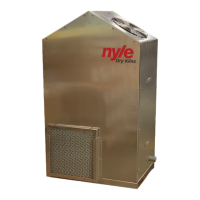
Thank you for purchasing a Nyle Dehumidication
Kiln and taking the rst step towards making the
lumber industry cleaner and more ecient! Years of
development, innovation and the highest quality
materials have gone into building your kiln, but it’s
our dedication to eciency that sets Nyle System’s
kilns apart from the rest and makes your system the
best on the market.
During kiln drying moisture in green lumber is
evaporated into the air increasing the humidity
inside the chamber. If the air becomes oversaturated
the lumber can’t continue to dry so moisture must
be periodically removed from the chamber. In
a conventional kiln moisture would be expelled
through venting. Venting causes a signicant loss of
heat requiring more energy to bring the kiln back up
to temperature.
Your Nyle Dehumidication Kilns doesn’t waste
energy through venting. Instead a refrigeration
system condenses the excess moisture which is
drained o and the existing heat energy is recovered
to be reused. After the moisture is removed and heat
is reintroduced to the dry air it is pumped back into
the kiln chamber to start the process over. Unlike
conventional kilns the heater in your Nyle Kiln is only
used during the initial warm up and, sometimes,
when temperature increases are desired during the
cycle, saving you time and money. But that’s not all
your new kiln has to oer!
Though Nyle kilns don’t rely on venting to get rid
of moisture, a Vent System is supplied to add extra
control of your kiln temperature. If the internal kiln
temperature exceeds what’s required, these vents
can be opened to remove excess heat and bring the
temperature back to where it needs to be.
And nally Nyle Systems oers a wide variety of
upgrades and accessories to enhance your kiln drying
experience. See the upgrades and accessories section
on page 34 for more information.
Concrete oors with insulation installed underneath
is recommended for best results. However if the
kiln is going to be on an existing concrete oor, the
insulation may be omitted. Concrete must not extend
beyond the kiln walls.
Wood oors may be used but must be built to
construction guidelines (see Pg 3)
If the kiln chamber is a freestanding outside building,
the attic space must be well ventilated through the
eaves. This is done to avoid any moisture buildup
in this space, which will condense on the cold roof,
dripping onto the insulation.
An interior kiln can have the ceiling insulation open
to the atmosphere.
Build ceilings to construction guidelines. (Pg 3)
At the front of the kiln chamber install bay/loading
doors with at least two sides hinges, and a center
door latch to close (recommended). Top hinged or a
lift o doors are also acceptable.
At least one access door should be installed in
the back of the chamber to allow for service of the
dehumidier and/or lumber monitoring.
All installed doors must:
•
Be built to construction guidelines. However they
may be lightened by increasing the stud spacing and
using 3/8” plywood. The lighter weight will reduce
the load on the hinges
Please read through carefully as some options
may not apply.
By purchasing a Nyle Kiln you have the support of
Nyle’s service team, the very same professionals that
built and tested your unit. Enjoy your new system!
Your Kiln
Getting Started
How your Dehumidication Kiln Works
Floors
Ceilings
Doors


 To Next Page