EasyManua.ls Logo

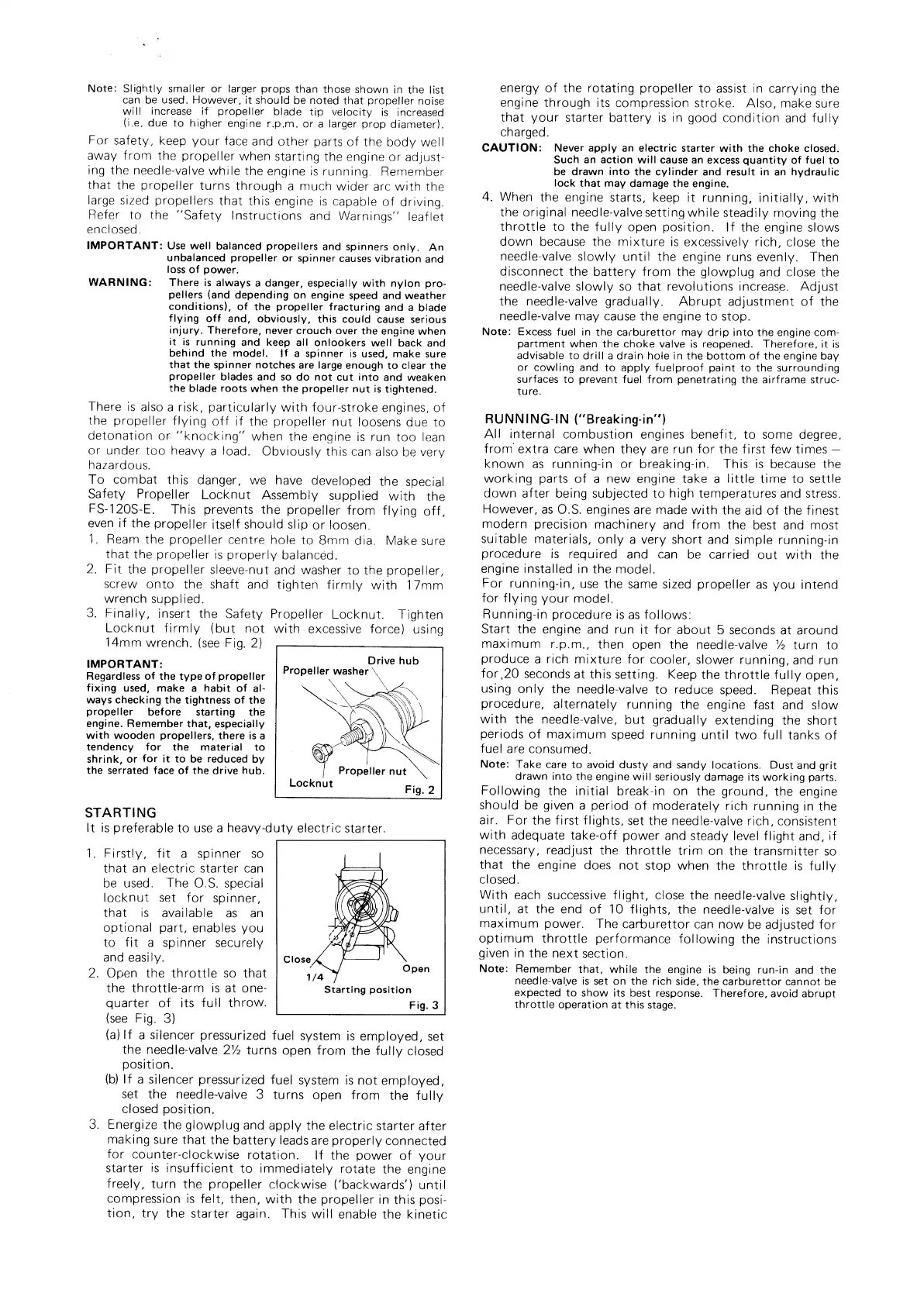
O.S. engine FS-120S-E - Page 3

O.S. engine FS-120S-E
5 pages
Print Icon
To Next Page IconTo Next Page
To Previous Page IconTo Previous Page
Loading...
Note:
Slightly
smaller
or
larger
props
than
those
shown
in
the
list
can
be
used.
However,
it
should
be
noted
that
propeller
noise
will
increase
if
propeller
blade
tio
velocity
is
increased
(i.e.
due
to
higher
engine
r.p.m.
or
a
larger
prop
diameter).
For
safety,
keep
your
face
and
other
parts
of
the
body
well
away
from
the
propeller
when
starting
the
engine
or
adjust-
ing
the
needle-valve
while
the
engine
is
running.
Remember
that
the
propeller
turns
through
a
much
wider
arc
with
the
large
sized
propellers
that
this
engine
is
capable
of
driving.
Refer
to
the
“Safety
Instructions
and
Warnings”
leaflet
enclosed.
IMPORTANT:
Use
well
balanced
propellers
and
spinners
only.
An
unbalanced
propeller
or
spinner
causes
vibration
and
loss
of
power.
There
is
always
a
danger,
especially
with
nylon
pro-
pellers
(and
depending
on
engine
speed
and
weather
conditions),
of
the
propeller
fracturing
and
a
blade
flying
off
and,
obviously,
this
could
cause
serious
injury.
Therefore,
never
crouch
over
the
engine
when
it is
running
and
keep
all
onlookers
well
back
and
behind
the
model.
if
a
spinner
is
used,
make
sure
that
the
spinner
notches
are
large
enough
to
clear
the
propeller
blades
and
so
do
not
cut
into
and
weaken
the
blade
roots
when
the
propeller
nut
is
tightened.
WARNING:
There
is
also
a
risk,
particularly
with
four-stroke
engines,
of
the
propeller
flying
off
if
the
propeller
nut
loosens
due
to
detonation
or
“knocking”
when
the
engine
is
run
too
lean
or
under
too
heavy
a
load.
Obviously
this
can
also
be
very
hazardous.
To
combat
this
danger,
we
have
developed
the
special
Safety
Propeller
Locknut
Assembly
supplied
with
the
FS-120S-E.
This
prevents
the
propeller
from
flying
off,
even
if
the
propeller
itself
should
slip
or
loosen.
1.
Ream
the
propeller
centre
hole
to
8mm
dia.
Make
sure
that
the
propeller
is
properly
balanced.
2.
Fit
the
propeller
sleeve-nut
and
washer
to
the
propeller,
screw
onto
the
shaft
and
tighten
firmly
with
17mm
wrench
supplied.
3.
Finally,
insert
the
Safety
Propeller
Locknut.
Tighten
Locknut
firmly
(but
not
with
excessive
force)
using
14mm
wrench.
(see
Fig.
2)
IMPORTANT:
Regardless
of
the
type
of
propeller
fixing
used,
make
a
habit
of
al-
ways
checking
the
tightness
of
the
propeller
before
starting
the
engine.
Remember
that,
especially
with
wooden
propellers,
there
is
a
tendency
for
the
material
to
shrink,
or
for
it
to
be
reduced
by
the
serrated
face
of
the
drive
hub.
Drive
hub
Propeller
washer
\
STARTING
It
is
preferable
to
use
a
heavy-duty
electric
starter.
1.
Firstly,
fit
a
spinner
so
that
an
electric
starter
can
be
used.
The
O.S.
special
locknut
set
for
spinner,
that
is
available
as
an
optional
part,
enables
you
to
fit
a
spinner
securely
and
easily.
2.
Open
the
throttle
so
that
the
throttle-arm
is
at
one-
Starting
position
quarter
of
its
full
throw.
Fig.
3
(see
Fig.
3)
(a)
lf
a
silencer
pressurized
fuel
system
is
employed,
set
the
needle-valve
2⁄2
turns
open
from
the
fully
closed
position.
(b)
If
a
silencer
pressurized
fuel
system
is
not
employed,
set
the
needle-valve
3
turns
open
from
the
fully
closed
position.
3.
Energize
the
glowplug
and
apply
the
electric
starter
after
making
sure
that
the
battery
leads
are
properly
connected
for
counter-clockwise
rotation.
If
the
power
of
your
starter
is
insufficient
to
immediately
rotate
the
engine
freely,
turn
the
propeller
clockwise
(‘backwards’)
until
compression
is
felt,
then,
with
the
propeller
in
this
posi-
tion,
try
the
starter
again.
This
will
enable
the
kinetic
energy
of
the
rotating
propeller
to
assist
in
carrying
the
engine
through
its
compression
stroke.
Also,
make
sure
that
your
starter
battery
is
in
good
condition
and
fully
charged.
CAUTION:
Never
apply
an
electric
starter
with
the
choke
closed.
Such
an
action
will
cause
an
excess
quantity
of
fuel
to
be
drawn
into
the
cylinder
and
result
in
an
hydraulic
lock
that
may
damage
the
engine.
4.
When
the
engine
starts,
keep
it
running,
initially,
with
the
original
needle-valve
setting
while
steadily
moving
the
throttle
to
the
fully
open
position.
If
the
engine
slows
down
because
the
mixture
is
excessively
rich,
close
the
needle-valve
slowly
until
the
engine
runs
evenly.
Then
disconnect
the
battery
from
the
glowplug
and
close
the
needle-valve
slowly
so
that
revolutions
increase.
Adjust
the
needle-valve
gradually.
Abrupt
adjustment
of
the
needle-valve
may
cause
the
engine
to
stop.
Note:
Excess
fuel
in
the
carburettor
may
drip
into
the
engine
com-
partment
when
the
choke
valve
is
reopened.
Therefore,
it
is
advisable
to
drill
a
drain
hole
in
the
bottom
of
the
engine
bay
or
cowling
and
to
apply
fuelproof
paint
to
the
surrounding
surfaces
to
prevent
fuel
from
penetrating
the
airframe
struc-
ture.
RUNNING-IN
(‘‘Breaking-in’’)
All
internal
combustion
engines
benefit,
to
some
degree,
from
extra
care
when
they
are
run
for
the
first
few
times
known
as
running-in
or
breaking-in.
This
is
because
the
working
parts
of
a
new
engine
take
a
little
time
to
settle
down
after
being
subjected
to
high
temperatures
and
Stress.
However,
as
O.S.
engines
are
made
with
the
aid
of
the
finest
modern
precision
machinery
and
from
the
best
and
most
suitable
materials,
only
a
very
short
and
simple
running-in
procedure
is
required
and
can
be
carried
out
with
the
engine
installed
in
the
model.
For
running-in,
use
the
same
sized
propeller
as
you
intend
for
flying
your
model.
Running-in
procedure
is
as
follows:
Start
the
engine
and
run
it
for
about
5
seconds
at
around
maximum
r.p.m.,
then
open
the
needle-valve
%
turn
to
produce
a
rich
mixture
for
cooler,
slower
running,
and
run
for
,20
seconds
at
this
setting.
Keep
the
throttle
fully
open,
using
only
the
needle-valve
to
reduce
speed.
Repeat
this
procedure,
alternately
running
the
engine
fast
and
slow
with
the
needle-valve,
but
gradually
extending
the
short
periods
of
maximum
speed
running
until
two
full
tanks
of
fuel
are
consumed.
Note:
Take
care
to
avoid
dusty
and
sandy
locations.
Dust
and
grit
drawn
into
the
engine
will
seriously
damage
its
working
parts.
Following
the
initial
break-in
on
the
ground,
the
engine
should
be
given
a
period
of
moderately
rich
running
in
the
air.
For
the
first
flights,
set
the
needle-valve
rich,
consistent
with
adequate
take-off
power
and
steady
level
flight
and,
if
necessary,
readjust
the
throttle
trim
on
the
transmitter
so
that
the
engine
does
not
stop
when
the
throttle
is
fully
closed.
With
each
successive
flight,
close
the
needle-valve
slightly,
until,
at
the
end
of
10
flights,
the
needle-valve
is
set
for
maximum
power.
The
carburettor
can
now
be
adjusted
for
optimum
throttle
performance
following
the
instructions
given
in
the
next
section.
Note:
Remember
that,
while
the
engine
is
being
run-in
and
the
needle-valve
is
set
on
the
rich
side,
the
carburettor
cannot
be
expected
to
show
its
best
response.
Therefore,
avoid
abrupt
throttle
operation
at
this
stage.

Other manuals for O.S. engine FS-120S-E

Related product manuals