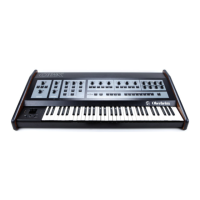
Need help?
Do you have a question about the Oberheim OB-1 and is the answer not in the manual?
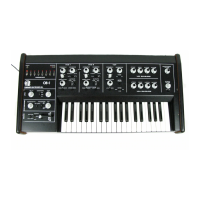
Adjusts initial pitch of VCO-1 up to five octaves in 1/2 step increments.
Selects VCO-1 waveform from square, pulse, to triangle or sawtooth.
Selects pulse-type or saw-type wave for the oscillator.
Passes the oscillator's output to the VCF section (ON, half power, OFF).
Passes the subharmonic of VCO-1 (one octave below) to the VCF.
Uses LFO as signal source to increase waveshape or frequency change.
Determines if frequency or waveshape is affected by modulation amount.
Allows VCO-2 frequency to modulate VCO-1 for pitch changes.
Non-programmable pitch adjustment for VCO-1.
Changes the initial pitch of VCO-2, similar to VCO-1.
Selects VCO-2 waveform from square, pulse, to triangle or sawtooth.
Selects pulse-type or saw-type wave for the oscillator.
Passes the oscillator's output to the VCF section (ON, half power, OFF).
Passes the subharmonic of VCO-2 (one octave below) to the VCF.
Modulates VCO-2 using LFO or VCF envelope signals.
Determines modulation effect on VCO-2, same as VCO-1.
Selects LFO or VCF envelope to modulate VCO-2.
Slaves VCO-2 to VCO-1, controlling its pitch.
Non-programmable pitch adjustment for VCO-2.
Changes the cutoff frequency of the filter, affecting harmonic content.
Boosts harmonics at the VCF cutoff point, can cause self-oscillation.
Two-position switch controlling the filter cutoff slope (four pole vs. two pole).
Allows keyboard pitch to control VCF cutoff frequency.
Controls LFO or envelope signal effect on filter frequency.
Selects LFO or VCF envelope to modulate filter frequency.
Non-programmable frequency adjustment for the VCF.
Generates aperiodic waveform with all frequencies for sound effects.
Controls the time or speed of the envelope rise.
Controls the time from the high point to the sustain level.
Controls the sustain level after the attack/decay cycle.
Controls time or speed of envelope fall after keyboard release.
Controls VCF and VCO-2 pitch or waveform modulation.
Controls the voltage controlled amplifier/volume.
Programmable volume control for patch uniformity.
Controls overall output of the OB-1; non-programmable.
Bypasses VCA envelope, opening VCA for continuous sound.
Explains how to store synthesizer settings into memory for recall.
Details the step-by-step procedure for saving a sound setup.
Adjusts programmed volume for consistent output between patches.
Varies the speed of the low frequency oscillator.
Alters the waveshape of the LFO signal (sine, square, S/H).
Adds a time delay to the LFO signal for gradual onset.
Slows down voltage changes on the keyboard for note sliding.
Cancels envelope release function and resets them to zero.
Transposes the keyboard up or down an octave.
Master filter control for performance expression.
Selects VCO-2 or both oscillators for pitch bend effect.
Selects pitch bend range (step, octave) or modulation source.
Spring loaded lever for vibrato technique using narrow pitch bend.
Connects to a 117 volt AC line for power.
Synthesizer ON-OFF switch.
Location for the voltage protection fuse.
Low output jack for connecting to an instrument amplifier.
High output jack for feeding mixers or studio consoles.
Input for external VCA control.
Input for an external audio source.
Input for external VCF frequency control pedal.
Input for external control voltage sources.
Control voltage output from the keyboard.
Input for external gate sources.
Gate voltage output from the keyboard.
Cassette interface for storing and loading patches.
Input for external program selection.
 General
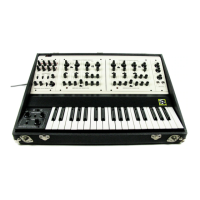
| Type | Analog |
|---|---|
| Oscillators | 2 |
| Waveforms | Sawtooth, Square, Pulse |
| LFO | 1 |
| Polyphony | Monophonic |
| Keyboard | 37 keys |
| Year released | 1978 |
| Filter | Low-pass |
| Envelope Generators | 1 ADSR |
| Outputs | Mono output |

 To Next Page