Need help?
Do you have a question about the Oberheim OB-X8 and is the answer not in the manual?
Details the connectors for power, USB, MIDI, audio, and pedals on the OB-X8's rear panel.
Provides step-by-step instructions to get the OB-X8 operational, including connections and initial settings.
Guides on running the built-in calibration procedure for optimal performance and tuning.
Instructions on how to select, recall, and edit existing sound programs on the OB-X8.
Instructions on how to save edited programs to memory and how to cancel the save process.
Details global parameters affecting all programs, including MIDI, curves, and calibration.
Detailed explanation of the OB-X8's two oscillators, including waveforms and modulation.
Description of filter frequency, resonance, modulation, and type selection.
Explanation of the 4-stage envelope generators for shaping sound over time.
Detailed parameters for the filter envelope: Attack, Decay, Sustain, and Release.
Detailed parameters for the volume envelope: Attack, Decay, Sustain, and Release.
Description of the LFO section, including waveforms and modulation destinations.
Controls for Master Volume, Vol/Balance, Tune, Hold, and Chord features.
Parameters affecting presets, including Vintage, Portamento, Velo, and Touch.
Details on the Lever Box, including Pitch and Mod levers, Arpeggiator, and LFO.
Explanation of Arp mode, Arpeggiator controls, and various arpeggiation modes.
Tutorial on creating a classic synth bass sound using oscillators, filter, and envelopes.
Guide to creating a synth brass sound with a pitch blip effect using filter modulation.
Tutorial for creating a hard-sync lead sound using oscillator synchronization and pitch modulation.
Solutions for common problems like no sound, sequencer issues, or erratic behavior.
 General
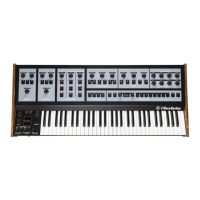
| Type | Analog Synthesizer |
|---|---|
| Polyphony | 8 voices |
| Oscillators per Voice | 2 |
| Arpeggiator | Yes |
| Display | OLED |
| Waveforms | Triangle |
| LFO | 1 LFO |
| Keyboard | 61 keys, velocity-sensitive |
| Effects | Chorus, Delay, Reverb |
| Connectivity | MIDI, USB, CV/Gate |
| Weight | 32 lbs |
| Filter | 2-pole/4-pole Low-Pass Filter |

 To Next Page