Suspension adjustment could affect vehicle
handling. Always take time to familiarize
yourself with the vehicle's behavior after
any suspension adjustment has been made.
Choice of suspension adjustments vary with
vehicle load, personal preference, driving
speed and terrain condition.
The best way to set up the suspension, is to
start from factory settings, then customize
each adjustment one at a time.
Front and rear adjustments are interrelated.
It may be necessary to readjust the rear
shock absorbers after adjusting front shock
absorbers for instance.
Test run the vehicle under the same
conditions; trail, speed, load, etc.
Change one adjustment and retest.
Proceed methodically until you are
satisfied.
Spring Preload Adjustment
The left and right shock adjustment on
front or rear suspension must always be set
to the same position. Never adjust one only.
never adjustment can cause poor handling
and loss of stability which could lead to an
accident
Shorten the springs for a firmer drive and
rough conditions.
Lengthen the springs for a softer drive and
smooth conditions.
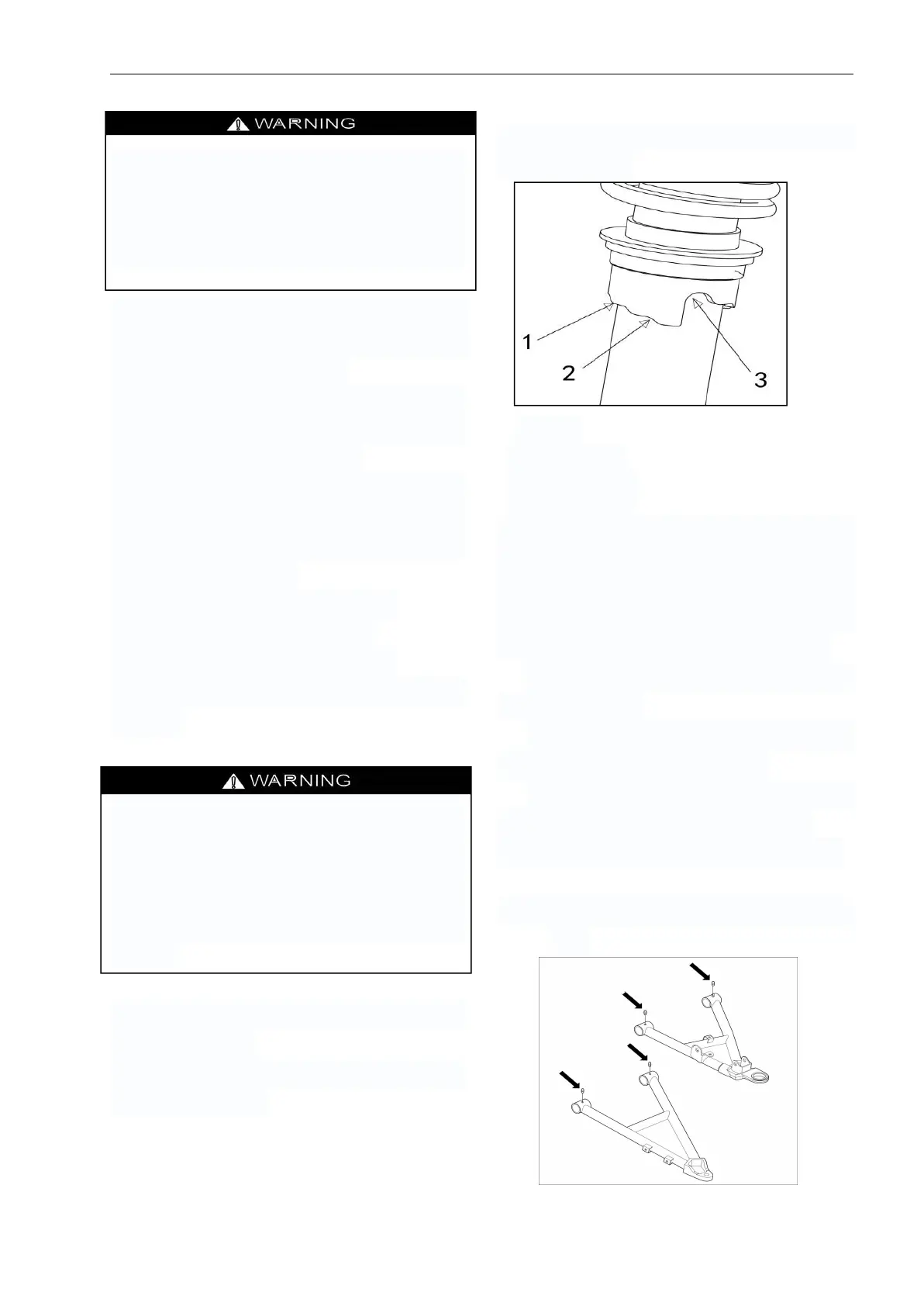
Ordinary shock absorption
Adjust spring preload by turning
adjustment cam.
TYPICAL
1.Adjustment cam
2.Firmer adjustment
3.Softer adjustment
Extend and compress the piston several
times over its entire stroke. Check that it
moves smoothly and with uniform
resistance with rod up. Any of the following
conditions will denote a defective shock:
A skip or hang up when reversing stroke
at mid-travel.
Seizing or binding conditions except at
extreme end of either stroke.
A gurgling noise after completing one
full compression and extension stroke.
If you find any of these, replace the shock.
Suspension Arm
Lubricate suspension arm at grease fittings.
front



 To Next Page