NOTE:
Z Make sure the battery voltage ≥ 12V.
The ignition coil wires are connected.
Z When using multimeter and the peak
voltage adapter, please refer to the user
manual.
Z Move the gear to the neutral position,
turn on the ignition device.
Z Press the start button and crank the
engine for a few seconds. Then measure
the primary peak voltage of the
ignition coil;
Z Repeat the steps above for several times.
Measure the maximal value of the
primary peak voltage.
Set the multimeter at the AC voltage
position.
Primary peak voltage of ignition coil: ≥150V
Note: Do not touch the test probes or spark
plug, in case of electric shock.
Z If the voltage is lower than the standard
value, check the ignition coil and
coupling coil.
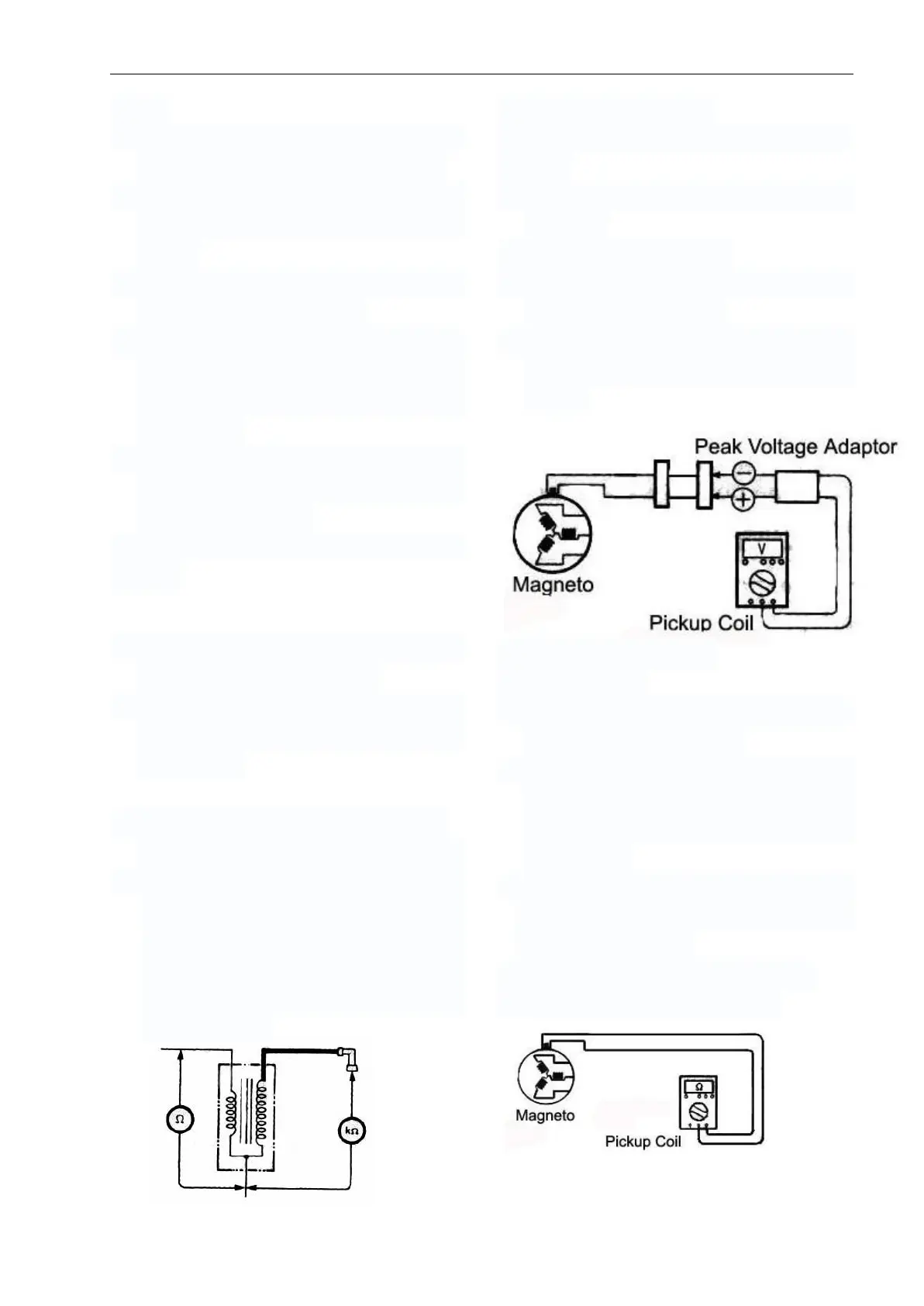
Resistance of ignition coil
Z Disconnect the ignition coil wires and
spark plug cap. Remove the ignition coil;
Z Measure the resistance of the primary
and secondary windings of the ignition
coil with the multimeter. If the
resistance of two coils is close to the
specified value, the ignition coil is in
good condition.
Resistance of ignition coil
Primary winding: 0.58±0.058 Ω (terminal –
ground)
Secondary coil: 7.1±0.71 (terminal - spark
plug cap)
Peak voltage of coupling coil
Z Check the peak voltage of the coupling
coil with following steps.
Z As shown in right figure, connect the
multimeter with the peak voltage
adapter.
+Probe: Green/white wire
-Probe: BL/Y wire
Z Move the gear to the neutral position,
turn on the ignition device.
Z Press the start button and crank the
engine for a few seconds, and then
measure the primary peak voltage of the
coupling coil;
Z Repeat the steps above for several times.
Measure the maximal value of the
primary peak voltage.
Put the multi meter at AC voltage step.
Peak voltage of coupling coil: ≥4V



 To Next Page