
 Need help?
Do you have a question about the OEM CYCLONE and is the answer not in the manual?
Essential safety checks before performing maintenance or repairs on the machine.
Pre-operation checks including hydraulic fluid level and fittings.
Procedure to start the motor and adjust speed settings using controls.
Instructions for replacing dull blades on the machine for optimal performance.
Details on the Summit II Series 1425W Switch Mode Industrial Battery Charger.
Steps for operating the on-board charger and understanding its status indicators.
Information on using the stand-alone charger and its associated safety aspects.
Critical safety precautions for handling lead-acid batteries, including explosion and burn risks.
Impact of temperature on battery performance, capacity, and potential freezing risks.
Guidance for periodic maintenance and record-keeping for battery systems.
Best practices for fully charging batteries to maintain optimal capacity and prevent sulfate.
Daily checks for hydraulic oil, bolts, nuts, and hydraulic components.
Maintenance tasks required every 100 operating hours, including greasing and tightening.
Scheduled maintenance for hydraulic oil and filter every 250 hours.
Awareness of environmental effects on equipment and tire recommendations.
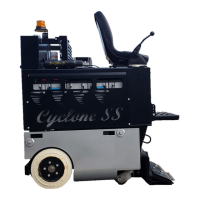
The O.E.M. Products Inc. Cyclone SS is an electric-powered, skid-steer, zero-turn radius machine designed for surface preparation, specifically for removing surface coverings and coatings. It operates by lowering a weighted, sharpened blade onto the surface and moving forward, utilizing a high-torque drive system. The machine's weight ensures the flexible blade conforms firmly to the floor, preventing it from lifting over well-adhered material and effectively removing floor coverings.
The Cyclone SS features a user-friendly control area with a steering joystick, a blade positioning joystick, an On/Off switch, a display monitor, and a throttle/RPM dial.
Before operation, it's crucial to check the hydraulic fluid level (should be about 2" from the top of the tank) and inspect for any major hydraulic oil leaks. Loose hydraulic fittings should be snugged with two wrenches, taking care not to overtighten. Lug bolts should be torqued between 85-100 ft. lbs., and the axle nut to at least 200 ft. lbs.
The operator must be seated for the electric motor to start. Pulling up the red knob located on the left side, behind the blade control joystick, will initiate the electric motor. The battery gauge, also behind the red knob, will first display recorded hours. The black throttle dial on the left side should be in the "OFF" position initially. Once the red knob is pulled up, turn the black dial clockwise to achieve the desired motor speed. Lower settings result in slower machine speed, which is desirable for loading/unloading or navigating tight spaces.
Familiarization with the equipment is recommended before use. The left-hand joystick controls blade positioning: pushing it forward lowers the blade bar assembly, and pulling it back raises it. Pushing the joystick left or right adjusts the blade pitch. The right-hand joystick controls movement. When scraping, the blade or Tile Tooth should be as parallel to the floor as possible while staying under the material. The blade pitch can then be increased for productivity. Front caster wheels should be retracted and kept off the floor during scraping to ensure maximum weight on the blade and extend caster wheel life.
When parking, ensure the machine is on a level surface and chock the wheels to prevent rolling. Operators should always lower the blade to the ground when leaving the machine to prevent injury. The machine should not be transported with the front off the floor by more than 1/2".
The voltage meter on the left side instrument panel displays battery percentage. When the readout reaches 20%, the machine enters "limp mode" (RPMs slow down) to indicate it needs charging or transport to a charging location. The machine must be charged to resume scraping.
The Cyclone is equipped with wheel scrapers to remove debris like VCT from the tires. If traction is lost or debris accumulates, loosen two bolts on the wheel scrapers, slide them against the tires, and retighten.
The charger features Bluetooth wireless communication via the ChargerConnect app (Apple® or Android™).
Battery temperature significantly impacts performance and life. Cold temperatures reduce capacity. A fully charged battery will not freeze in cold weather, but a discharged battery can freeze even in moderately cold conditions. Frozen batteries cannot charge or discharge effectively and can be permanently damaged.
Lifeline® AGM batteries do not require electrolyte additions. Periodic servicing, including good record keeping, is essential to maintain battery system integrity.
 General
| Brand | OEM |
|---|---|
| Model | CYCLONE |
| Category | Floor Machine |
| Language | English |

 To Next Page