11
English
Introduction
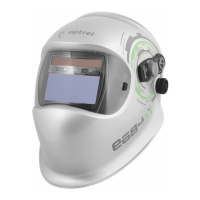
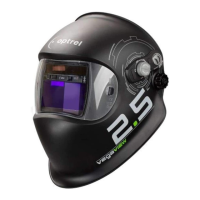
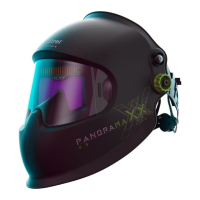
A welding helmet is a type of headgear used when performing certain types of welding to
protect the eyes, face and neck from flash burn, ultraviolet light, sparks, infrared light, and
heat. The helmet consists of several parts (see spare parts list). An automatic welding filter
combines a passive UV and a passive IR filter with an active filter, the luminous transmittance
of which varies in the visible region of the spectrum, depending on the irradiance from the
welding arc. The luminous transmittance of the automatic welding filter has an initial high value
(light state). After the welding arc strikes and within a defined switching time, the luminous
transmittance of the filter changes to a low value (dark state).
Safety instructions
Please read the operating instructions before using the helmet. Check that the front
cover lens is fitted correctly. If it is not possible to eliminate errors, you must stop
using the cartridge.
Precautions & protective restrictions / Risks
During the welding process, heat and radiation are released, which can cause damage to
the eyes and skin. This product offers protection for the eyes and face. When wearing the
helmet, your eyes are always protected against ultraviolet and infrared radiation, regardless
of the shade level. To protect the rest of your body, appropriate protective clothing must also
be worn. In some circumstances, particles and substances released by the welding process
can trigger allergic skin reactions in correspondingly predisposed persons. Materials that
come into contact with skin may cause allergic reactions to susceptible persons. The protective
welding helmet must only be used for welding and grinding and not for other applications.
Optrel assumes no liability when the welding helmet is used for purposes other than intended
or with disregard for the operating instructions. The helmet is suitable for all established welding
procedures, excluding gas and laser welding. Please note the recommended protection
level in accordance with EN169 on the cover.
The helmet does not replace a safety helmet. Depending on the model, the helmet can be
combined with a protective helmet. The helmet can affect the field of view due to constructive
specifications (no view on the side without turning the head) and may affect a color perception
due to the light transmission of the auto darkening filter. As a result, signal lights or warning
indicators may not be seen. Further there is an impact hazard due to a larger contour (head
with helmet on). The helmet also reduces the audio and heat perception.
Sleep mode
The cartridge has an automatic switch-off function, which increases the service
life. If no light falls on the solar cells for a period of approx. 10 minutes, the cartridge
automatically switches off. To reactivate the cartridge, the solar cells must be briefly
exposed to daylight. If the shade cartridge cannot be reactivated or does not darken
when the welding arc is ignited, the cartridge must be judged faulty.
Warranty & Liability
The warranty conditions can be found in the instructions from the national sales
organisation of Optrel. Please contact your dealer for further information concerning
this matter.
The warranty only applies to material and manufacturing defects. In the event of
damage caused by improper use, unauthorised intervention or use for a purpose
that is not intended by the manufacturer, the warranty and liability will be null and
void. Likewise, liability and the warranty are no longer valid if spare parts other than
those sold by Optrel are used.
Expected Lifetime
The welding helmet has no expiration date. The product can be used as long as no
visible or invisible damage or functional problems occur.
Usage
1. Head band. Please adjust the upper adjusting strap to your head size. Depress
ratchet knob and rotate until the head band sits firmly yet comfortably.
2. Eye distance and helmet inclination. The distance between the cartridge and
the eyes is adjusted by releasing the locking knobs. Adjust to the same extent
at both sides without jamming. Then retighten the locking knobs. The helmet
inclination can be adjusted using the rotary knob.
3. Shade level. The shade level can be selected between 9 and 13.
4. Sensor bar. The fitted sensor bar reduces the openings of the sensors and
therefore the influence of external light, e.g. reflections. The sensor bar can be
removed using your finger nail.
5. Delay. The opening knob allows to select an opening delay from dark to light.
The knob allows infinite adjustment from dark to light between 0.1 to 1.0 s which
protects the eyes.
6. Sensitivity. Use the sensitivity knob to set the light sensitivity according to the
welding arc and the ambient light.
Cleaning and desinfection
The shade cartridge and the front cover lens must be cleaned with a soft cloth at regular
intervals. No strong cleaning agents, solvents, alcohol or cleaning agents containing
scouring agent must be used. Scratched or damaged lenses must be replaced
Storage
The welding helmet must be stored at room temperature and at low humidity.
Replacing the the front cover lens
Push in one side clip to release the front cover lens and then remove it. Attach the new
front cover lens to one side clip. Pull the front cover lens round to the second side clip
and clip in place. This action requires some pressure to ensure that the gasket on the
front cover lens has the desired effect.
Removing/installing the cartridge (see cover)
1. Unlock the cartridge retention spring as shown
2. Carefully tilt the cartridge out
The cartridge is installed in the reverse order.
Troubleshooting
Cartridge does not darken
→ Change the sensor bar position
→ Clean sensors or front cover lens
→ Check the light flow to the sensor
Poor vision
→ Clean the front cover lens or cartridge
→ Increase the ambient light
Welding helmet slips
→ Adjust/tighten the head band
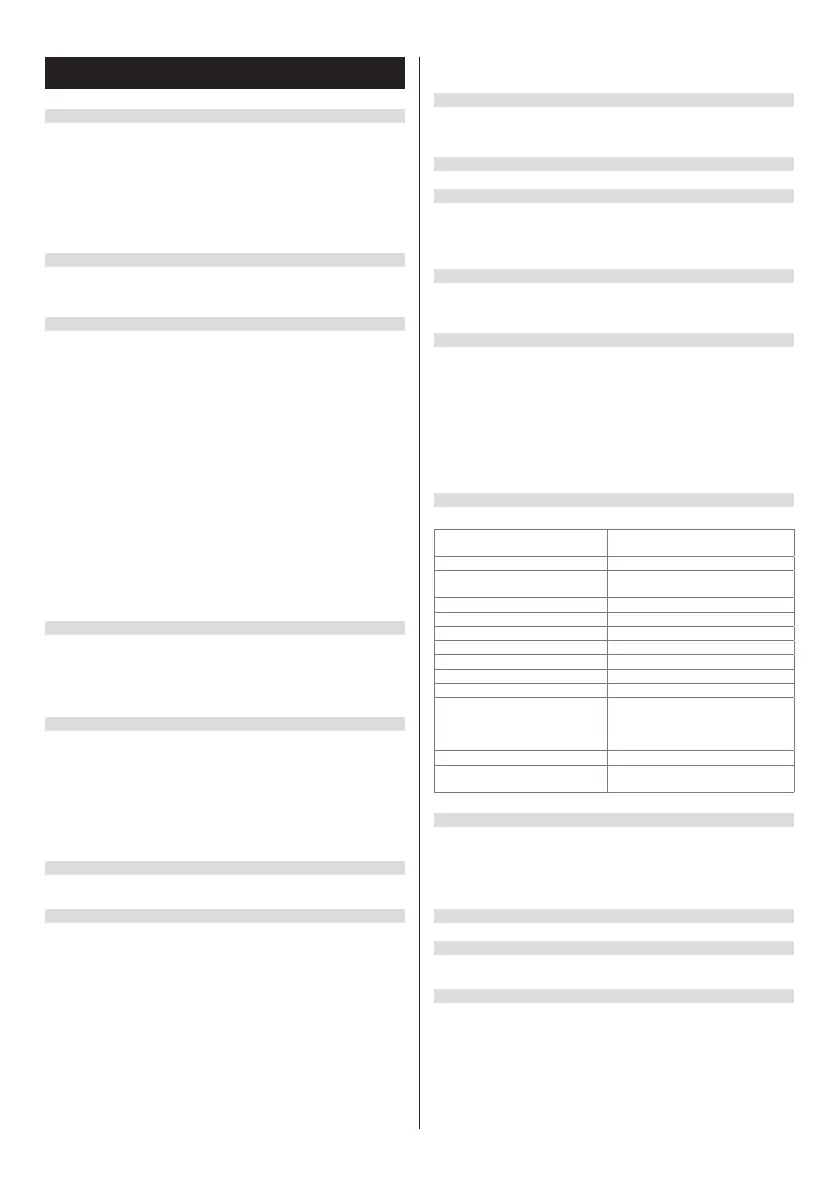
Specifications
(We reserve the right to make technical changes)
Shade Level 4 (light mode)
9 – 13 (dark mode)
UV/IR protection Maximum protection in light and dark modes
Switching time from light to dark 0,00015s (23°C / 73°F)
0,00010s (55°C / 131°F)
Switching time from dark to light 0.1s - 1.0s
Dimensions of cartridge 90 x 110 x 7mm / 3.55 x4.33 x 0.28“
Dimensions of field of vision 50 x 100 mm / 1.96 x 3.94“
Power supply 2 x CR2032 (replaceable)
Weight 460g / 16,226 oz
Operating temperature -10°C – 70°C / 14°F – 157°F
Storage temperature -20°C – 80°C / -4°F – 176°F
Classification as per EN379 Optical class = 1
Light scatter = 1
Homogeneity = 1
Angle of vision dependency = 2
Standards CE, ANSI Z87.1, EAC, compliance with CSA Z94.3
Additional markings for PAPR version
(notified body CE1024)
EN12491 (TH3 in combination with e3000, TH2 for
versions with hardhat and e3000).
Spare parts (see cover)
1. Cartridge incl. satellite
2. Front cover lens
3. Inner protection lens
4. Head band with fastener
5. Sweat band
Declaration of conformity
See the Internet address on the last page.
Legal information
This document complies with the requirements of EU Regulation 2016/425 section 1.4 of
Annex II.
Notified body
For detailed information see last page.


 To Next Page
 Loading...