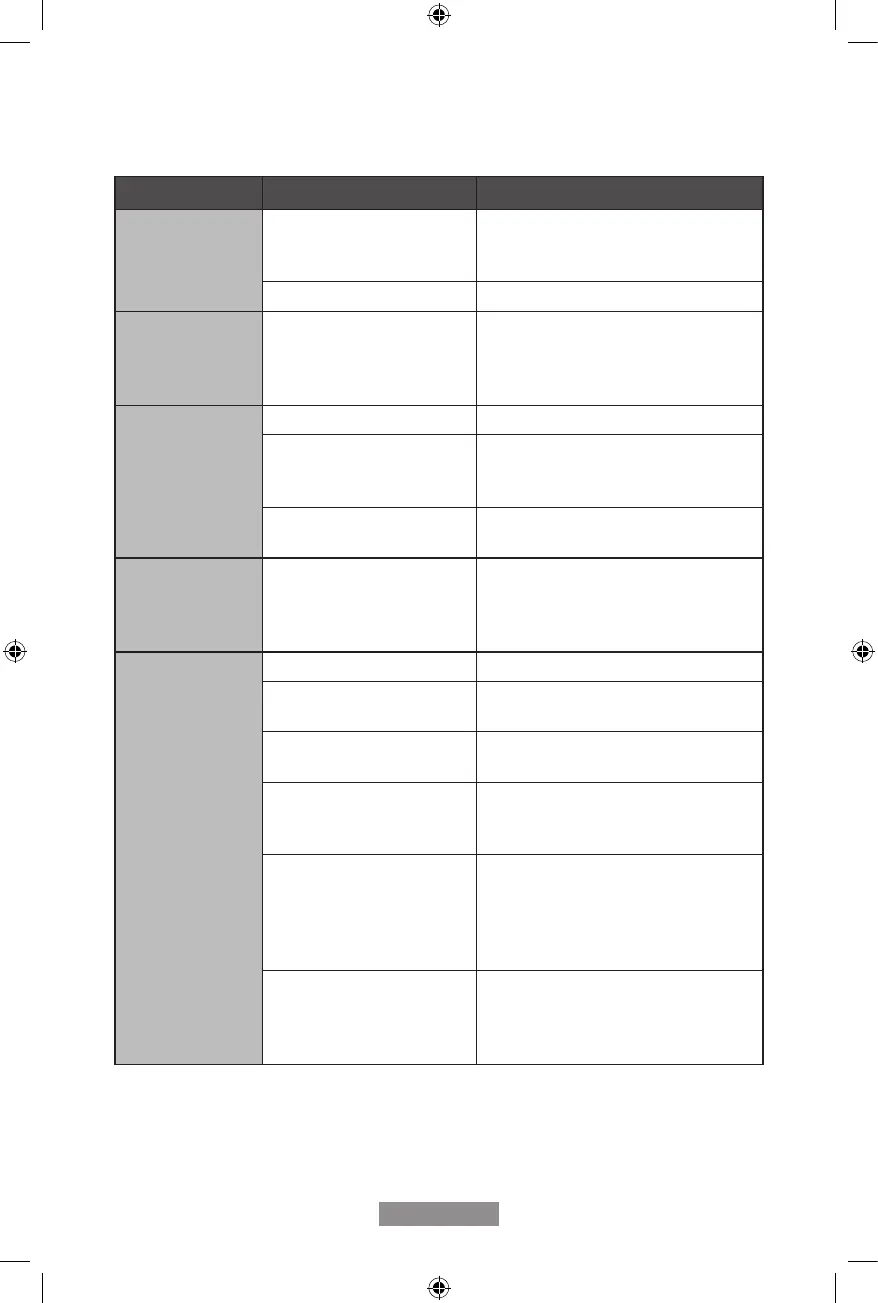
TROUBLESHOOTING GUIDE - ESPRESSO MACHINE
PROBLEM Possible Cause What To Do
Spent (used)coffee
cake is wet
A little water will remain on
top of the used coffee cake.
Rest Group Handle on the Drip Tray
for 5 sec to allow the water to dissipate
before disposing cake.
Too many coffee grinds used. Dose less coffee grinds.
Milky coffee is too
cold
Milk may not be heated
enough.
Ensure that milk is heated properly
during texturing, but be sure not to heat
too much and boil the milk.
See Tip for Milk Texturing, page 16.
No steam from the
Steam Wand
Steam Wand Tip is blocked. See Care & Cleaning, page 25.
No water in the Water
Reservoir.
Fill reservoir with water. Run hot water
through the Steam Wand to ensure
water flows.
Espresso Machine has scale
build up.
A Descaling Cycle is required. See
Descaling Cycle, pages 29-30.
Steam Wand
making a
screeching noise
Steam Wand Tip too deep.
Lower Milk Jug. Ensure the Steam
Wand Tip is positioned correctly when
texturing. See Tip for Milk Texturing,
page 15.
Not enough foam
when texturing
Milk is not fresh. Ensure the milk being used is fresh.
Milk temperature is too warm. Ensure you start texturing with milk that
is around 4°C.
Type of Milk Jug being used. For best texturing results use a chilled
Stainless Steel Milk Jug.
Milk has been boiled. Start again with fresh, chilled milk.
Heat till the Milk Jug can only be held for
approximately 3 second, 60-65°C.
The milk is making bubbles
rather than microfoam.
Ensure the Steam Wand Tip is positioned
correctly when texturing. Tap the Jug on
the benchtop when nished to release
trapped air bubbles.
See Tip for Milk
Texturing, page 16.
Milk is not taking in enough
air.
Keep the Steam Wand Tip just under
the surface of the milk. This will help
introduce air into the milk to create
microfoam.
English - 33
BVSTEM7300-054_19ESM4 (LA).indd 33 6/26/19 09:34



 To Next Page