4
Vehicle Battery
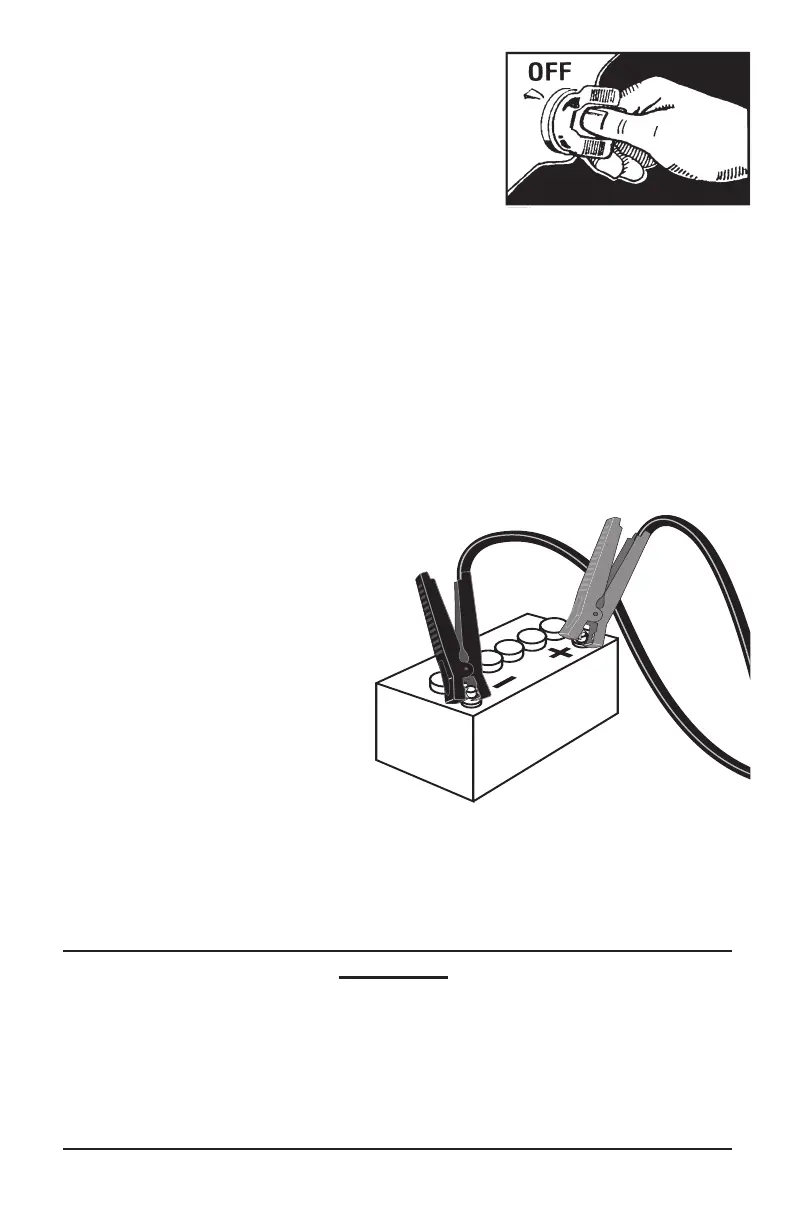
1.TurnignitionkeyOFF;notintheACCESSORIES
position (Figure 2).EngineneedstobeOFFand
all electrical loads must be removed from the
batteryforpropertesting.Ifloadsstillexist,refer
tothevehiclesoperatorandservicemanual.
2.Ifbatteryisbeingcharged,thenstop,turncharger
OFFanddisconnectclampsorleads.Thebattery
cannotbetestedwhilebeingcharged.
3.Theconnectionsmustbecleanandmustmake
goodcontacttoachievecorrecttestresults.
4.On side-post type batteries, install terminal stud adapters. These are not
included,butareavailableatmostautomotivepartsstores.
Battery Temperature
The most accurate test results will be obtained when battery temperature is
at approximately 70°F (21.1°C). If testing battery between 70°F (21.1°C) and
40°F(4.4°C),add0.1voltforevery10°F(5.6°C)below70°F.Iftestingabattery
between70°F(21.1°C)and100°F(37.8°C),subtract0.1Vforevery10°F(5.6°C)
above70°F(21.1°C).
Load Test
1.Connect the tester’s Black
clamptothenegative(-)battery
terminal and the Red clamp to
thepositive(+)batteryterminal
(Figure 3).Makesurebothjaws
makegoodcontact.Ifrequired,
rock clamps back and forth to
improve connection.
2.TheLCDdisplaywillturnonand
displaythebatteryvoltage.Thebatterymustbeatleast75%chargedbefore
conductingtheLoadTest.At70°F(21.1°C),thevoltageshouldbeatleast12.45V
(or6.23Vfora6Vbattery).Remembertoadjustvoltagefortemperaturesother
than70°F(21.1°C).
CAUTION!
• The Battery Load Tester becomes hot when applying the load.
Allow tester to cool between discharges; about 2 minutes. In warm
temperatures, allow more time to cool. If overheating occurs, the LCD
might temporarily become dim. After cooling down, the tester’s LCD
will return to normal.
• Do not activate and hold the load switch for more than 15 seconds.
This will overload the tester resulting in damage and void the warranty.
Figure 2 Engine OFF
Figure 3 Battery Connections


 To Next Page