Microstat He Manual
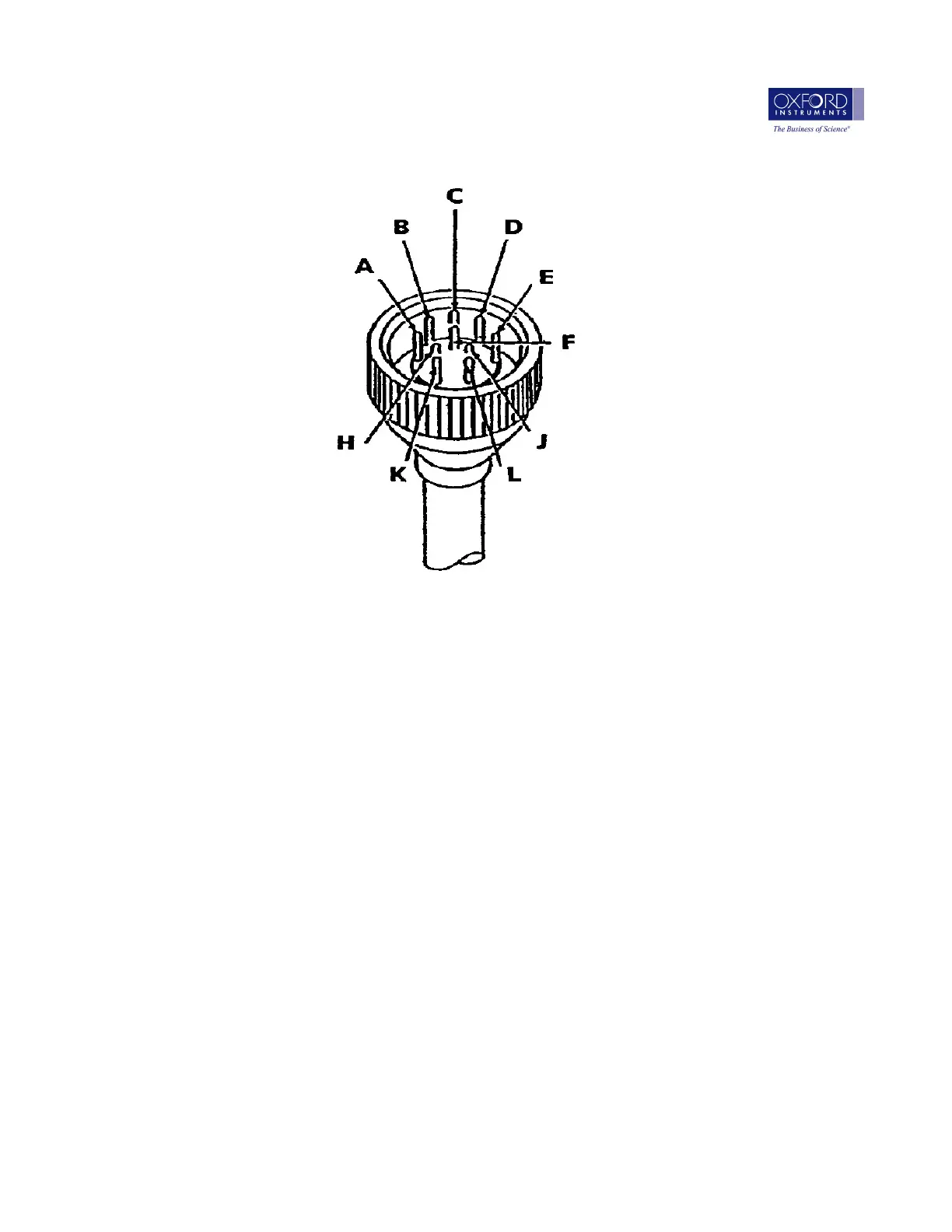
Figure 9.1: Ten-pin seal configuration
Any wiring made to the sample should be thermally anchored to the heat exchanger or sample holder in order to reduce the heat load on
the sample.
9.2 Troubleshooting
The following list summarises the most common faults on the system. You may also need to refer to the troubleshooting guide in the
transfer siphon manual.
Cryostat OVC cannot be pumped to high vacuum OR Water condenses on the cryostat body when it is cold
Check the cryostat OVC for leaks. In particular check the top plate seals and outer window seals.
If there is no leak there may be too much moisture in the OVC and it should be pumped with a rotary pump, with the gas ballast valve
open.
Cryostat will not cool down
Check whether there is any flow of gas through the system, using the gauge on the VC-U if applicable.
Poor temperature stability
Check that the PID settings on the temperature controller and the cryogen flow rate are as suggested in the manual and test results.
Cryostat cannot be warmed up from base temperature OR Heater not working
Check that the set temperature is higher than the present sample temperature, or switch the heater on manually.
© 2017 Oxford Instruments Nanoscience MAN-MHE-1.1.0 (28ff3d8) Sep 2017 34


 To Next Page