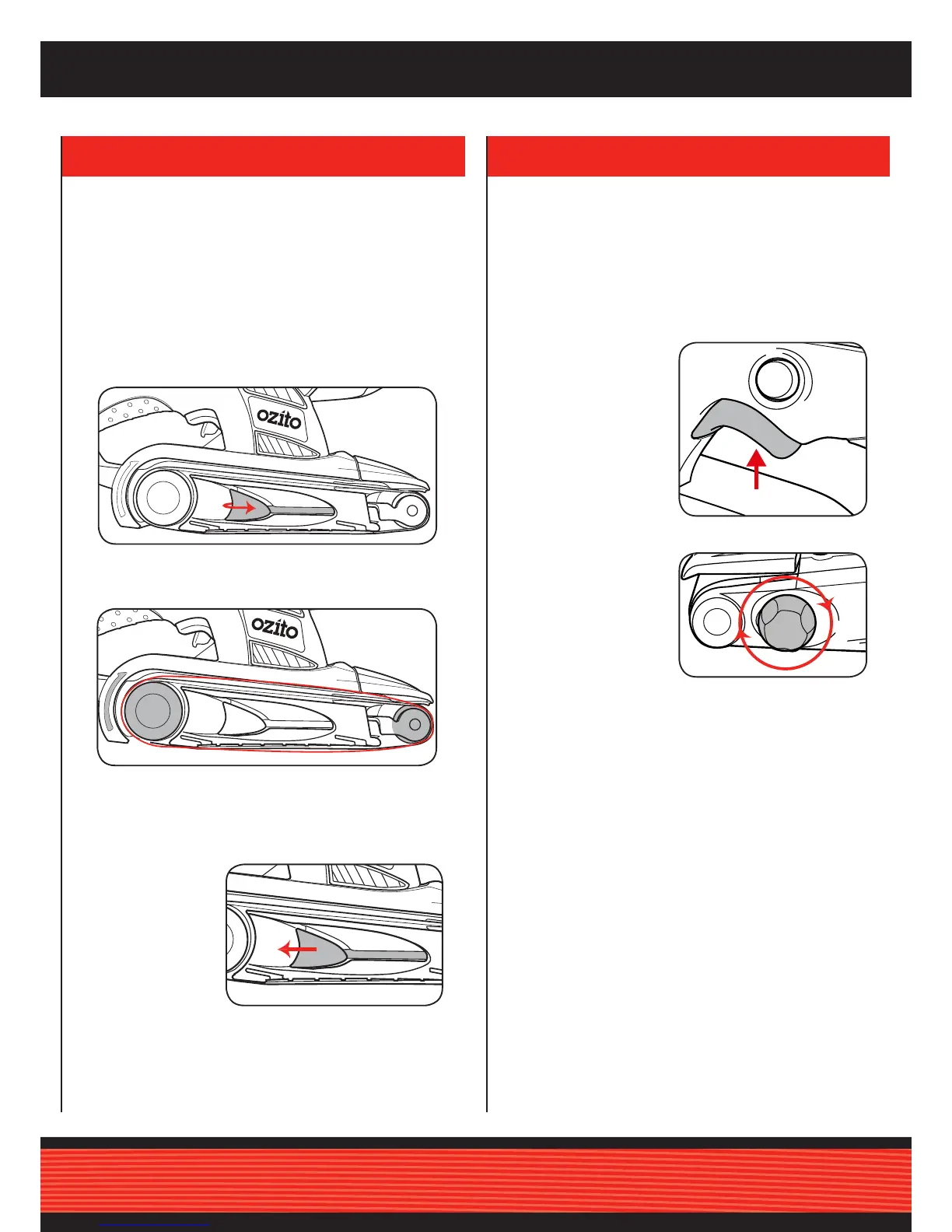
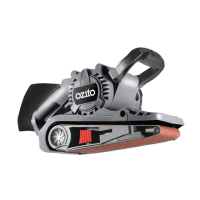
2. SANDING BELT 3. BELT ADJUSTMENT
OPERATION
When installing a belt, ensure you have the correct size for your
belt sander, and correct grit for your workpiece. Belts have arrows
markedonthemtoassistinttingthemtothebeltsanderinthe
correct direction. Belts are also marked with a grit rating.
Install
3. Gently place the belt over the front and rear rollers.
1. Placethebeltsanderonitsleftsideonaatsurface.
CAUTION: The arrows on the belt must be aligned with the
markings on the belt sander.Incorrecttmentcouldcausethe
belt to break. Belts are not covered by the warranty.
CAUTION: Ensure body parts, cords, workpieces and any
loose items are clear of the sanding belt before performing
the tracking adjustment operation
Tracking Adjustment
1. Turn the sander upside
downandholditrmly
with one hand. Press the
on/off switch to start the
sander and observe the
tracking of the sanding
belt.
2. If the belt tracks
outward, turn the belt
tracking knob clockwise.
If the belt tracks inward
turn the belt tracking
knob counter clockwise.
the belt sander.
It is necessary to ensure the belt is tracking correctly, in a straight
line, to avoid the belt ‘tracking off’ the belt sander’s rollers.
3. Adjust the belt until its outer edge is even with the outer edge
of the front and rear rollers. Make sure the belt does not rub
against the rear guide strip. Once the belt stabilizes you can
begin operation.
2. Pull the belt tension lever out, toward the front of the sander.
4. Close the belt
tension lever.
Follow the above procedure to remove a sanding belt,
removing the belt in step 3 instead of placing the belt.



 To Next Page