Why does mist emerge from my Panasonic CS-E15LKEW Air Conditioner indoor unit?
- JJeremy PowellAug 31, 2025
Mist emerges from the indoor unit of your Panasonic Air Conditioner due to the condensation effect caused by the cooling process.
Why does mist emerge from my Panasonic CS-E15LKEW Air Conditioner indoor unit?
Mist emerges from the indoor unit of your Panasonic Air Conditioner due to the condensation effect caused by the cooling process.
What to do if my Panasonic Air Conditioner remote control does not work?
If the remote control for your Panasonic Air Conditioner isn't working, make sure the batteries are inserted correctly or replace weak batteries.
What does it mean when the timer indicator is always on in my Panasonic CS-E15LKEW Air Conditioner?
If the timer indicator on your Panasonic Air Conditioner is always on, it means the timer setting repeats daily once set.
What does it mean when the power indicator blinks during HEAT mode with no warm air supply in my Panasonic CS-E15LKEW?
If the power indicator blinks during HEAT mode and there's no warm air supply from your Panasonic Air Conditioner, the unit is likely in defrost mode and the AIR SWING is set to AUTO.
What to do if my Panasonic Air Conditioner unit stops and the timer indicator blinks?
To address this issue, use the remote control to retrieve the error code: press for 5 seconds, then press until you hear a beep sound and note the error code. For certain errors, you may restart the unit with limited operation, indicated by 4 beeps during start-up. If the problem persists, turn the unit off and provide the error code to an authorized dealer.
Why does my Panasonic CS-E15LKEW Air Conditioner emit water or steam from the outdoor unit?
The water or steam emitted from the outdoor unit of your Panasonic Air Conditioner is due to condensation or evaporation occurring on the pipes.
What to do if my Panasonic CS-E15LKEW Air Conditioner is not working efficiently?
If your Panasonic Air Conditioner's heating or cooling isn't working efficiently, try the following: ensure the temperature is set correctly, close all doors and windows, clean or replace the filters, and clear any obstructions at the air inlet and outlet vents.
Why is my Panasonic Air Conditioner noisy during operation?
If your Panasonic Air Conditioner is noisy during operation, check if the unit has been installed at an incline and ensure the front panel is closed properly.
What to do if my Panasonic CS-E15LKEW Air Conditioner does not receive the signal from the remote control?
If your Panasonic Air Conditioner isn't receiving the signal from the remote control, make sure the receiver isn't obstructed. Be aware that certain fluorescent lights may interfere with the signal transmitter; consult an authorized dealer if this is the case.
Why does my Panasonic CS-E15LKEW Air Conditioner make a cracking sound during operation?
The cracking sound during operation of your Panasonic Air Conditioner is due to changes in temperature causing the expansion and contraction of the unit.
Safety guidelines for electrical power connections, including cord usage and earthing.
Precautions for handling and operating the indoor and outdoor units to prevent damage or injury.
Safety advice regarding the use and handling of the remote control unit.
Specifies operating temperature ranges for cooling and heating for single split units.
Details operating temperature ranges for multi-split air conditioning systems.
Explanation of multi air conditioner systems connecting multiple indoor units to one outdoor unit.
Describes how indoor units operate individually or simultaneously within a multi-system.
Guidelines for cleaning the indoor unit, specifying safe cleaning agents and methods.
Information on the Eco Patrol sensor, its function, and handling precautions.
Instructions for using the auto on/off button when the remote is lost or malfunctioning.
Procedures for cleaning and replacing e-ion filters for optimal air purification.
Recommendation for cleaning the active e-ion generator to ensure fresh air.
Instructions for turning the unit on/off and setting the desired temperature.
Guide to selecting different operation modes like AUTO, HEAT, COOL, and DRY.
How to select fan speed and adjust vertical and horizontal airflow directions.
Using features like Quiet environment, Eco Patrol, and quick temperature achievement.
Procedure for setting ON and OFF timers for automated operation.
Common operational sounds or visual effects that do not indicate a malfunction.
Actions to take before calling for service, covering operational issues and remote control problems.
Steps to retrieve error codes when the unit stops and the timer indicator blinks.
Guidance for seasonal inspection and preparing the unit for extended periods of non-use.
Conditions requiring immediate consultation with an authorized dealer for service.
Information on collecting and disposing of used electrical/electronic products and batteries.
Guidelines specific to the European Union for waste disposal and recycling.
Information for users outside the European Union regarding disposal methods.
Steps for preparing the remote control, including battery installation and clock setting.
Instructions for selecting operating modes, temperature, and starting/stopping the unit.
| Thermostat range | - °C |
|---|---|
| Hose length (max) | 15 m |
| Remotely operated | Yes |
| Cooling capacity (max) | 3610 BTU/h |
| Dehumidifying capacity | 2.4 l/h |
| Heating capacity (max) | 4640 BTU/h |
| Cooling capacity in watts (max) | 4200 W |
| Heating capacity in watts (max) | 5400 W |
| Cooling energy efficiency (EER, W/W) | 3.44 |
| Heating energy efficiency (COP, W/W) | 3.68 |
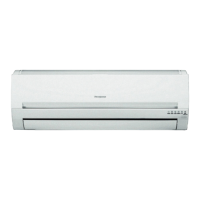
| Indoor unit type | Wall-mountable |
| Airflow | 750 m³/h |
| Noise level | 59 dB |
| Power requirements | 230 V |
| Weight | 9000 g |
|---|---|
| Dimensions (WxDxH) | 780 x 204 x 290 mm |


Loading...