
 Need help?
Do you have a question about the Panasonic KX-T7730 and is the answer not in the manual?
Guidelines for shipping the product and obtaining service from authorized centers.
Critical warnings about fire/shock risks, magnetism, and power failure operation.
Instructions for calling extensions, external parties, redialing, and one-touch dialing.
Procedures for answering directed calls, group calls, and handsfree answerback.
Procedures for handling calls when the dialed extension is busy or no answer.
Managing calls during conversations, including holding and retrieving calls.
Instructions for managing call waiting and transferring calls.
Instructions for paging extensions/speakers and setting up three-party conferences.
Procedures for setting and canceling absent messages.
Steps for logging into and out of the system.
Instructions for forwarding all calls, busy/no answer, or to an outside line.
How to set and cancel the Do Not Disturb feature.
Procedures for locking and unlocking the extension, and clearing settings.
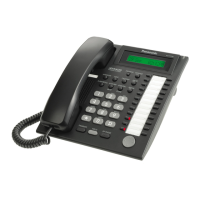
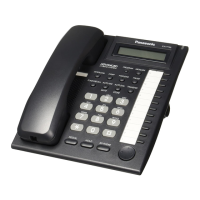
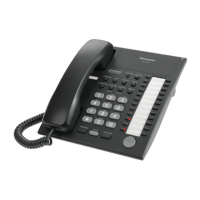
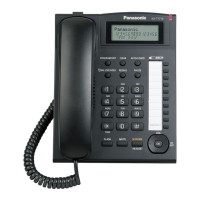
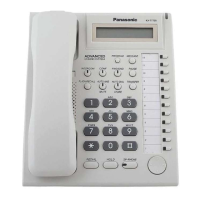
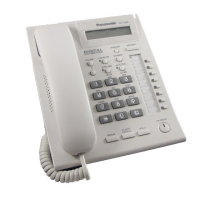
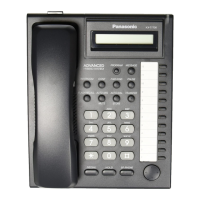
Identifies all physical buttons and their primary functions on the telephone unit.
Guides for adjusting speaker volume, handset volume, ringer, and display contrast.
Instructions for connecting the telephone line cord and headset to the main unit.
Steps for securely mounting the telephone unit on a wall.
Details FCC compliance, ACTA registration, REN, FIC, SOC, and USOC jack types.
Contact information for repair or warranty information.
Information on USOC jacks for modes and system port data.
Guidelines for connecting KX and PX adjunct devices.
Basic safety measures to reduce risks of fire, electric shock, or injury.
Guidance on when to seek servicing and safety in electrical storms/environments.
Information on Class B digital device compliance and interference mitigation.
Precautions for usage, cleaning, and basic troubleshooting steps.
This document provides a quick reference guide and important information for Panasonic Proprietary Telephones, specifically models KX-T7720, KX-T7730, KX-T7731, KX-T7735, KX-T7736, and KX-T7750. It covers essential features, operations, initial settings, connection instructions, and safety guidelines.
The Panasonic Proprietary Telephones are designed for use within a private branch exchange (PBX) system, offering a range of communication functionalities for both internal and external calls. These telephones act as extensions within a larger telephone system, enabling users to make and receive calls, manage multiple conversations, and utilize various call handling features. They are equipped with programmable feature buttons, allowing for customized access to frequently used functions. The devices support both handset and hands-free operation, catering to different user preferences and work environments. Certain models feature a Liquid Crystal Display (LCD) for visual feedback and navigation, enhancing user interaction. The phones are designed to integrate with a PBX system, providing advanced call management capabilities beyond a standard single-line telephone.
The telephones offer a comprehensive set of features for efficient call management:
CO button and then dialing the phone number, users can initiate external calls.REDIAL button allows for quick redialing of the last number called.PROGRAM, CO or PF, 2, /, 9, 9, then AUTO DIAL, phone no., STORE. To dial, press CO or PF and the assigned One-Touch Dialing button.0 to reach an operator.2, * (for KX-TA624) or 3, 0 (for KX-TA1232), then desired no., #, and personal speed dial no.. To dial, press #, 3, * (for KX-TA624) or personal speed dial no. (for KX-TA1232).AUTO DIAL, system speed dial no., STORE.AUTO ANS to answer calls hands-free.4, *. For directed calls, press 4, extension no. or 4, 1, extension no.. For group calls, press 4, 0.6. To call, if you hear callback ringing, pick up the handset.MESSAGE.MESSAGE, receiver's extension no. (for KX-TA624) or 7, 0, 0, receiver's extension no. (for KX-TA1232).MESSAGE.7, 0, 0, #, your extension no. (for KX-TA624) or 7, 0, 0, your extension no. (for KX-TA1232).1 to wait for an answer.7, 3, 1, 1, # to set, or 7, 3, 1, 0, # to cancel. For intercom calls, press 7, 3, 2, 1, # to set, or 7, 3, 2, 0, # to cancel.7, 3, 1, 1 to set, or 7, 3, 1, 0 to cancel.CO or INTERCOM.HOLD.CO or INTERCOM.HOLD, then CO or INTERCOM.CO.HOLD, then HOLD, CO or INTERCOM.TRANSFER, then extension no. (to an extension) or CO, phone no. (to an external party). Wait for an answer, then announce.TRANSFER, then extension no..3, 3, 0.3, 3, group no..3, 4.3, 3, *.3, 2, 0.3, 2, external speaker no..3, 3, *.4, 3.4, 3 (for KX-TA624) or 4, 2, external speaker no. (for KX-TA1232).CONF, then third party's no., then CONF.7, 5, message no., parameter (if required), #.7, 5, 0, message no., parameter (if required).7, 5, 0, #.7, 5, 0, 0.7, 3, 6, 0, #.7, 3, 6, 1, #.4, 5, 1.4, 5, 0.1, extension no., #.2, extension no., #.3, line access code, phone no., #.5, your extension no., #.8, your extension no., #.0, #.2, extension no..3, extension no..4, extension no..5, extension no..6, line access code, phone no., #.7, your extension no..8, your extension no..0.4, #.0, #.1.0.7, 7, lock code, lock code, #.7, 7, lock code, #.7, 7, lock code, lock code.7, 7, lock code.7, 9, #.7, 9, 0.The manual provides important safety instructions and general maintenance guidelines to ensure the longevity and proper functioning of the telephone.
The manual also includes information regarding ACTA registration, Ringer Equivalence Number (REN), Facility Interface Code (FIC), Service Order Code (SOC), and USOC Jack Type for different models, ensuring compliance and proper installation within the telephone network.
 General
| Speakerphone | Yes |
|---|---|
| Programmable Keys | 12 |
| Fixed Function Keys | Yes |
| Headset Jack | No |
| Wall Mountable | Yes |
| Volume Control | Yes |
| Redial | Yes |
| Hold | Yes |
| Mute | Yes |
| Flash | Yes |
| Type | Proprietary |
| Compatibility | Panasonic PBX Systems |





 To Next Page
