--
TR-1030P
THIS
MODEL
COMPLIES
WITH
DHHS
RULES
21 CFR SUBCHAPTER
J
APPLICABLE
AT
DA
TE
OF
MANUFACTURE.
SAFETY PRECAUTIONS
GENERAL
GUIDELINES
1.
It
is
advisable
to
insert
an
isolation transformer between
the
television
set and the
AC
power
line
before servicing
the chassis.
2.
In
servicing, pay
attention
to
the
original
lead
dress,
especially
in the high voltage
circuit.
If
a short
circuit
is
found,
replace all
parts
which
have
been
overheated
as
a
result
the short
circuit
.
3.
After
servicing, observe
that
all
the protective devices
such
as
insulation
barriers,
insulation
papers,
shields,
isolation
and
R-C
combinations,
are-
properly
installed.
4.
Before
turning
the receiver on, check the resistance
between the B+
line
and
chassis
ground.
Connect
8
side
of
an
ohmmeter
to
B+
line
and
8'
side
to
ground. Each
line should
have more resistance than specified below.
B+
line
Minimum
Resistance
4.SV
600!1
5.
When the
TV
set
will
not
be
used
for
a
long
period
of
time,
unplug
the power cord
from
the
AC
line outlet..
6.
Potentials
as
high
as
4.
7kV
are
present when this receiver
is
operating. Operation
of
the receiver
without
the rear
cover on involves danger
of
shock.
Servicing should
not
be
attempted
by
anyone
who
is
not
thoroughly
familiar
with
the precautions necessary when
working
on high-voltage equipment.
Always
discharge
the anode
of
the picture tube
to
the receiver
chassis
before
handling
the tube.
7.
After
servicing make the
following
leakage current check
to
prevent the customer
from
undergoing shock hazard.
LEAKAGE
CURRENT
COLD CHECK
1.
Unplug the
AC
cord and connect a
jumper
between the
two
prongs on the
plug.
2.
Turn
the
rece_iver
power switch on.
3.
Measure the resistance
value
with
an
ohmmeter
between
the jumpered
AC plug
and each exposed
metallic
part
such
as
screwheads, antennas,
control
shafts,
handle
bracket, etc. When
the
exposed
metallic
part
has
a return
path
to
the chassis, the reading should
be
1.8 megohm
to
4 megohms. When
the
exposed
metal
does
not
have
a
return path
to
the
chassis,
the reading must
be
infinity.
4. Remove the
jumper
from
the
AC plug.
LEAKAGE
CURRENT
HOT
CHECK
1.
Plug
the
AC
cord
directly
into
the
AC outlet.
Do
not
use
an
isolation transformer
during
this check.
2.
Connect
a
1500
ohm,
10
watt
resistor,
paralleled
by a
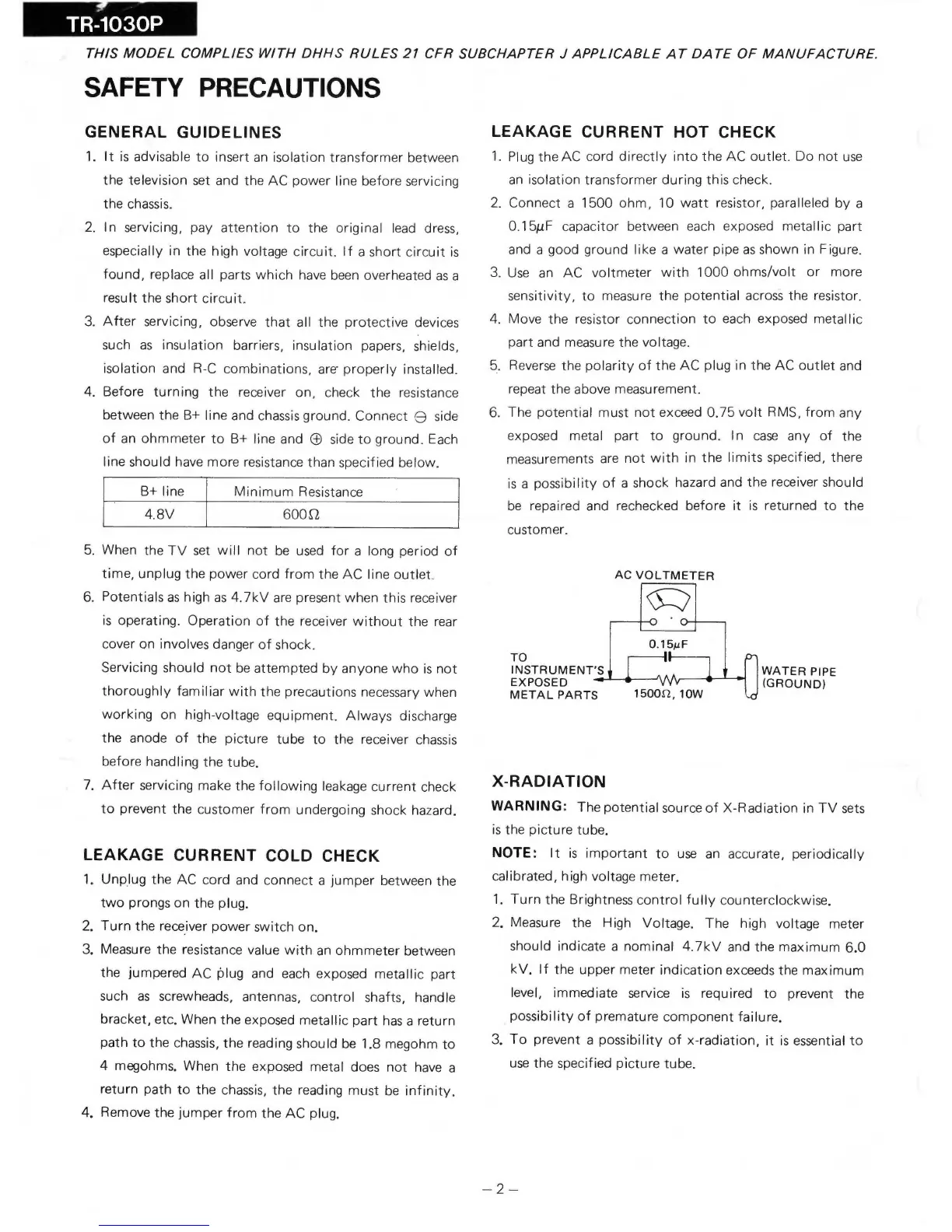
0.15µF capacitor between
each
exposed metallic
part
and a good ground
like
a water pipe
as
shown in Figure.
3.
Use
an
AC
voltmeter
with
1000
ohms/volt
or
more
sensitivity,
to
measure the
potential
across the resistor.
4.
Move the resistor connection
to
each exposed
metallic
part and measure the
voltage.
5.
Reverse
the
polarity
of
the
AC plug
in the
AC
outlet
and
repeat the above measurement.
6.
The
potential
must
not
exceed 0.75
volt
RMS,
from
any
exposed
metal
part
to
ground.
In
case
any
of
the
measurements
are
not
with
in the
limits
specified, there
is
a
possibility
of
a shock hazard and the receiver
should
be
repaired and rechecked before
it
is
returned
to
the
customer.
AC
VOLTMETER
0.15µF
TO
INSTRUMENT'S
EXPOSED
-.JL--.1.._~,AA~---<11
..........
----i
METAL
PARTS
X-RADIA
TION
WATER
PIPE
(GROUND)
WARNING:
The
potential source
of
X-Radiation in
TV
sets
is
the picture tube.
NOTE:
It
is
important
to
use
an
accurate, periodically
calibrated,
high
voltage
meter.
1.
Turn
the Brightness
control
fully
counterclockwise.
2. Measure the High Voltage.
The high
voltage
meter
should
indicate a
nominal
4.
7kV
and the maximum 6.0
kV.
If
the upper meter
indication
exceeds the
maximum
level, immediate service
is
required
to
prevent the
possibility
of
premature component
failure.
3.
To
prevent a
possibility
of
x-radiation,
it
is
essential
to
use
the specified picture tube.
-2-


 To Next Page
 Loading...