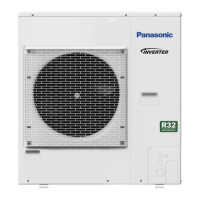
Why does my Panasonic U-16MF2E8 fan keep running after I turn it off?
- NnrogersSep 12, 2025
The fan may continue to rotate after operation stops to ensure smooth operation and to dry the heat exchanger, depending on the settings.


Why does my Panasonic U-16MF2E8 fan keep running after I turn it off?
The fan may continue to rotate after operation stops to ensure smooth operation and to dry the heat exchanger, depending on the settings.
Why is the fan still rotating on my Panasonic U-16MF2E8 Air Conditioner after I turn it off?
The fan in your Panasonic Air Conditioner may continue to run even after the unit is stopped by the remote controller because it helps to ensure smooth operation.
Why is my Panasonic U-16MF2E8 Air Conditioner making noise in heating mode?
The noise you hear in heating mode from your Panasonic Air Conditioner is likely due to the defrost operation.
Why is my Panasonic Air Conditioner making noise when heating?
The noise you hear during heating operation of your Panasonic Air Conditioner may be due to the defrost operation being in process.
Why are there dewdrops near the air outlet of my Panasonic U-16MF2E8?
Dewdrops may accumulate near the air outlet of your Panasonic Air Conditioner during cooling operation because internal moisture is cooled by the cool wind, causing it to condense into dewdrops.
Why is my Panasonic U-16MF2E8 Air Conditioner cooling or heating poorly?
If your Panasonic Air Conditioner's cooling or heating performance is poor, check if the air inlet or outlet of the indoor and outdoor units are blocked by dust and remove any dust. Also, ensure the air speed control is set to 'High' or 'Strong'. Verify that the temperature settings are correct by lowering the temperature setting or setting it to 'High' or 'Strong'. Finally, consider that direct sunlight exposure in cooling mode can affect performance.
Why does the fan keep running on my Panasonic Air Conditioner after I turn it off?
The fan in your Panasonic Air Conditioner may continue to run even after you turn it off to ensure smooth operation. Also, depending on the settings, the fan may rotate to dry the heat exchanger.
How to fix a noisy Panasonic Air Conditioner?
The noise you hear from your Panasonic Air Conditioner could be due to a few reasons: it could be the sound of refrigerant liquid flowing inside the unit, the sound of drainage water through the drain pipe, or sound due to temperature changes of parts. These are normal and do not indicate a problem.
Why is the outdoor unit fan on my Panasonic U-16MF2E8 Air Conditioner still running after I turn it off with the remote?
Fan rotating makes operation smoothly.
Why does the fan on my Panasonic Air Conditioner rotate faster than the setting speed at the initial high-speed operation?
This happens for operation check in order to confirm whether the fan motor rotation is within use range.
Critical warnings and precautions for installation, wiring, and handling.
Detailed explanation of compressor control methods and operations.
Information regarding system alarms and error codes.
Functions for automatic and manual backup operation during failures.
Protective control mechanisms for compressors.
Information on discharge temperature protection and related alarms.
Information on alarms related to current protection.
Information on high and low-pressure sensor failures.
Protection mechanisms and alarms for abnormal high and low pressures.
Alarms and troubleshooting for temperature sensor failures.
Troubleshooting magnet switch failures and their operational impact.
Function and engagement of automatic backup operation.
Procedures for performing manual backup operation.
Steps for safely discharging compressor oil.
Procedures for operating the system in backup mode.
Steps for recovering refrigerant from the system.
Methods for checking for refrigerant leaks after repair work.
Procedure for evacuating the refrigerant system.
Steps for charging compressor oil into the system.
Procedure for pumping out refrigerant from an outdoor unit.
Information and procedures related to compressor maintenance and replacement.
Procedure for discharging oil from the oil separator.
Procedure for discharging oil directly from the compressor.
Criteria for accepting or rejecting discharged compressor oil.
Details on automatic backup operation for compressors.
Procedure for adjusting refrigerant levels during backup operation.
Procedures for manual backup operation.
Step-by-step guide for recovering refrigerant from an outdoor unit.
Procedures for recovering refrigerant from indoor units.
Refrigerant recovery process using an indoor unit ball valve.
Refrigerant recovery steps for indoor units without ball valves.
Procedure for recovering refrigerant from the entire system.
Performing a pressure check to detect leaks in the outdoor unit.
Procedure for evacuating gases from a repaired outdoor unit.
Procedure for charging compressor oil when refrigerant is already present.
Steps for charging compressor oil into the outdoor unit.
Procedure when outdoor unit has not been charged with refrigerant or compressor.
Procedure for charging additional compressor oil after replacement.
Procedure for pumping out refrigerant using the CZ-RTC2 remote controller.
Procedure for pumping out refrigerant without the remote controller.
Final steps for pumping out refrigerant from an outdoor unit.
Methods for diagnosing compressor troubles and checking components.
Procedures for replacing compressors.
Procedure to replace all compressors in a failed unit.
Procedure to replace all compressors across the entire system.
Procedure for dry core cleaning to remove contaminants.
Dry core cleaning steps when no ball valve is installed on the outdoor unit.
Procedure for removing compressors from the unit.
Specific steps for removing constant-speed compressors.
Steps to replace a single failed compressor.
Overview of alarm codes displayed on the remote controller.
Understanding the LED indicators on the outdoor unit control panel.
List and explanation of specific 3WAY system alarm codes.
Diagnosing and resolving symptoms related to thermostat cycling.
Details and troubleshooting for E06 alarm.
Details and troubleshooting for E16 alarm.
Details and troubleshooting for E25 alarm.
Troubleshooting for F04 and F05 discharge temperature sensor alarms.
Troubleshooting for F06 and F23 gas temperature sensor alarms.
Troubleshooting for F08 outdoor air temperature sensor alarm.
Troubleshooting for F16 high-pressure sensor malfunction alarm.
Troubleshooting for F17 low-pressure sensor trouble alarm.
Troubleshooting for H11/H12 constant speed compressor overcurrent/lock alarms.
Troubleshooting for H03/H13 compressor CT sensor alarms.
Troubleshooting for H06 abnormal low-pressure alarm.
Troubleshooting for H08/H27 oil sensor connection alarms.
Troubleshooting for L10 outdoor unit capacity not set alarm.
Troubleshooting for L17 outdoor unit model mismatch alarm.
Details and troubleshooting for E12 alarm.
Details and troubleshooting for E20 alarm.
Details and troubleshooting for E26 alarm.
Troubleshooting for F07 and F24 liquid temperature sensor alarms.
Troubleshooting for F12 compressor intake temperature sensor alarm.
Troubleshooting for H05/H15 discharge temperature sensor alarms.
Troubleshooting for H31 HIC trouble alarm.
Troubleshooting for L11 solenoid valve kit installation failure alarm.
Details and troubleshooting for E15 alarm.
Details and troubleshooting for E24 alarm.
Details and troubleshooting for E29 alarm.
Troubleshooting for F14 SCG temperature sensor alarm.
Troubleshooting for H01 compressor 1 current trouble alarm.
Troubleshooting for L04 outdoor system address duplication alarm.
Details and troubleshooting for E31 alarm.
| Brand | Panasonic |
|---|---|
| Model | U-16MF2E8 |
| Category | Air Conditioner |
| Language | English |


Loading...