5
Connecting to Power Source
FIRE HAZARD
Do not connect the Inverter to RV or household AC distribution wiring, to an AC load circuit
or where the neutral conductor is connected to the negative terminal of a DC power source.
Connecting to these circuits could cause damage to the Inverter and/or create a spark.
Do not use with positive ground electrical systems. Connecting the Inverter to a
positive ground electrical system will damage the Inverter. Only use the Power Inverter on
negative ground electrical systems. If in doubt, check with your vehicle dealer or consult the
vehicle’s owner’s manual.
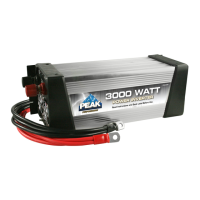
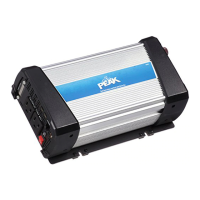
The Power Inverter can be connected to a 12-volt cigarette lighter/accessory socket using the 12-volt
power plug and harness, or to a 12-volt battery or 12-volt DC power source using the battery clips
and harness.
The Power Inverter is equipped with two screw connectors to attach the battery leads or the power
plug leads to the Inverter. The red is positive (+) and the black is negative (-).
Connecting to 12-volt Cigarette Lighter/Accessory Socket
The 12-volt power plug is capable of delivering up to 140 continuous watts of power
output. Do not exceed 140 continuous watts when the Inverter is connected to the 12-volt
cigarette lighter/accessory socket. The Inverter or power plug could be damaged.
Press the ON/OFF switch to the OFF position.1.
Connect the red positive (+) power plug lead to the red positive (+) screw connector on the 2.
Inverter. Tighten the screw connecter securely.
Connect the black negative (-) power plug lead to the black negative (-) screw connector on the 3.
Inverter. Tighten the screw connecter securely.
Insert the power plug into the 12-volt cigarette lighter/accessory socket. Rotate the power plug to 4.
make good contact with the socket.
Connecting to 12-volt Battery or Power Source Using the Battery Clips
Press the ON/OFF switch to the OFF position.1.
Connect the red positive (+) battery 2. lead to the red positive (+) screw connector on the Inverter.
Tighten the screw connecter securely.
Connect the black negative (-) battery 3. lead to the black negative (-) screw connector on the
Inverter. Tighten the screw connecter securely.
Securely connect the red positive (+) clip to the positive (+) terminal of the battery or power 4.
source.
Securely connect the black negative (-) clip to the negative (-) terminal of the battery or power 5.
source.
Connecting a Load to the Power Inverter
Ensure that total power consumption of the device being used is less than the
rating of the Power Inverter.
FIRE HAZARD
Do not operate high wattage appliances or equipment that will produce heat, such as hair
dryers, irons, heaters and toasters, with this Inverter.
The manufacturer provides a label with power consumption information in watts or amps for their
product. If the item’s power consumption is not indicated in watts, but in amps AC, multiply the amp
AC value by 120 (AC volts) to determine the wattage.
When you turn on an appliance or device, it will require twice the rated wattage
of the appliance or device to start. This is known as the “starting load” or “peak load.” To
determine the starting load or peak load, multiply the rated wattage by two. If this exceeds the
peak surge output of the Inverter, do not operate the appliance or device with the Inverter.
The Power Inverter can operate a resistive load device or an inductive load device.
Operating a resistive load device is the easiest for the Inverter. However, the Inverter will not operate
larger resistive load devices such as electric stoves and heaters. Their resistive load requires higher
wattage than the Inverter can produce.
TVs and stereos are inductive load devices (devices with a coil or transformer). They require more
current to operate than a resistive load device of the same wattage rating.
Operating the 120-volt AC Receptacles
Only connect appliances to the Power Inverter after the Inverter is properly connected to the battery
of the vehicle.


 To Next Page