7.13. Using FFT
A FFT breaks down signals into component frequencies, which the oscilloscope uses to display a graph of the frequency
domain of a signal, as opposed to the oscilloscope's standard time domain graph. You can match these frequencies with
known system frequencies, such as system clocks, oscillators, or power supplies.
FFT in this oscilloscope can transform 2048 points of the time-domain signal into its frequency components and the final
frequency contains 1024 points ranging from 0Hz to Nyquist frequency.
The following table describes the FFT menu:
Taking the FFT operation for example, the operation steps are as follows:
1.) Press MENU key and the function menu appear on the right side of the screen.
2.) Press MENU ▲ or MENU ▼ key to select FFT MODE. Four items selectable are available at the bottom of the
screen.
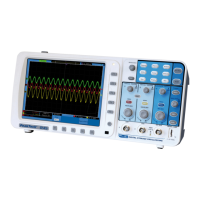
3.) Press F1 to set FFT ON. The green FFT waveform is shown in the screen after calculation.
4.) Press F2 to switch over Window including Hamming, Rectangle, Blackman and Hanning.
5.) Press F3 to switch over Format dB and Vrms.
6.) Press F4 to zoom in or out the waveform, the magnification includes x1, x2, x5, x10.
7.) Press the button CHANNEL SETTING:
One of the following two prompts circularly will show at the bottom-left of the screen when the format is dB.
▲/▼- CH Volts/Div
▲/▼- FFT dB Scale
If left bottom of the screen displays "▲/▼ - FFT dB Scale", press ▲ of CHANNEL SETTING and ▼ of
CHANNEL SETTING to adjust dB value of each DIV, including 1dB, 2dB, 5dB, 10dB, 20dB.
If left bottom of the screen displays "▲/▼- CH Volts/Div" , press ▲ of CHANNEL SETTING and ▼ of CHANNEL
SETTING to adjust voltage of channel, and "2V~" shows in left bottom of the screen
If left bottom of the screen displays "▲/▼- FFT Zero", press ▲ of VERTICAL ZERO and ▼of VERTICAL ZERO
to adjust the position of the waveform along the vertical position such as "FFT 1.20 divs".
-112-


 To Next Page
 Loading...