Need help?
Do you have a question about the Peavey Classic VT Series and is the answer not in the manual?
Explains the master gain control's function for loudness and dynamics.
Explains the bright channel gain's sensitivity and Automix role.
Describes the normal channel sensitivity and distortion.
Describes the phase oscillator speed and its integral switch.
Discusses the master volume for effects, distortion, and noise reduction.
Describes speaker output jacks and impedance matching.
Details the patching system for accessories and signal flow.
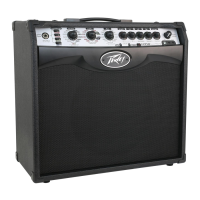
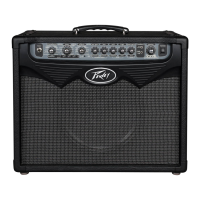
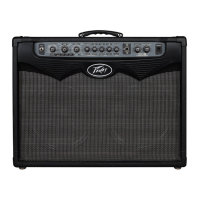
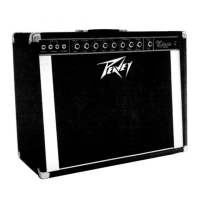
The Peavey VT Series Classic is a tube-type guitar amplifier, representing a redesigned and updated version of the popular Peavey Classic series. It incorporates advanced circuitry and design innovations from larger, more powerful Peavey amplifiers, aiming to provide a versatile and high-performance experience for musicians.
The amplifier features two distinct preamps: a bright channel and a normal channel. The bright channel offers a single input and is voiced with more high-frequency response. The normal channel provides both a high-gain (A) and a low-gain (B) input, allowing for flexibility with different signal levels and the connection of two instruments simultaneously.
A unique "Automix" input is included, which connects to the bright channel. The bright channel's output then feeds into the normal channel through a signal processing circuit, creating a series/parallel arrangement. This allows the bright channel to overdrive the normal channel, with the bright channel's gain control moderately affecting the overdrive signal. This setup enables both a straight signal from the normal bright channel and a smooth overdrive signal from the normal channel, selectable via the supplied remote footswitch.
The VT Series Classic boasts a highly effective three-band equalization system (Bass, Middle, Treble) with a wide range of variation, allowing users to achieve diverse tonal colorations. The middle control, in particular, is noted for its ability to significantly alter the amp's voicing and match the sound of other competing units.
A standout feature is the integrated phase circuit, which offers an extremely wide range of phasing effects, from subtle colorations to deep "swooshing" sounds, and even tremolo/vibrato effects. The versatile oscillator circuit can modulate the phase effect from very slow to extremely rapid rates, encompassing conventional phasors, tremolo/vibrato circuits, and even approximating rotating speaker systems. The "Color" control determines the amount of internal feedback, setting the level of the phasing effect from subtle changes to deep effects with regeneration introduced at higher settings. The "Rate" control adjusts the speed of the phase oscillator, with a wide range from extremely slow to rapid. An integral switch on the rate control allows the phase circuitry to be completely cut out of the circuit, taking precedence over the remote footswitch. It is recommended to cut off the phasor when not in use to avoid modulating residual noise.
The amplifier also includes a deep-sounding reverb system, which follows the master volume control. The reverb drive circuitry feeds a reverb spring, and the amplified return signal is remixed with the clear signal before being applied to the power amplifier. The reverb master control determines the gain of the reverb return amplifier, providing ample reverb even at low settings. The reverb can be turned on or off by the remote footswitch when plugged into the rear panel.
A master gain control allows for overall loudness and gain adjustment, and also provides control over the dynamics of the preamp circuit. This control, in conjunction with the bright and normal gain controls, can be used to achieve harmonic distortion and sustain by setting front-end gains high and master volume low. It also affects the noise level, allowing for improved noise performance in studio environments at lower settings.

 To Next Page
 General