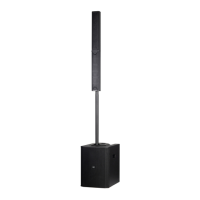
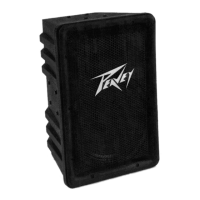
Hum may be ground loop related. It may be helpful to lift the shield ground on a balanced cable at the DPE
™
2P-4P end
by only using the ground lift switch (5). Check any input changes carefully by first turning down the gain control(s) (13)
before plugging and unplugging cables, or lifting the shield ground at the speaker end by using the Ground Lift switch (5).
Check to make sure light dimmers are not on the same circuit as the DPE 2P-4P, the mixer or any source devices. If light
dimmers are used, it may be necessary to turn them full ON or full OFF to eliminate or reduce hum. This is a typical AC
wiring/light dimmer interference problem, not a design flaw of the DPE 2P-4P.
The third wire (ground plug) on the AC plug should NEVER be removed or broken off, as this is a potential safety hazard.
CARE AND MAINTENANCE
Your DPE 2P-4P is a sturdy and durable product and will provide years of reliable use if properly cared for. Use common
sense and read the safety warnings to avoid hazardous operating conditions.
The unit must be disconnected from the AC power source before any work is done on it. Refer all servicing to qualified
service personnel.
SUNLIGHT/HEAT
Avoid prolonged exposure to direct sunlight, as this may cause the unit to overheat and thermally shut off.
Excessively hot operating conditions can also cause a thermal shutdown.
Do not store in extremely hot or cold conditions or extremely high humidity. Always allow unit to come to room
temperature before use.
CLEANING
Never clean the DPE 2P-4P while plugged in or turned ON! When the unit has been fully disconnected from AC power
sources, use a dry cloth to remove soil or other dirt. Never use strong solvents on the DPE 2P-4P, as they could damage the
cabinet. Do not allow ANY fluids to drip inside the DPE 2P-4P.
TOUCHUP
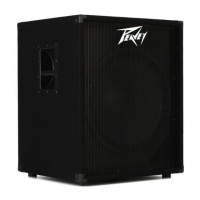
To touch up the painted surfaces of the DPE™ 118P Sub, you can use Peavey® Black Touch-Up paint (part # 00052110).
Never paint the enclosure or other parts while the unit is plugged in or turned on!
CHECK FOR SECURE HARDWARE
After the first few weeks of use and periodically thereafter, check the hardware of the DPE
™
2P-4P for tightness, including
the rear panel screws and the screws that hold the baffle and rear cabinet together. The unit is subject to a great deal of
vibration, and this could cause them to loosen with use.
ARCHITECTURAL AND ENGINEERING SPECIFICATIONS
The powered loudspeaker system shall have a frequency response from 60 Hz to 18 kHz. The peak SPL with inaudible
distortion shall reach 131 dB with music as a source, when measured at a distance of 1M and driven to full output capacity.
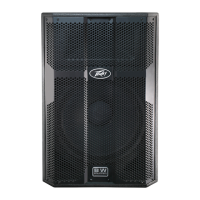
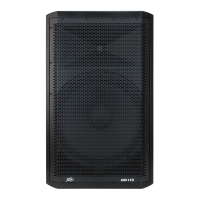
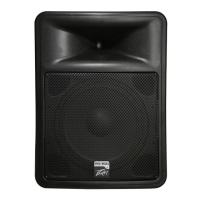
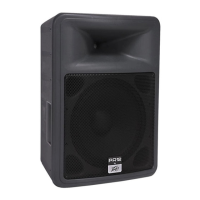
The system shall utilize a Peavey
®
15" Black Widow
®
BWX woofer and a Peavey RX
™
22CT true compression driver tweeter.
The nominal radiation pattern shall be 100˚ in the horizontal plane, and 50˚ in the vertical plane. Axis of the vertical main
polar lobe is angled down 10 degrees, resulting in the angular vertical pattern with respect to straight ahead being +15, -35
degrees.
The powered, bi-amplified loudspeaker system shall have two input channels capable of being mixed together with
independent level controls. On the rear panel, it shall have a group of medium impedance input connectors. For one
channel, these connectors will consist of a combo female XLR and 1/4" TRS phone jack. For the other channel, the
connectors will consist of two RCA phono jacks and a combo female XLR and 1/4" TRS phone jack.
The combo female XLR and 1/4" TRS phone jack of each channel will have a gain adjust pad that provides 30 dB of gain
adjust and provides for switching between line-level input signals and mic-level input signals.
The input section shall have a push button activated, and DSP-controlled EQ system that provides for various combinations
of nominally flat frequency response, response filtered at the frequency extremes, response with dynamic boost of just the
high frequencies, and response with dynamic boost at the low and high frequencies (Fletcher-Munson style compensation).
There shall be a group of line out connectors consisting of a male XLR jack, and a 1/4" TRS phone jack.


 To Next Page
 Loading...