EasyManua.ls Logo

Peavey TKO 65 - Gain Section and Tone Charts; Gain Section Operation; Input Jack Functions; Tone Charts for Techniques

Peavey TKO 65
4 pages
Print Icon
To Next Page IconTo Next Page
To Previous Page IconTo Previous Page
Loading...
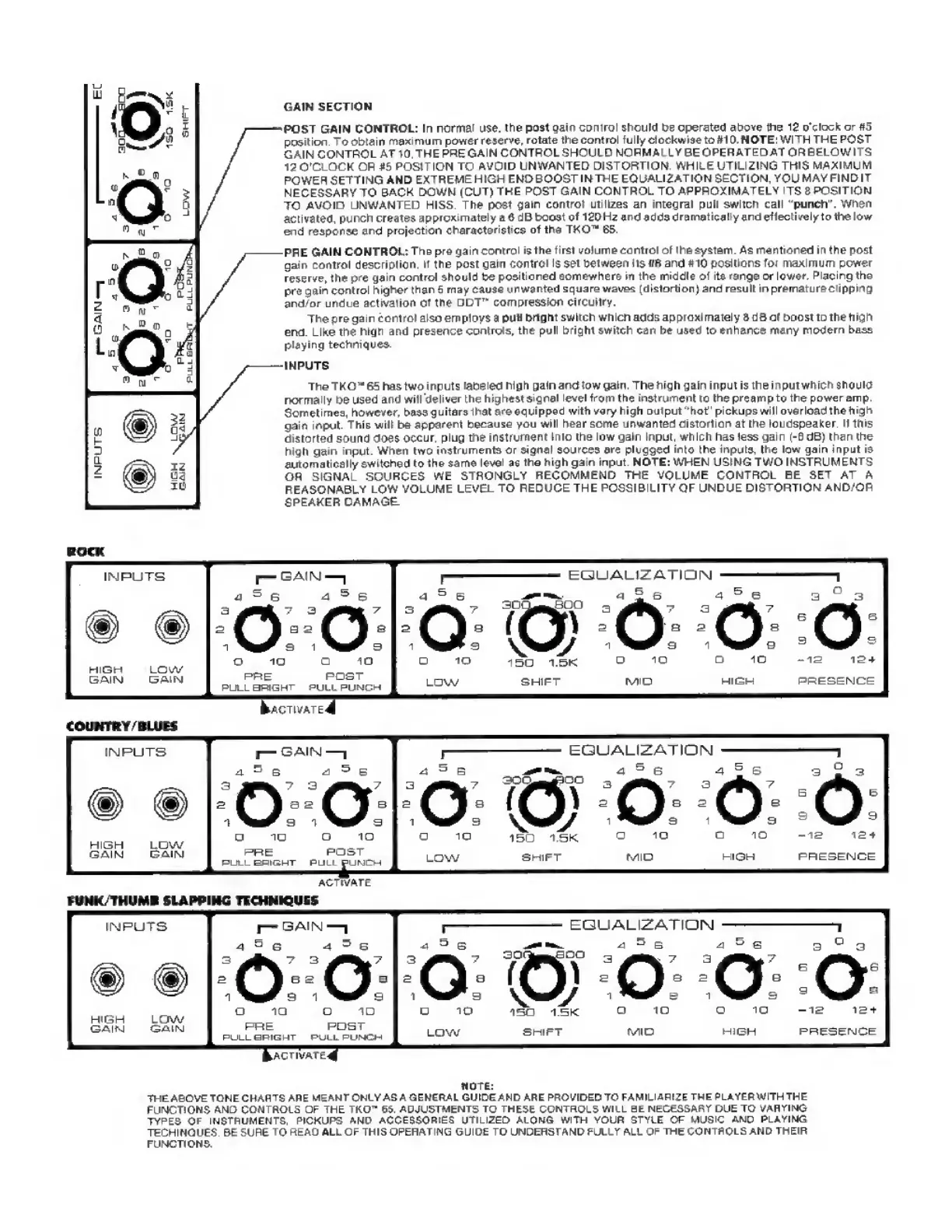
GAIN
SECTION
POST
GAIN
CONTROL:
In
normal
use,
the
post
gain
control
should
be
operated
above
the
12
o'clock
or
#5
position.
To
obtain
maximum
power
reserve,
rotate
the
control
fully
clockwise
to
#10.
NOTE:
WITH
THE
POST
GAIN
CONTROL
AT
10,
THE PRE
GAIN
CONTROL
SHOULD
NORMALLY
BE
OPERATED
AT
ORBELOWITS
12
O'CLOCK
OR
#5
POSITION
TO
AVOID
UNWANTED
DISTORTION.
WHILE
UTILIZING
THIS
MAXIMUM
POWER
SETTING
AND
EXTREME
HIGH
END
BOOST
IN
THE
EQUALIZATION
SECTION,
YOU
MAY
FIND
IT
NECESSARY
TO
BACK
DOWN
(CUT)
THE
POST
GAIN
CONTROL
TO
APPROXIMATELY
ITS
8
POSITION
TO
AVOID
UNWANTED
HISS.
The
post
gain
control
utilizes
an
integral
pull
switch
call
“punch”.
When
activated,
punch
creates
approximately
a
6
dB
boost
of
120Hz
and
adds
dramatically
and
effectively
to
the low
end
response
and
projection
charactoristics
of
the
TKO™
65,
PRE
GAIN
CONTROL:
The
pre
gain
control
is
the
first
volume
control
of
the
system.
As
mentioned
in
the
post
gain
control
description,
if
the
post
gain
control
is
set
between
its
#8
and
#10
positions
for
maximum
power
reserve,
the
pre
gain
control
should
be
positioned
somewhere
in
the
middle
of
its
range
or
lower.
Placing
tho
pra
gain
control
higher
than
5
may
cause
unwanted
square
waves
(distortion)
and
result
in
premature
clipping
and/or
undue
activation
of
the
DDT"
compression
circuitry.
The
pre
gain
Control
also
employs
a
pull
bright
switch
which
adds
approximately
8
d8
of
boost
tothe
high
ena.
Like
the
high
and
presence
controls,
the
pull
bright
switch
can
be
used
to
enhance
many
modern
bass
playing
techniques.
INPUTS
‘The
TKO"
65
has two
inputs
labeled
high
gain
and
low
gain.
The
high
gain
input
is
the
inputwhicn
should
normally
be
used
and
will
deliver
the
highest
signal
level
from
the
instrument
to
the
preamp
to
the
power
amp.
‘Sometimes,
however,
bass
guitars
that
are
equipped
with
very
high
output
“hot
pickups
will
overload
the
high
gain
input.
This
will
be
apparent
because
you
will
hear
some
unwanted
cistortian
at
the
loudspeaker.
If
this,
distorted
sound
does
occur,
plug
the
instrument
into
the
low
gain
input,
which
has
less
gain
(-8
dB)
then
the
high
gain
input.
When
two
instruments
or
signal
sources
are
plugged
into
the
inputs,
the
low
gain
input
is
‘automatically
switched
to
the
same
level
as
the
high
gain
input.
NOTE:
WHEN
USING
TWO
INSTRUMENTS,
OR
SIGNAL
SOURCES
WE
STRONGLY
RECOMMEND
THE
VOLUME
CONTROL
BE
SET
AT
A
REASONABLY
LOW
VOLUME
LEVEL
TO
REDUCE
THE
POSSIBILITY
OF
UNDUE
DISTORTION
AND/OR
SPEAKER
DAMAGE.
INPUTS
GAINS]
EQUALIZATION
——
aS6
a56
0-0:
o
10
4124
HIGH
Low
GAN
GAIN
PRE
past
PULL
BRIGHT
PULL
PUNCH
PRESENCE
COUNTRY/BLUES
INPUTS
r
—
EGUALIZATION
——
Ss
ee
n
a56
48s
Ong
7
S
3
7
3
7
wA
20):
eC).
s
J
s
s
FUNK/THUMB
SLAPPING
TECHNIQUES
INPUTS
SAIN]
EGUALIZATION
—————4
aSe6
456
z>
a
5
De
ò
s
a
Tog
3
73
7
agi
no
a
r 3
7
6 e
2
ee
8 2
ae
a
4
21
s
A
1
s
a
s
s
o
10
w0
o
wo
me
o
10
o
124
PRE
PosT
PULLERIGHT
PULL
PUNCH
Mio
HIGH
PRESEN
NOTE:
‘THE
ABOVE
TONE
CHARTS
ARE
MEANT
ONLY
AS
A
GENERAL
GUIDE
AND
ARE
PROVIDED
TO
FAMILIARIZE
THE
PLAYER
WITHTHE
FUNCTIONS
AND
CONTROLS
OF
THE
TKO™
65.
ADJUSTMENTS
TO
THESE
CONTHOLS
WILL
BE
NECESSARY
DUE
TO
VARYING
TYPES
OF
INSTRUMENTS,
PICKUPS
AND
ACCESSORIES
UTILIZED
ALONG
WITH
YOUR
STYLE
OF
MUSIC
AND
PLAYING
TECHINQUES.
BE
SURE
TO
READ
ALL
OF
THIS
OPERATING
GUIDE
TO
UNDERSTAND
FULLY
ALL
OF
THE
CONTROLS
AND
THEIR
FUNCTIONS.