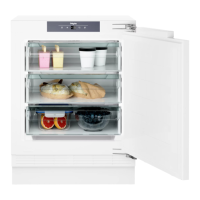
This document provides instructions for use of Pelgrim built-in freezers, specifically models PVS24088L, PVS24102N, and PVS24140N. The freezer is designed for freezing fresh food and long-term storage of frozen food for up to one year.
Important Notes and Precautions
Before connecting the appliance to the power mains, users must read the instructions carefully. The manual covers several appliance types/models, so some described settings or equipment may not be available on all units. It is recommended to save the manual for future reference. The manual also includes information for NO FROST versions, which feature a fan and automatic defrosting.
Users should check for any damage upon receipt and notify the retailer if found. Before connecting to power, the appliance should rest in a vertical position for at least 2 hours to prevent operational faults in the cooling system due to transport.
Important Safety Instructions
The appliance must be connected to the power mains and grounded according to effective standards and regulations. Multiple portable socket-outlets or power supplies should not be located at the rear of the appliance. Before cleaning, the appliance must be unplugged. If the supply cord is damaged, it must be replaced by the manufacturer, its service agent, or similarly qualified persons to avoid hazards. When positioning the appliance, ensure the supply cord is not trapped or damaged. If LED lighting fails, a service technician should be called; users should not attempt repairs due to high voltage risk.
No electric devices should be used inside the appliance unless approved by the manufacturer. Mechanical devices or other means to accelerate defrosting, other than those recommended by the manufacturer, should not be used. To ensure stability, the appliance must be installed as instructed.
Danger of frostbite: Never put frozen food directly in the mouth and avoid touching it to prevent frostnip or frostbite.
Safety of children and vulnerable persons: The appliance is not intended for use by persons (including children) with reduced physical, sensory, or mental capabilities, or lack of experience and knowledge, unless supervised or instructed by a responsible person. Children should be supervised to ensure they do not play with the appliance. Cleaning and user maintenance should not be performed by children without supervision. Packaging materials should be kept out of reach of children due to injury or suffocation risk. When disposing of a used appliance, disconnect the power cord, remove the door, and leave shelves inside to prevent children from getting trapped.
For European markets only: Children aged 8 years and above, and persons with reduced physical, sensory, or mental capabilities or lack of experience and knowledge, can use the appliance if supervised and instructed on safe use and understanding of hazards. Children must not play with the appliance. Children aged 3 to 8 years are allowed to load and unload refrigerating appliances.
Warning regarding the refrigerant: The appliance contains a small amount of environmentally friendly, flammable gas R600a. Ensure no parts of the cooling system are damaged. A gas leak is not environmentally hazardous but can cause eye injury or fire. In case of a gas leak, ventilate the room thoroughly, disconnect the appliance from power, and call a service technician.
This appliance is intended for household and similar applications, including staff kitchen areas, farmhouses, hotels, motels, bed and breakfast environments, and catering. Ventilation openings in the appliance enclosure or built-in structure must be kept clear of obstruction. The appliance should not be used outdoors or exposed to rain. Explosive substances like aerosol cans with flammable propellants should not be stored in the appliance.
If the appliance will be out of use for an extended period, switch it off, unplug it, empty, defrost, clean, and leave the door ajar. In case of a defect or power cut, do not open the freezer compartment if the appliance has been out of operation for less than the "temperature rise time" indicated on the type plate. After this time, frozen food must be used or properly cooled.
A rating plate inside the appliance provides technical data such as voltage, gross and net volume, refrigerant type and amount, and climate classes.
Environment Protection: Packaging materials are recyclable. To dispose of an obsolete appliance, take it to an authorized collection center after disconnecting it from power and ensuring children cannot play with it. Do not damage the refrigerant circuit. The product should not be treated as normal household waste but taken to an authorized collection center for waste electrical and electronic equipment.
Advice for Saving Energy with Refrigeration Appliances
To save energy:
- Install the appliance as specified in the manual.
- Do not open the door more often than necessary.
- Ensure unobstructed air circulation underneath the appliance.
- Replace damaged gaskets promptly.
- Store food in tightly sealed containers or appropriate packaging.
- Remove some drawers to utilize the entire freezer compartment volume.
- Defrost conventional freezers when a 3-5 mm layer of frost or ice builds up.
- Lower temperature settings increase energy consumption.
Installation and Connection
Selecting the Room: Install in a dry, well-ventilated room. The appliance operates correctly within the environment temperature range specified by its climate class (SN, N, ST, T). The climate class is on the rating plate. Do not place the appliance where temperatures can drop below 5 °C, as this may cause abnormal operation. The mains plug should be accessible after installation. A minimum of 1 m³ of space per 8 grams of refrigerant is required. For integrated appliances, there must be at least 200 cm² free space at the base of the kitchen unit for air circulation. The upper part of the appliance should not have its air outflow opening covered. For side-by-side built-in installations, a dew prevention kit must be purchased and installed by an authorized service technician.
Connecting the Appliance: Connect to power mains using a grounded wall outlet. Nominal voltage and frequency are on the rating plate. The appliance must be grounded according to standards and regulations and can withstand short-term voltage deviations of +/- 6%.
Changing the Door Opening Direction and Integrating into a Cabinet: Instructions for changing door opening direction and integrating the appliance into a cabinet are provided on a separate sheet.
Appliance Description
NoFrost appliance:
- Control unit
- LED lighting
- NO FROST freezing unit
- Drawers for freezing and storage
- Storage compartment
The best location for freezing fresh food is indicated by a checkmark.
Conventional appliance:
- Control unit
- Drawers for freezing and storage
The best location for freezing fresh food is indicated by a checkmark.
Operating the Appliance
A Temperature setting and on/off knob: Used to switch the appliance on/off, set temperature, and control the ECO function.
B Display of the set temperature
Switching the Appliance On/Off:
- Switching on: Rotate the A dial clockwise.
- Switching off: Rotate the A dial counter-clockwise until aligned with the symbol (appliance remains powered).
Adjusting the Temperature in the Appliance:
- After switching on, it may take several hours to reach the set temperature. Do not place food inside until the temperature drops.
- Rotate the A dial clockwise to set the desired temperature.
- The recommended setting is the ECO position.
- Ambient temperature affects appliance temperature; adjust the A dial accordingly. Positions towards '-' mean cooler, '+' mean warmer.
- If ambient temperature is below 16 °C, set temperature lower than -18 °C.
Intensive Freezing:
Recommended before cleaning or 24 hours before inserting large amounts of food to ensure faster cooling/freezing, retaining nutrients and flavor.
- Switching on: Rotate the A dial to position '*'.
- When active, the B display shows 'FF'.
- The appliance operates at maximum power, which may be louder.
- After the cycle, rotate the A dial back to the desired setting.
- If not manually deactivated, it deactivates automatically after approximately two days, returning to the most recently set temperature.
High-Temperature Alarm
A signal is given when the appliance temperature is too high. The set temperature on the display and LED lighting (if present) will flash.
Causes of high temperature:
- Door opened too long or too frequently.
- Door not sealing properly.
- Too much fresh food added at once.
The alarm is disabled for the first 24 hours after switching on to prevent unnecessary activation while the appliance reaches temperature. If the temperature remains too high, flashing continues when the door is open.
Open Door Alarm
If the door is open for more than 1 minute, "do" appears on display B. The alarm is canceled by closing the door. If the door is open for more than 10 minutes, the alarm turns off automatically, and the set temperature reappears, but the appliance continues to operate with the set values.
Appliance Interior Equipment
Ice tray: Fill with water and place horizontally in the freezer to make ice.
Storing and Freezing Food
Recommended Distribution:
- Top section: Leftovers, ice, pizza.
- Middle section: Meat, fish, bread.
- Bottom section: Standard freezer items, vegetables, fruit.
Do not store lettuce, eggs, apples, pears, grapes, peaches, yogurt, buttermilk, sour cream, or mayonnaise in the freezer.
Avoid Contamination of Food:
- Opening the door for long periods significantly increases compartment temperature.
- If the appliance is left empty for long periods, switch off, defrost, clean, dry, and leave the door open to prevent mold.
Freezing and Storing Foods in the Freezer:
Important recommendations for freezing fresh food:
- Do not exceed the maximum quantity of food stated on the type plate for freezing at once, as this slows freezing and reduces quality of both new and stored food.
- Use only good-quality fresh food suitable for freezing.
- Allow hot food to cool to room temperature.
- Freeze food quickly, preferably in small packs.
- Use airtight and watertight packaging to prevent drying out and vitamin loss.
- Label packaging with food type, quantity, and freezing date.
- Do not allow fresh food to contact frozen food.
- Drawers can be removed to use the total freezer volume, placing food directly on shelves and the freezer base.
Freezing smaller quantities of fresh food (1-2 kg): Refer to the "Appliance description" chapter for the best location.
Freezing large quantities of fresh food: Activate the intensive freezing function 24 hours before freezing. Distribute fresh food equally among drawers. After 24 hours, food can be moved to another compartment, and a new batch can be frozen.
Important recommendations for storing frozen food:
- Follow manufacturer's instructions and recommended storage temperature/use-by date on packaging.
- Use only food in undamaged packaging stored at -18 °C or lower.
- Avoid buying food covered in frost, indicating thawing and inferior quality.
- Ensure food does not thaw during transport to maintain storage life and quality.
Recommended storage times of frozen food (****):
- Fruit, beef: 10 to 12 months
- Vegetables, veal, poultry: 8 to 10 months
- Venison: 6 to 8 months
- Pork: 4 to 6 months
- Finely chopped or minced meat: 4 months
- Bread, pastas, cooked dishes, whitefish: 3 months
- Offal: 2 months
- Smoked sausage, bluefish: 1 month
Thawing Frozen Food
- Thawing is important and must be done correctly.
- Suitable thawing methods: in the refrigerator, in cold water, or in a microwave/conventional oven with a thaw program.
- Some frozen products can be prepared without thawing first (check packaging).
- Pack food in small portions for faster thawing.
- Use partially or completely thawed food as quickly as possible, as bacteria reactivate and food spoils rapidly, especially fruit, vegetables, and ready-made food.
- Do not refreeze partially or completely thawed food.
Defrosting the Appliance
Defrosting a Conventional Freezer:
- Defrost when a 3-5 mm layer of frost or ice builds up.
- 24 hours before defrosting, activate intensive freezing to cool food further.
- After this period, remove food and protect it from defrosting.
- Switch off the appliance and unplug the power cord.
- Do not use defrosting sprays, which can melt plastic parts or harm health.
- Do not use knives or sharp objects to remove frost, as this can damage cooling system pipes.
- Clean and dry the interior.
Defrosting a No Frost Freezer:
- NO FROST freezers defrost automatically. Occasional frost on walls disappears automatically.
- Ice/frost buildup can occur due to abnormal use (frequent/long door openings, improper door closure). In such cases, unplug the appliance, remove food, clean and dry the interior. Switch on and select desired setting before returning frozen food.
Cleaning the Appliance
Before cleaning, unplug the appliance.
- Use a soft cloth for all surfaces. Avoid abrasive cleaners, acids, or solvents, which can damage surfaces.
- Clean the exterior with water or a mild soap solution. Lacquer-coated and aluminum surfaces can be cleaned with lukewarm water and mild detergent. Low-alcohol cleaners (e.g., window cleaners) are allowed, but avoid alcohol-containing cleaners for plastic materials.
- The interior can be cleaned with lukewarm water and some vinegar.
- Do not wash interior equipment parts in a dishwasher, as they may be damaged.
- After cleaning, switch the appliance back on and insert food.
Troubleshooting
Problem: Appliance connected to power but not working.
- Cause/remedy: Check voltage in power outlet and ensure appliance is switched on.
Problem: Cooling system operates continuously for a long time.
- Cause/remedy:
- Too high ambient temperature.
- Door opened too frequently or too long.
- Door not closed correctly (impurities on seal, misaligned door, damaged seal).
- Too much fresh food inserted at once.
- Insufficient compressor/condenser cooling; check air circulation behind appliance and clean condenser.
Problem: Temperature display and/or LED lighting flashing.
- Cause/remedy:
- Door opened too long or too frequently. Close door properly. If flashing continues after two hours, call service center.
- Door not sealing properly (dirty, misaligned, or damaged seal).
- Too much fresh food inserted at once.
Problem: Build-up of ice or frost in freezer interior.
- Cause/remedy:
- Freezer compartment not defrosted periodically (for conventional freezers). Defrost to remove ice.
- Door not properly closed.
- Door not sealing properly (dirty, misaligned, or damaged seal).
Problem: Door is difficult to open.
- Cause/remedy: If opened immediately after closing, negative pressure can make it difficult. This normalizes after a few minutes.
Problem: LED lighting not working.
- Cause/remedy: Call a service technician. Do not attempt repair due to high voltage risk.
Problem: Appliance makes a noise.
- Cause/remedy:
- Cooling system with compressor (and fan in some models) makes noise. Noise level depends on installation, correct use, and age.
- Initial noise after connecting to power may be louder due to compressor/refrigerant flow; this is normal and will decrease.
- Appliance may be temporarily noisier after door opened too long/frequently, large quantity of fresh food added, or intensive freezing function activated.
If problems persist, call an authorized service center and provide the type, model, and serial number from the rating plate. The manufacturer reserves the right to make changes that do not affect appliance functionality.



 To Next Page

 General