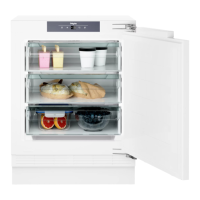
This document provides instructions for the Pelgrim built-in upright freezer models PVS5178N and PVS25178N.
Function Description
The Pelgrim built-in upright freezer is designed for household use, specifically for freezing fresh food and for long-term storage of frozen food, up to one year depending on the food type. Some models feature a NO FROST system with a fan for automatic defrosting.
Important Technical Specifications
- Models: PVS5178N, PVS25178N
- Refrigerant: The appliance contains a small amount of environmentally friendly yet flammable gas R600a. The amount of refrigerant is indicated on the rating plate inside the appliance.
- Climate Classes: The appliance is designed to operate correctly within specific ambient temperature ranges, indicated by its climate class on the rating plate:
- SN (subnormal): +10 °C to +32 °C
- N (normal): +16 °C to +32 °C
- ST (subtropical): +16 °C to +38 °C
- T (tropical): +16 °C to +43 °C
- Relative humidity should be less than 75%.
- Power Connection: The appliance must be connected to a grounded power mains in compliance with effective standards and regulations. Nominal voltage and frequency are indicated on the rating plate. It can withstand short-term voltage deviations of +/- 6%.
- Installation Requirements:
- Install in a dry, well-ventilated room.
- Ensure at least 1 m³ of space per 8 grams of refrigerant.
- For integrated appliances, there must be at least 200 cm² free space at the base of the kitchen unit for adequate air circulation.
- The opening for outflow air on the upper part of the appliance should not be covered.
- If installing built-in appliances side-by-side, a dew prevention installation kit (to be installed by an authorized service technician) is required.
- Maximum Freezing Capacity: The maximum quantity of food that can be frozen at once is stated on the type plate.
Usage Features
Control Unit:
The control unit allows for appliance on/off, temperature settings, and extra function activation.
- A Key: Used for appliance on/off, temperature settings, and activating extra functions.
- B Temperature Display: Shows the selected temperature.
- C Intensive Freezing Function Indicator: Lights up when intensive freezing is active.
- D High Temperature Indicator: Lights up to signal high temperature.
Switching On/Off:
- Switching On: Press and hold the A key for 3 seconds.
- Switching Off: Press and hold the A key for 3 seconds. The appliance will be off but still connected to the power mains.
Adjusting Temperature:
- The factory default temperature is -18 °C.
- To adjust, press the A key repeatedly until the desired temperature indicator (-24, -22, -20, -18, -16 °C) lights up.
- The selected setting will flash and then be stored automatically after three seconds, with the relevant symbol continuously lit.
- Do not place food in the appliance until the selected temperature has been reached (several hours after switching on).
Intensive Freezing Function:
- This function rapidly decreases the freezer compartment temperature.
- Activation: Press the A key several times until symbol C lights up. Activate 24 hours before freezing large quantities of fresh food.
- Deactivation: Press the A key to select the desired temperature B.
- Automatic Deactivation: If not manually disabled, the function automatically switches off after about two days, returning to the last set temperature.
- Power Failure: If a power failure occurs while active, the function reactivates upon power restoration.
- Note: When active, the appliance operates at maximum capacity and may be noisier. Adjusting the temperature while intensive freezing is active will immediately disable the function.
Open Door Alarm:
- An alarm sounds if the door is open for too long.
- Stopping the Alarm: Close the door. The alarm will stop sounding. Touching the A key only temporarily silences the alarm if the door remains open.
High Temperature Alarm:
- A signal sounds and symbol D flashes if the temperature in the appliance is too high.
- Causes: Door open too long/frequently, improper door seal, too much fresh food added.
- Stopping the Alarm: Touch the A key. The alarm will stop sounding, but symbol D will continue to flash until the temperature normalizes.
- Note: The alarm is disabled for the first 24 hours after switching on to allow the appliance to reach the correct temperature. If not manually stopped and the temperature remains high, the signal will sound for the first minutes of every half hour and when the door is opened.
Appliance Interior Equipment:
- Ice Tray: Fill with water and place horizontally in the freezer to make ice.
- Drawers: Can be removed to utilize the total volume of the freezer compartment, allowing food to be placed directly on shelves and the freezer base.
Storing and Freezing Food:
- Recommended Distribution:
- Top section: leftovers, ice, pizza.
- Middle section: meat, fish, bread.
- Bottom section: standard freezer, vegetables, and fruit.
- Food Not Suitable for Freezing: Lettuce, eggs, apples, pears, grapes, peaches, yoghurt, buttermilk, sour cream, or mayonnaise.
- Freezing Fresh Food:
- Use only good-quality fresh food.
- Allow hot food to cool to room temperature.
- Freeze quickly, preferably in small, air and watertight packs.
- Label packs with food type, quantity, and freezing date.
- Do not allow fresh food to contact frozen food.
- Activate intensive freezing 24 hours before freezing large quantities.
- Distribute fresh food evenly among drawers.
- After 24 hours, food can be moved, and a new batch can be frozen.
- Storing Frozen Food:
- Follow manufacturer's instructions and use-by dates on packaging.
- Store food in undamaged packaging at -18 °C or lower.
- Avoid food covered in frost, indicating previous thawing.
- Prevent thawing during transport to maintain quality and storage life.
- **Recommended Storage Times (at **):
- Fruit, beef: 10 to 12 months
- Vegetables, veal, poultry: 8 to 10 months
- Venison: 6 to 8 months
- Pork: 4 to 6 months
- Finely chopped or minced meat: 4 months
- Bread, pastas, cooked dishes, whitefish: 3 months
- Offal: 2 months
- Smoked sausage, bluefish: 1 month
- Thawing Frozen Food:
- Thaw food correctly using methods such as in the refrigerator, in cold water, or in a microwave/conventional oven with a suitable thaw program.
- Some products can be prepared without thawing (check packaging).
- Pack food in small portions for faster thawing.
- Use partially or completely thawed food quickly, as bacteria reactivate.
- Do not refreeze partially or completely thawed food.
Maintenance Features
Defrosting:
- NO FROST Freezer: Defrosts automatically. Occasional frost on walls will disappear on its own.
- Excessive Ice/Frost Build-up: If caused by abnormal use (frequent/long door openings, improper door closure), unplug the appliance, remove food, clean and dry the interior. Switch on and select desired setting before returning frozen food.
Cleaning:
- Before Cleaning: Unplug the appliance from the power mains and switch it off.
- Exterior: Clean all surfaces with a soft cloth and water or a mild solution of suds. Lacquer-coated and aluminum surfaces can be cleaned with lukewarm water and mild detergent. Cleaners with low alcohol content (e.g., window cleaners) are allowed, but avoid cleaners containing alcohol for plastic materials.
- Interior: Clean with lukewarm water and some vinegar.
- Parts: Do not wash interior equipment parts in a dishwasher as they may be damaged.
- After Cleaning: Switch the appliance back on and reinsert food.
Troubleshooting:
- Appliance not working: Check power outlet voltage and ensure the appliance is switched on.
- Continuous cooling system operation: Could be due to high ambient temperature, frequent/long door openings, improperly closed door (impurities on seal, misaligned/damaged seal), too much fresh food, or insufficient compressor/condenser cooling (check air circulation and clean condenser).
- Ice/frost build-up: Caused by frequent/long door openings, improper door closure (dirty/misaligned/damaged seal).
- Indicator D flashes: Indicates high temperature due to frequent/long door openings, improperly closed door, extended power failure, or too much fresh food.
- Difficult to open door: After closing, cool air escapes and is replaced by warm air, creating negative pressure. This normalizes after a few minutes.
- LED lighting not working: Call a service technician. Do not attempt self-repair due to high voltage risk.
General Warnings:
- Risk of fire/flammable materials.
- Do not locate multiple portable socket-outlets or power supplies at the rear.
- If the supply cord is damaged, it must be replaced by the manufacturer or service agent.
- Ensure the supply cord is not trapped or damaged when positioning.
- Do not use electric devices inside the appliance unless allowed by the manufacturer.
- Do not use mechanical devices or other means to accelerate defrosting other than those recommended by the manufacturer.
- Ensure stable installation.
- Never put frozen food in your mouth or touch it to avoid frostnip/frostbite.
- Keep packaging out of reach of children.
- When removing a used appliance, disconnect power, remove the door, and leave shelves in to prevent children from locking themselves in.
- Keep ventilation openings clear of obstruction.
- Do not use outdoors or expose to rain.
- Do not store explosive substances.
- If out of use for an extended period, switch off, unplug, empty, defrost, clean, and leave the door ajar.
- In case of defect or power cut, do not open the freezer compartment unless the appliance has been off for longer than the temperature rise time indicated on the type plate.
Energy Saving Advice:
- Install as per instructions.
- Do not open the door more often than necessary.
- Ensure unobstructed air circulation underneath the appliance.
- Replace damaged gaskets promptly.
- Store food in tightly sealed containers or appropriate packaging.
- Remove some drawers to utilize the entire freezer volume.
- Do not block fan slots or vents.
- Setting a lower temperature increases energy consumption.



 To Next Page
 General