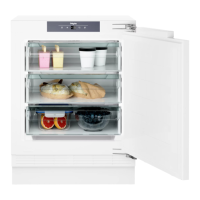
This document provides instructions for use of Pelgrim freezers, specifically models PVS25178N, PVS35178N, PVD25178N, and PVD35178N. These freezers are designed for simple operation and optimum comfort.
Function Description
The Pelgrim freezer is a household appliance intended for freezing and storing food. It features a NoFrost freezer unit, eliminating the need for manual defrosting. The appliance includes a control panel for adjusting temperature and activating special functions, LED lighting for interior illumination, and freezer drawers for organized storage. It also includes an ice cube tray for making ice.
Important Technical Specifications
- Climate Class: The appliance's permitted ambient temperature range depends on its climate class, indicated on the type plate.
- Extended temperate (SN): +10 to +32 °C
- Temperate (N): +16 to +32 °C
- Subtropical (ST): +16 to +38 °C
- Tropical (T): +16 to +43 °C
- Relative Humidity: The appliance is designed for environments with a relative humidity of <75%.
- Refrigerant: Contains isobutene (R600a), a natural and flammable gas with high environmental compatibility.
- Insulation: The insulation foam contains flammable gas and the refrigerant circuit and insulation materials are ozone friendly.
- Electrical Connection: The appliance requires an earthed connection to the power supply. The nominal voltage and frequency are specified on the type plate. It can withstand mains voltage variations of up to ±6%.
- Room Volume: The room where the appliance is placed must have a volume of at least 1 m³ of air for every 8 grams of refrigerant.
- LED Lighting: The product contains a light source of energy efficiency class .
Usage Features
Control Panel:
The control panel features a single key (A) for appliance on/off, temperature settings, and extra functions. It includes a temperature display (B) with indicators for selected temperature, an intensive freezing function indicator (C), and a high temperature indicator (D).
Switching On/Off:
- Switching On: Press and hold key A for 3 seconds.
- Switching Off: Press and hold key A for 3 seconds. The appliance will be off but remains connected to the power mains.
Temperature Adjustment:
- The recommended factory default temperature is -18 °C.
- Press key A successively to cycle through temperature settings (-24, -22, -20, -18, -16 °C). The selected temperature indicator will light up.
- Settings flash while being adjusted and are stored automatically after 3 seconds of inactivity.
- If the ambient temperature is below 16 °C, a temperature lower than -18 °C is recommended.
- After switching on, allow several hours for the appliance to reach the set temperature before loading food.
Intensive Freezing (FastFreeze):
- This function rapidly decreases the freezer compartment temperature.
- Activation: Press key A until symbol C lights up. Activate 24 hours before freezing large quantities of fresh food.
- Deactivation: Press key A to select the desired temperature B, or it will automatically deactivate after approximately two days.
- The appliance operates at maximum capacity during intensive freezing, which may result in increased noise.
- If a power failure occurs, the function will reactivate upon power restoration.
Alarms:
- Open Door Alarm: Sounds if the door is open for too long. Close the door to stop the alarm.
- High Temperature Alarm: Sounds if the temperature in the appliance is too high, and symbol D flashes. This can be caused by prolonged/frequent door opening, improper door sealing, or loading too much fresh food.
- Switching Off: Touch key A to stop the alarm. Symbol D will continue to flash until the temperature normalizes.
- The alarm is disabled for the first 24 hours after switching on to allow the appliance to reach the correct temperature.
- If not manually stopped and the temperature remains high, the signal will sound for the first minutes of every half hour and when the refrigerator door is opened.
Food Storage and Freezing:
- Recommended Distribution: The best location for freezing fresh food is marked with a checkmark.
- Avoid Contamination: Do not store lettuce, eggs, apples, pears, grapes, peaches, yoghurt, buttermilk, sour cream, or mayonnaise in the freezer.
- Freezing Fresh Food:
- Use only good-quality fresh food suitable for freezing.
- Allow hot food to cool to room temperature before freezing.
- Freeze food quickly in small, airtight, and watertight packs.
- Label packaging with food type, quantity, and freezing date.
- Do not allow fresh food to contact frozen food.
- For large quantities, activate intensive freezing 24 hours prior. Distribute food evenly among drawers.
- Drawers can be removed to utilize the total freezer volume, placing food directly on shelves and the freezer base.
- Storing Frozen Food:
- Follow manufacturer's instructions and use-by dates on packaging.
- Store food at -18 °C or lower in undamaged packaging.
- Avoid buying food covered in frost, as this indicates thawing and refreezing.
- Prevent thawing during transport to preserve quality and storage life.
- Recommended Storage Times (****):
- Fruit, beef: 10 to 12 months
- Vegetables, veal, poultry: 8 to 10 months
- Venison: 6 to 8 months
- Pork: 4 to 6 months
- Finely chopped or minced meat: 4 months
- Bread, pastas, cooked dishes, whitefish: 3 months
- Offal: 2 months
- Smoked sausage, bluefish: 1 month
Thawing Frozen Food:
- Thaw food in the refrigerator, in cold water, or in a microwave/conventional oven with a suitable thaw program.
- Some products can be prepared from frozen (check packaging).
- Pack food in small portions for faster thawing.
- Use thawed food as quickly as possible, especially fruit, vegetables, and ready-made meals, as bacteria reactivate rapidly.
- Do not refreeze partially or completely thawed food.
Maintenance Features
Defrosting:
- NoFrost Freezer: Defrosts automatically.
- Manual Defrost (if needed): If ice forms due to unusual use (e.g., frequent/long door openings, poor door seal), switch off the appliance, remove and protect food, clean and dry the interior, then restart and set the temperature before returning food.
- Warnings:
- Do not use defrosting sprays as they may damage plastic parts or harm health.
- Do not use sharp objects (knives) to remove frost, as this may damage cooling system pipes.
Cleaning:
- Preparation: Switch off the appliance and remove the plug from the socket before cleaning.
- Interior Cleaning: Regularly clean with lukewarm water and a neutral cleaning agent or special refrigerator cleaner. Wipe with a soft cloth, then with clean water, and dry thoroughly.
- Warnings:
- Do not use abrasive cleaning agents, as they can damage surfaces.
- Do not put appliance parts in a dishwasher.
- Activate intensive freezing 24 hours before cleaning the freezer.
- Extended Storage: If not using the appliance for a long period, switch it off, disconnect from mains, empty, defrost, clean, and leave the door ajar to prevent mold.
Troubleshooting:
The manual provides a faults table to help diagnose common issues, such as the appliance not working, cooling continuously, excessive ice formation, flashing symbol D, difficulty opening the door, or LED lighting not working. For issues not resolved, contact the service center with the appliance's type, model, and serial number.
Environmental Aspects:
- The appliance is made from sustainable materials and should be disposed of responsibly at the end of its service life.
- Packaging materials (cardboard, polyethylene foil, CFC-free polystyrene) are recyclable and should be disposed of according to government regulations.
- The crossed-out wheeled bin symbol indicates that the appliance should not be disposed of with unsorted household waste but taken to a special municipal waste processing location or returned to a dealer.
- Separate disposal helps recover materials, save energy, and reduce environmental impact.



 To Next Page
 General