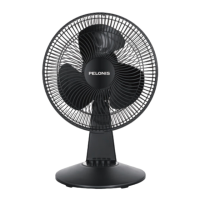
This document is a user manual for the Pelonis PFT30T3ABB Table Fan.
Function Description
The Pelonis PFT30T3ABB is a table fan designed for household use. Its primary function is to provide air circulation and cooling. The fan features side-to-side oscillation and manual tilt adjustment to direct airflow. It is equipped with a control panel for speed selection and an on/off function. The fan is designed for easy assembly and includes safety features such as a polarized plug and overload protection (fuse).
Important Technical Specifications
- Model: PFT30T3ABB
- Type: Table Fan
- Rated Voltage: 120V
- Rated Power: 30W
- Frequency: 60Hz
- Fuse Rating: 2.5 Amp, 125 Volt fuse (for overload protection)
Usage Features
The Pelonis PFT30T3ABB table fan offers several user-friendly features:
Control Panel:
The fan is operated via buttons on its base, providing three speed settings and an off switch:
- 0: OFF
- 1: Low Speed
- 2: Medium Speed
- 3: High Speed
Oscillation:
The fan includes a side-to-side oscillation feature. To activate or deactivate oscillation, there is a pull/push mechanism on the top of the motor housing:
- Pull to lock: Stops oscillation, fixing the fan in one direction.
- Push for movement: Enables side-to-side oscillation.
Tilt Adjustment:
The fan head can be manually tilted up or down to adjust the vertical angle of the airflow. This is done by adjusting the vertical knob on the side of the motor housing.
Base Installation:
The motor assembly is placed into the base, and a knob underneath the base is rotated to secure the motor assembly firmly.
Safety Features:
- Polarized Plug: The fan is equipped with a polarized plug (one blade wider than the other) to reduce the risk of electric shock. This plug is designed to fit into a polarized outlet only one way. Users are instructed to contact a qualified electrician if the plug does not fit.
- Overload Protection (Fuse): The product incorporates overload protection via a fuse located within the plug. If the fuse blows, it indicates an overload or short-circuit situation. The manual provides detailed instructions for replacing the fuse.
- Rotor Blade Guard: Once assembled, the rotor blade guard is not meant to be removed, ensuring user safety from moving blades.
Maintenance Features
Cleaning:
Regular cleaning is recommended to maintain the fan's performance and longevity.
- Unplug Before Cleaning: Always unplug the fan from the electrical supply source before cleaning to prevent electric shock.
- Plastic Parts: Plastic parts, including the fan enclosure and rotor blade guard, should be cleaned with mild soap and a damp cloth or sponge. It is important to thoroughly remove any soap film with clean water.
- Motor Protection: Ensure that water or other liquids do not enter inside the motor housing to prevent damage.
- Rotor Blade Guard: The rotor guard should not be disassembled or opened to clean the rotor blades. Instead, the fan enclosure and rotor blade guard should be wiped with a slightly damp cloth.
Fuse Replacement:
The manual provides detailed instructions for replacing the fuse in the event of an overload or short-circuit.
- Unplug the Fan: Disconnect the fan from the outlet.
- Open Fuse Cover: Slide open the fuse access cover located on top of the plug, towards the blades.
- Remove Old Fuse: Carefully remove the blown fuse using a tool to pry it out gradually.
- Insert New Fuse: Replace the fuse only with a 2.5 Amp, 125 Volt fuse. Ensure the new fuse is in the correct orientation.
- Close Fuse Cover: Slide the fuse access cover back to the closed position.
- Safety Warning: If the replacement fuse blows, a short-circuit may be present, and the product should be discarded or returned to an authorized service facility for examination and/or repair. The attachment plug, which contains the safety device (fuse), should not be replaced if damaged; the entire product should be discarded.
General Maintenance Advice:
- Stable Surface: Always operate the fan on a stable surface to prevent overturning.
- Cord Management: Do not run the cord under carpeting or cover it with throw rugs. Arrange the cord away from traffic areas to prevent tripping.
- Unattended Operation: Do not leave the fan running unattended.
- Children and Infirm Persons: Keep electrical appliances out of reach from children and infirm persons, and ensure they do not use the appliances without supervision.
- Damaged Cord: If the supply cord is damaged, it must be replaced by the manufacturer, its service agent, or a similarly qualified person to avoid hazards.
- Environmental Conditions: Do not operate the appliance in humid rooms such as bathrooms or laundry rooms.
- Grille Integrity: Never insert fingers, pencils, or any other object through the grille when the fan is running.
This comprehensive manual ensures users can safely and effectively operate and maintain their Pelonis PFT30T3ABB table fan.

 Need help?


 To Next Page
 General