
 Need help?
Do you have a question about the PENTA 30 Series and is the answer not in the manual?
Fields for recording mixer model, serial number, and dealer details.
Details about the serial number and its location on the mixer for service.
Form for documenting warranty registration and pre-delivery inspection by dealer and customer.
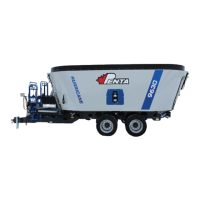
Overview of PENTA TMR Mixer components and features.
Details the applications and benefits of PENTA TMR mixers for livestock feeding.
General safety measures to be taken before operating or servicing the mixer.
Safety instructions specific to servicing the mixer, including PTO disconnection.
Key safety instructions and precautions for operating the PENTA TMR Mixer.
Specific safety points for road transport compliance and safe practices.
Explanation of how tire pressure affects service life and wear patterns.
Detailed list of checks to perform before operating the PENTA TMR Mixer.
Guidance on selecting the appropriate tractor size and power for the TMR mixer.
Procedure for safely coupling the mixer to the tractor's hitch system.
Instructions for connecting and maintaining hydraulic lines and ensuring system integrity.
Steps for safely disconnecting the mixer from the tractor's hitch.
Information and guidance on connecting the Power Take-Off (PTO) shaft.
Details on proper PTO shaft length, installation, and usage to prevent damage.
Checks for electrical connections and lights to ensure proper scale operation.
Information on the DIGI-STAR scale indicators, mounting, and power supply.
Guidance on calibrating, testing, and troubleshooting the weighing scale system.
Initial checks and procedures for the break-in period after first use.
Instructions on the order of adding ingredients and optimal mixing speeds for effective loading.
Procedures for operating the conveyor and discharge systems for unloading the mixer.
Maintenance and adjustment of the conveyor chain and operation.
Explanation of the dual side unloading conveyor operation.
Details on the operation of right/left flip-up discharge conveyors and their systems.
Pre-operation maintenance checks to ensure optimal mixer performance.
Procedure for running the mixer after initial checks to verify operation.
Post-operation checks required after the first half-hour of use.
Maintenance checks to be performed after 5 and 10 hours of operation.
Maintenance tasks for the 50-100 hour operating interval, including gearbox checks.
Guidelines for safely storing the mixer unit when not in use.
Detailed instructions for lubricating the planetary gearbox, including oil type and level checks.
Step-by-step procedure for refilling the planetary gearbox with oil, including important fitting details.
Identification of all points requiring regular greasing on the mixer and conveyor.
Specific grease points for the conveyor bearings and recommended greasing frequency.
Safety and maintenance guidelines for the PTO drive shaft, including guards and shear bolts.
Procedure for lubricating wheel bearings, including frequency and grease type.
Initial checks and monthly maintenance requirements for the mixer's brake system.
Torque values for Imperial size bolts and cap screws based on SAE grades.
Torque values for Metric size bolts and cap screws based on property classes.
Information on the placement, maintenance, and replacement of safety decals on the mixer.
Details regarding the importance of keeping safety decals clean and legible for operator awareness.
This document is the operator's manual for the PENTA 30 Series TMR Mixer, a piece of agricultural equipment designed for preparing Total Mixed Rations (TMR) for livestock.
The PENTA 30 Series TMR Mixer is a towable chassis-mounted machine powered by a PTO (Power Take-Off) and a 12V power supply. Its primary function is to cut, mix, and distribute various feed ingredients into a homogeneous Total Mixed Ration. This includes processing different forage types, commodities, and feed additives, such as powder, liquid, granular, silage, and baling materials/crops. The mixer is designed to offer flexibility in ration formulation and feeding, allowing for the inclusion of diverse forage types and storage methods at high levels, utilization of low-quality forages, and precise mixing for ration homogeneity, which helps in acidosis control. It also facilitates the addition of urea (NPN) and medications like ionophores to enhance cow efficiency and improve feed efficiency through properly balanced rations. The goal is to ensure every cow receives the same feed from start to finish.
The manual provides a table outlining the recommended horsepower for different mixer series:
The machine can weigh up to 10,000 kg (22,000 lbs) when loaded. Recommended auger speeds for mixing are 20-30 RPM, and for emptying, 30-40 RPM. The planetary gearbox uses 80/140 Full Synthetic GL5 Rating oil. Wheel nuts require a torque of 180 ft-lbs (244 N-m). Hitch bolts require a torque of 300 ft-lbs. Tire pressure recommendations vary by tire size:
The mixer incorporates augers, cutting knives, conveyors, weighing systems, hoppers, and gearing. The weighing system uses DIGI-STAR scale indicators (e.g., EZ2810 model), which are securely fastened to the mixer and can turn to face any direction. These scales can display weight in kilograms or pounds, as specified by the manufacturer. The mixer can be equipped with dual side unloading, allowing the conveyor to discharge on both sides. For right/left flip-up discharge models, a section of the conveyor can be raised and lowered using either a Lock Collar System (where stackable collars determine the drop height) or a Diverter Valve System (activated by a rope, allowing hydraulic control of conveyor height).
Loading procedures emphasize adding the heaviest materials last and materials requiring the shortest cut first. Hay typically goes in first, followed by balage, grains, minerals, and then corn silage, with wet materials placed on hay and balage to aid cutting. The mixer should be level during mixing. "Dog ears" (feed restrictors) are adjustable to hold hay closer to the knives for shorter cuts, though using them may increase the horsepower required to start and run the mixer when full. The conveyor speed can be adjusted via the tractor's flow control (recommended 5-10 gal/minute at 20 gal/min and 2500 PSI MAX).
The manual outlines a comprehensive maintenance schedule:
 General
| Brand | PENTA |
|---|---|
| Model | 30 Series |
| Category | Farm Equipment |
| Language | English |

 To Next Page
