Once
you
are
familiar with the functions
of
both
the check spring
and
the
thread
regulator,
you will be in a position to
perform
proper
adjustmetit
right
away,
without
first having to try
out
different
settings.
The check spring is correctly
set
if it
has
completed
taking up the
balance
of
the
thread
when
the
needle
stitches
into
the
material.
Since
the
amount,
of
travel
of
the
take-up
lever is
somewhat
lorger
with the PFAFF 433
than
is normal, it may be necessary to allow the
check
spring a larger amount
of
play
than
is
usual
so
that
it will
exert
still a slight pull on
the
thread
at
the time the
needle
reaches
the
goods.
26.
SelHng
fhe
Needle
Bar
at
Correct
Height
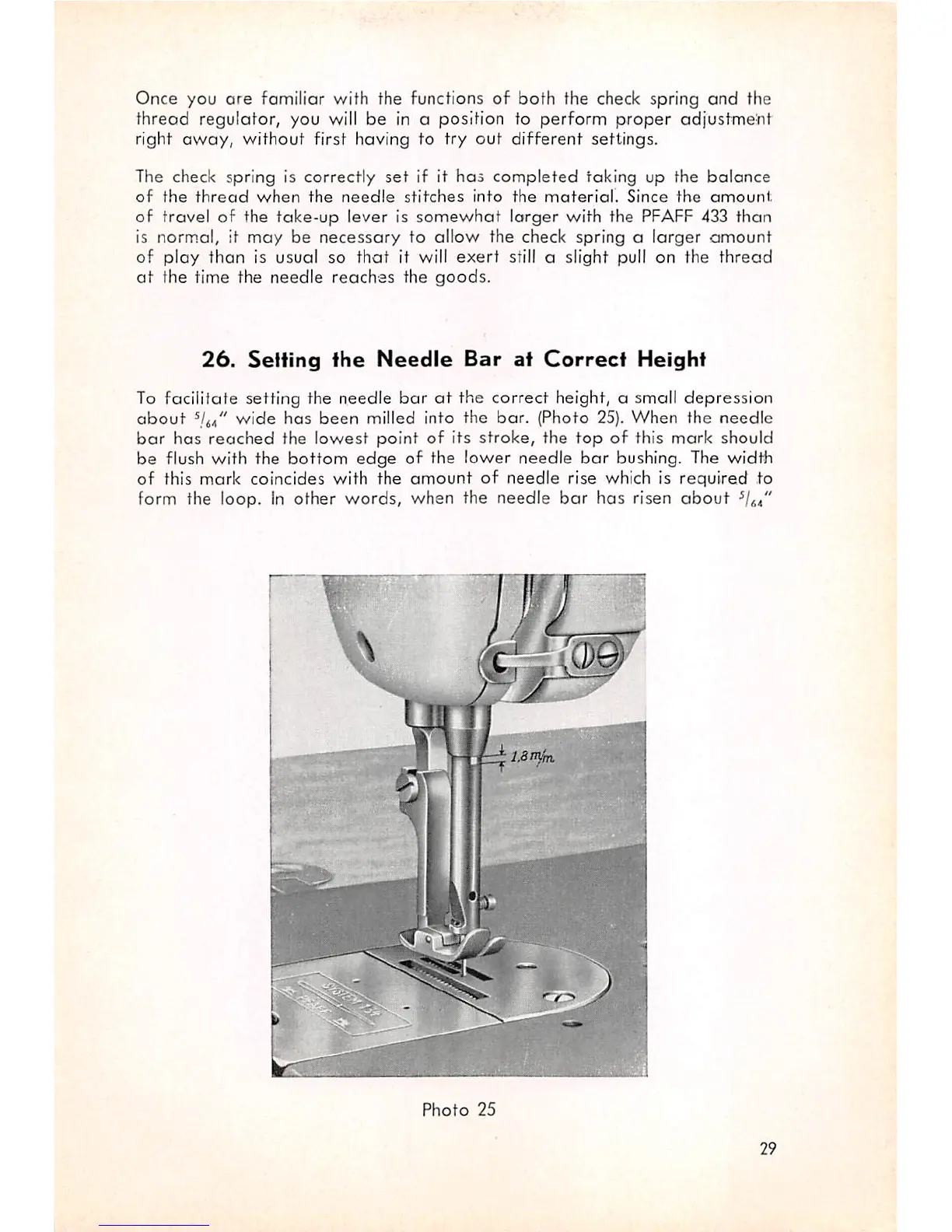
To facilitate setting the needle
bar
at
the correct height, a small depression
about
wide
has
been
milled into
the
bar.
(Photo
25).
When
the
needle
bar
has reached the lowest point of its stroke, the
top
of this mark should
be flush with the
bottom
edge
of the lower needle
bar
bushing. The widtti
of
this
mark
coincides
with
the
amount
of
needle
rise which is
required
to
form the loop. In
other
words,
when the
needle
bar
has
risen
about
^1^"
Photo
25
29


 To Next Page