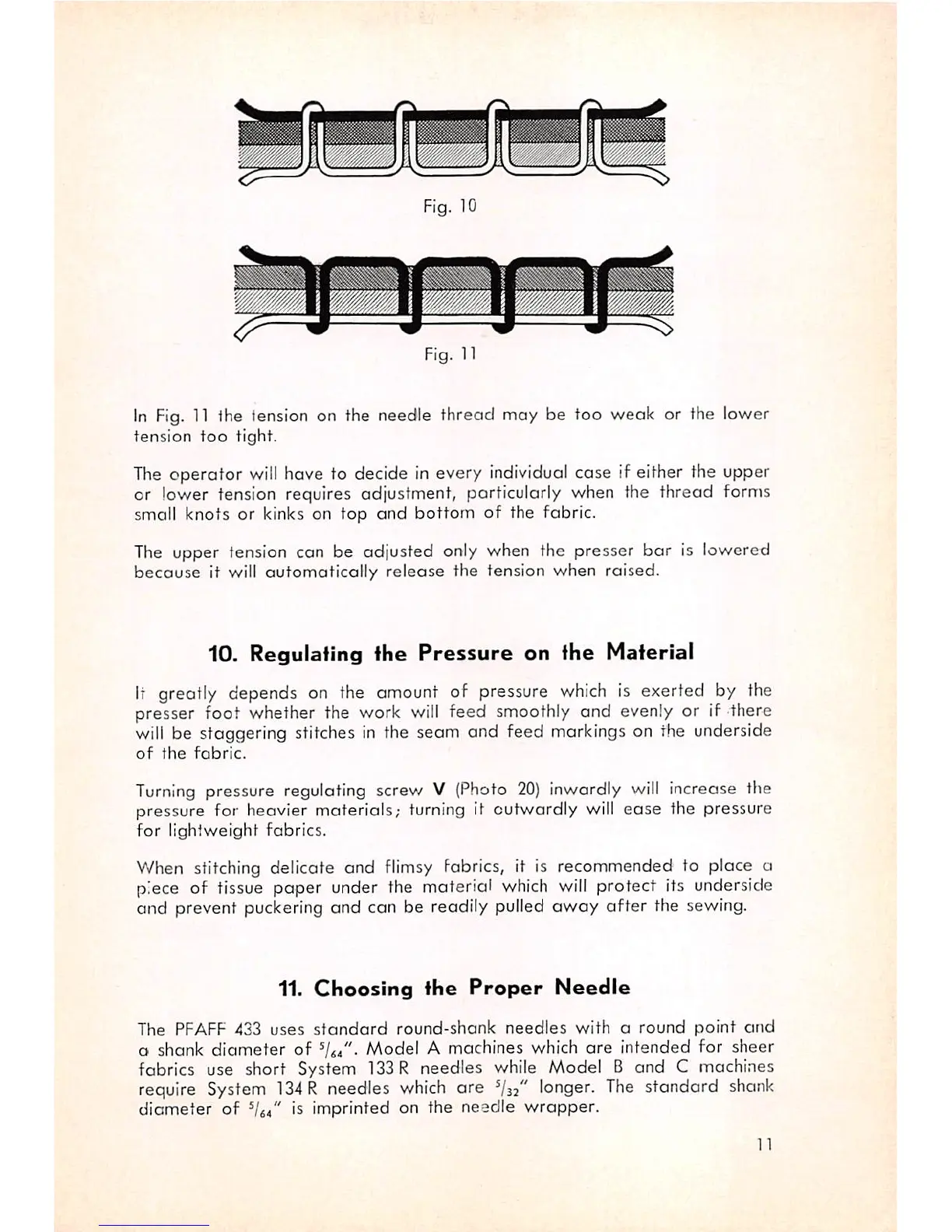
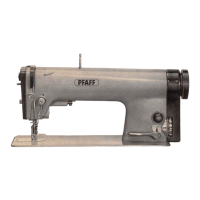
Fig. 10
Fig. 11
In
Fig.
11
Ihe
tension
on the needle thread may be too weak or the lower
tension
too
tight.
The operator
will
have to decide in every individual case if either the upper
or lower tension requires adjustment, porticularly when the thread fornts
small knots or kinks on top
and
bottom
of the fabric.
The upper tension can be adjusted only when the presser
bar
is lowered
because
it will
automatically
release
the tension
when
raised.
10. Regulating
the
Pressure
on the Material
it greatly depends on the amount of pressure
which
is exerted by the
presser foot whether the work
will
feed smoothly and evenly or if there
will
be staggering stitches in the seam and feed markings on ihe underside
of
the
fabric.
Turning
pressure regulating screw V
(Photo
20)
inwardly
will
increase tlie
pressure for heavier materials;
turning
it outwardly
will
ease the pressure
for lightweight fabrics.
When stitching delicate and
flimsy
fabrics, it is recommended to place a
piece of tissue paper under the material
which
will
protect its underside
and prevent puckering and can be readily pulled
away
after
the sewing.
11.
Choosing
the
Proper
Needle
The PFAFF 433
uses
standard
round-shank
needles
with
a
round
point
atid
o
shank
diameter
of
Model
A
machines
which
are
intended
for
sheer
fabrics use short System 133 R needles while Model B and C machines
require
System
134
R needles
which
are
longer.
The
standard
shank
diameter
of is imprinted on the needle
wrapper.
11


 To Next Page