Battery-Monitor BLS
REV 1A – APR 2019 - Software Version 1A page 5
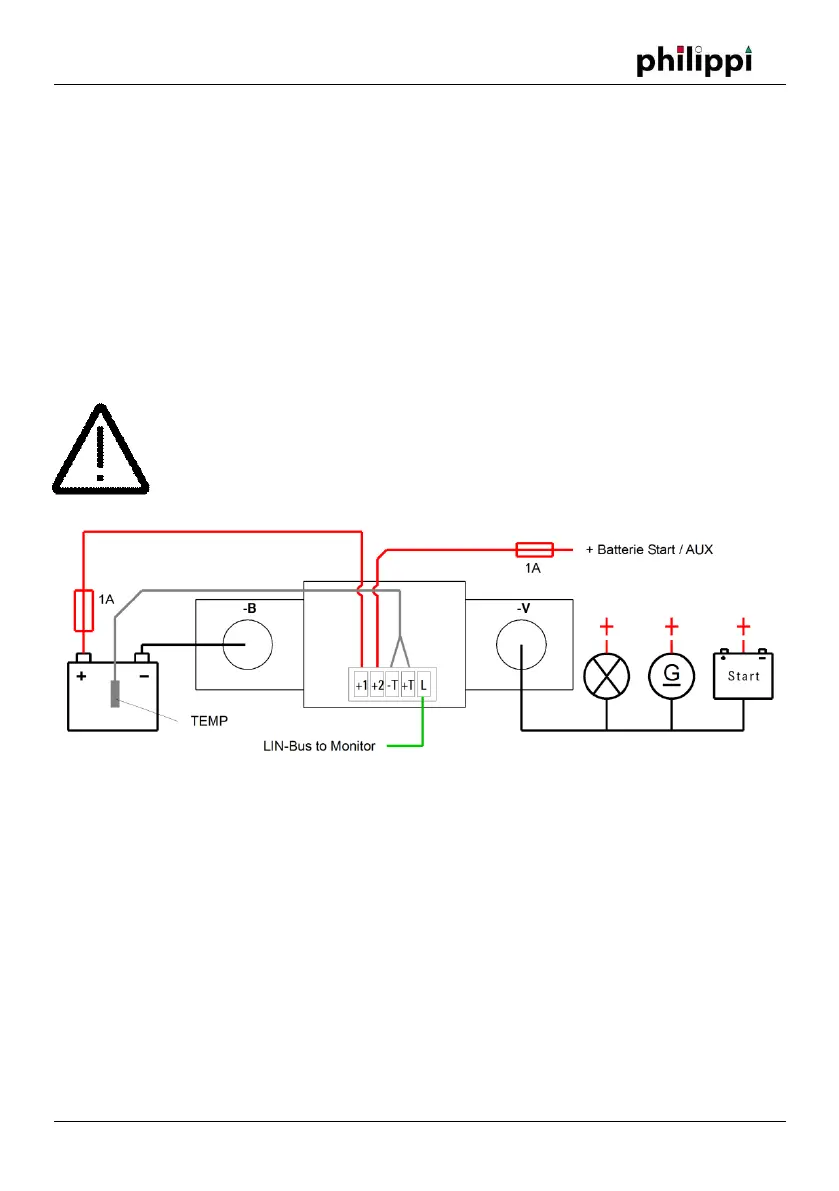
Install the active shunt SHE 300 as close as possible to the service battery. Avoid however, that the
shunt has contact with the plus connection of the batteries. Connect the B- marked side of the shunt
to the negative terminal of the main battery with a short, thick cable (35-70 mm²). Connect the
negative pole of the up to two starter batteries to the side of the shunt marked V-.
Note: If the main battery consists of several parallel-connected batteries, their negative poles must
all be connected to the B- marked side of the shunt. The minus cables of the starter batteries are
connected to the other side (V-) of the shunt. We recommend that all minus connections of the load,
charging devices and the negative poles of the starter batteries are combined on a ground bus and
from there a short line to the V-connection of the shunt. - Connect the measuring lead of the shunt
to the positive terminal of the main battery via an inline fuse holder (1A). This line is used to measure
the voltage of the main battery and at the same time to supply the shunt with power.
It is important that no further cables are connected between connection B and the
battery MINUS pole, since otherwise not all currents will be detected and the battery
management will not be able to work. All lines of the electrical system including the
connecting cable to the starter battery must be connected to the V side of the shunt
SHE 300.
After applying the operating voltage at pin +1, the shunt goes into operation and indicates the
operating status via the integrated LED:
- Fast flashing during firmware update of the Shunt SHE
- Flash every 1 sec. Normal operation
- Flash every 5 sec. Sleep Mode when monitor off
At the shunt following connections are at the 5 pol. Connector available:
1: Battery voltage measuring lead (+1) and simultaneously power supply for shunt
This cable is essential for the shunt function and should only be disconnected in winter storage in
order to allow a complete recording of the battery capacity. Due to the very low power consumption
in sleep mode, the shunt does not put any additional load on the battery.


 To Next Page