3-7
PHILIPS MEDICAL SYSTEMS
3
REMINDERS
• Remove any medicine patches and residual adhesive from the patient’s chest
before applying the pads.
• Do not allow the pads to contact other electrodes or metal parts that are
in contact with the patient.
• Avoid placing the pads directly over an implanted pacemaker or defibrillator.
A noticeable lump with a surgical scar should indicate the position of an
implanted device.
• If the pads do not stick well, check that the pads adhesive has not dried out.
Each pad has a layer of adhesive gel. If the gel is not sticky to the touch,
replace the pads with a new set.
• Keep the patient still and keep any movement around the patient to a
minimum during rhythm analysis. Do not touch the patient or the pads
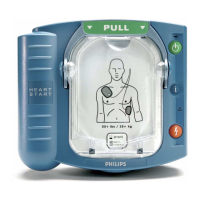
while the Caution light is on solid or flashing. If the OnSite is unable to
analyze due to electrical “noise” (artifact), it will tell you to stop all
movement and remind you not to touch the patient. If the artifact continues
for more than 30 seconds, the OnSite will pause briefly to allow you to deal
with the source of the noise, then resume analysis.
• The OnSite will not deliver a shock unless you press the flashing orange
Shock button. If you do not press the Shock button within 30 seconds after
the OnSite tells you to, it will disarm itself, and (for the first CPR interval)
give a reminder to make sure emergency medical services have been called,
then begin a CPR interval. This is designed to minimize interruption of CPR
and help ensure ongoing patient support.
• While waiting for you to press the Shock button, the OnSite will continue
to analyze the heart rhythm. If the patient’s rhythm changes before you
press the Shock button, and a shock is no longer needed, the defibrillator
will disarm and tell you a shock is not advised.
• If for any reason you want to turn off the defibrillator during a use, you can
press the On/Off button – holding it down for at least one second – to
return the device to standby mode.



 To Next Page