PHILIPS MEDICAL SYSTEMS
B-1
B
B GLOSSARY OF TERMS
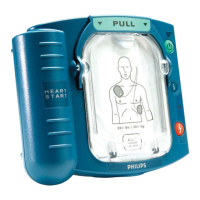
The terms listed in this Glossary are defined in the context of the Philips
HeartStart Defibrillator and its use.
AED Automated external defibrillator (a semi-automatic defibrillator).
AED mode The standard treatment mode for the HeartStart. It provides voice instructions
guiding the rescuer through applying the adhesive pads, waiting for rhythm analysis,
and delivering a shock if needed.
ALS Advanced Life Support.
analysis See “SMART analysis.”
arrhythmia An unhealthy, often irregular, beating of the heart.
artifact Electrical “noise” caused by sources such as muscle movements, CPR, patient
transport, or static electricity that may interfere with rhythm analysis.
battery The sealed lithium manganese dioxide battery used to power the HeartStart. It is
provided in a pack that fits into a compartment on the back of the defibrillator.
BLS Basic Life Support.
Caution light A triangular light on the front of the HeartStart that flashes during rhythm analysis
and is on solid when a shock is advised, as a reminder not to touch the patient.
configuration The settings for all operating options of the HeartStart, including treatment
protocol. The factory default configuration can be modified by authorized
personnel using HeartStart Event Review software.
CPR Cardiopulmonary resuscitation. A technique for providing artificial respiration and
heart compressions.
CPR Coaching Basic verbal instructions for performing cardiopulmonary resuscitation, including
hand placement, rescue breathing, compression depth and timing, provided by the
HeartStart when the flashing blue i-button is pressed during the first 30 seconds of
a patient care pause.
defibrillation Termination of cardiac fibrillation by applying electrical energy.
ECG Electrocardiogram, a record of the electrical rhythm of the heart as detected
through defibrillation pads.
fibrillation A disturbance of the normal heart rhythm that results in chaotic, disorganized
activity that cannot effectively pump blood. Ventricular fibrillation (fibrillation in
the lower chambers of the heart) is associated with sudden cardiac arrest.



 To Next Page