B-3
PHILIPS MEDICAL SYSTEMS
B
periodic self-tests Daily, weekly, and monthly tests automatically conducted by the HeartStart when
it is in its standby mode. The tests monitor many key functions and parameters of
the defibrillator, including battery capacity, pads cartridge readiness, and the state
of its internal circuitry.
practice kits Kits containing a reusable adult or infant/child practice pads cartridge and a pads
placement guide, designed for repeated use to practice correct placement of pads.
The defibrillator will chirp if the training cartridge remains installed for over one
hour without being used.
protocol A sequence of operations performed by the HeartStart to direct patient care in
the AED mode.
protocol pause A pause provided by the HeartStart after a shock series, during which the
responder can administer CPR. The defibrillator does not conduct background
monitoring of the patient’s heart rhythm during this pause.
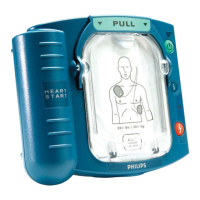
Ready light A green LED showing the readiness for use of the HeartStart. A blinking Ready
light means the defibrillator is ready for use; a solid Ready light means the
defibrillator is being used.
rhythm analysis See “SMART analysis.”
Shock button An orange button with a lightning bolt symbol on it, located on the front of the
HeartStart. The Shock button flashes when a shock is advised. You must press the
button for the shock to be delivered.
shockable rhythm A heart rhythm that the HeartStart determines is appropriate for defibrillation,
such as ventricular fibrillation and some ventricular tachycardias associated with
sudden cardiac arrest.
shock series interval A configurable interval between shocks, used by the HeartStart to decide if the
shocks are part of the same shock series.
SMART analysis The proprietary algorithm used by the HeartStart to analyze the patient’s heart
rhythm and determine whether the rhythm is shockable.
SMART biphasic
waveform
The patented, low-energy defibrillation shock waveform used by the HeartStart. It
is an impedance-compensated biphasic waveform. Used with the Adult SMART
Pads, it delivers 150 Joules, nominal, into a 50 ohm load; used with the Infant/Child
SMART Pads, it delivers 50 Joules, nominal, into a 50 ohm load.
SMART NSA pause See “NSA pause.”
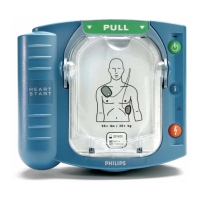
SMART Pads The adhesive pads, supplied in a cartridge, used with the HeartStart. Pulling the
handle on the cartridge turns on the defibrillator and opens the cartridge. The
pads are applied to the patient’s bare skin and used to detect the patient’s heart
rhythm and to transfer the defibrillation shock. Only HeartStart SMART Pads can
be used with the HeartStart.



 To Next Page