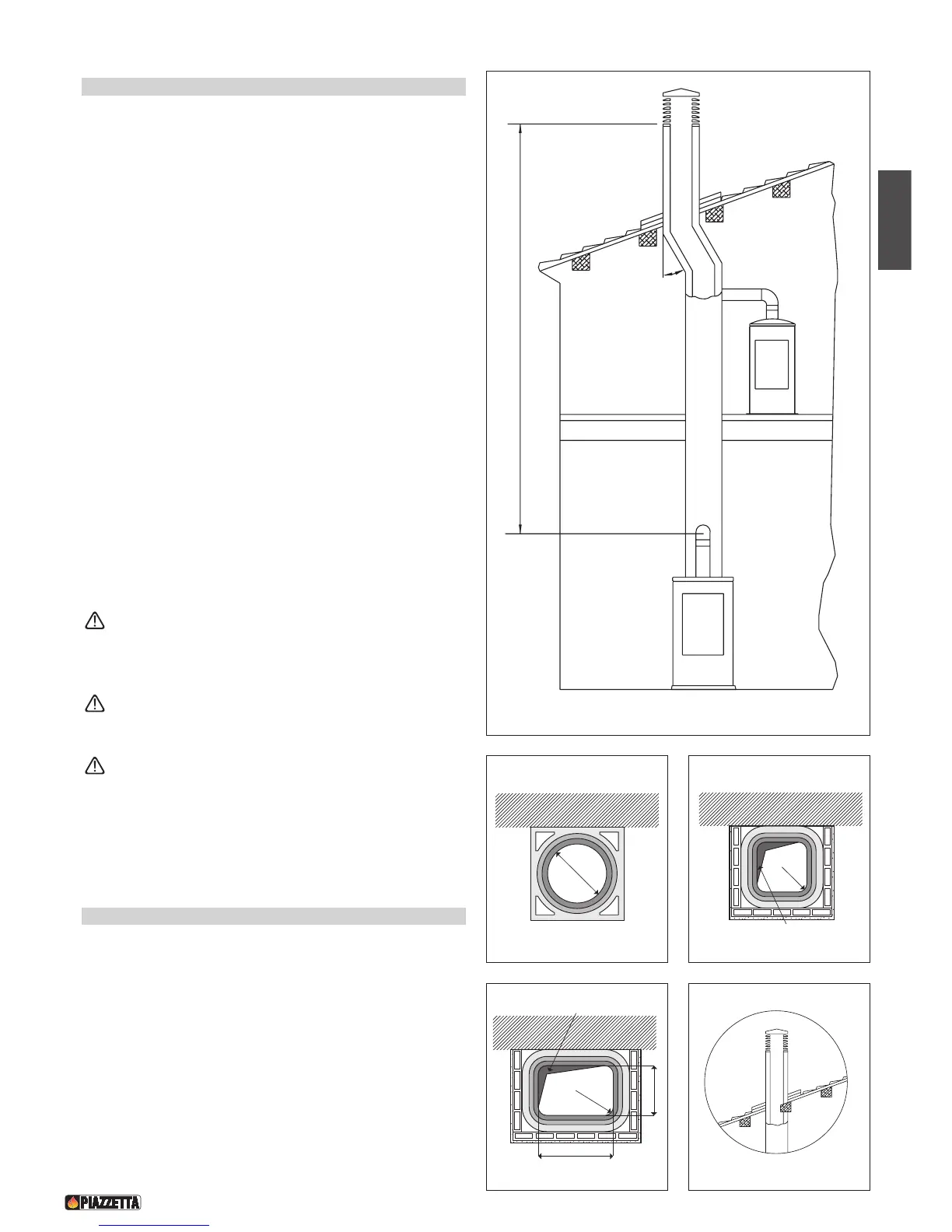
1.1 Single flueway or chimney - Fig. 2 - 6
Every appliance must have a vertical flue pipe operating by natural
draught to discharge the combustion gases outdoors.
The flue must:
- comply with regulations in force in the place of installation of the
appliance;
- be tight to the products of combustion, waterproof, suitably
insulated, made with materials resistant to the corrosion of the
gases and to stress;
- be connected to just one stove, fireplace or extraction hood;
- be properly sized, with constant free internal section, equal to or
greater than the diameter of the flue pipe of the stove and at least
3.5 m in length;
- be mainly in a vertical position with a deflection from the axis of
no more than 45° (Fig. 2);
- be at a suitable distance from combustible or flammable
materials, ensured by an air gap or suitable insulating material;
- be of uniform internal section, preferably round. Square or
rectangular sections must have rounded corners with a radius of
at least 20mm and a maximum ratio between the sides of 1.5
(Fig. 4). The walls must be smooth if possible and without
narrowing. Bends must be regular and without discontinuity (Fig.
3 - 4 - 5).
It is forbidden to make fixed or mobile apertures on the flue
pipe to connect appliances other than the one to which it is
already connected.
It is forbidden to pass other air ducts or service pipes inside
the flue pipe, however large it is.
If the flue pipe is an incorrect size or installed other than in
compliance with the above instructions, Gruppo Piazzetta
S.p.A. cannot be held liable for malfunctioning of the
product, damage to property or injury to persons or
animals.
1.2 Soot inspection Fig. 1
- The flue must have a chamber for collecting solid matter and any
condensate located below the connection and which may be
easily inspected by means of an airtight door. (Fig.1)
- The bends connecting to the flue must have inspection points
that allow the system to be checked, cleaned and maintained.


 To Next Page