
 Need help?
Do you have a question about the Pioneer DEH-P300 and is the answer not in the manual?
Essential safety precautions and warnings for handling the product and performing repairs.
Detailed diagrams showing component assembly and a list of all parts.
Electrical diagrams illustrating the circuit connections and component layout.
A comprehensive list of all electrical components used in the device.
Instructions for calibrating and adjusting the device's internal mechanisms.
Overview of general specifications, parts, and diagnostic modes.
Procedures for diagnosing issues and disassembling the unit for repair.
A high-level overview of the system's main blocks and their interconnections.
Details on user operations, device specifications, and performance characteristics.
Technical specifications for the CD player, amplifier, FM/AM tuner, and sub-woofer.
Layout of components and connections on the Tuner Amp Unit's PCB.
Component layout and connections for the Tuner Amp Unit's PCB, Side A.
Layout of components and connections on the FM/AM Tuner Unit's PCB.
Layout of components and connections on the Keyboard Unit's PCB.
Layout of components and connections on the Control Unit's PCB.
Layout of components and connections on the Photo Unit's PCB.
Details on entering and using the test mode for CD mechanism adjustments.
Step-by-step guide to check the grating angle using an oscilloscope and test mode.
Detailed pin assignments and functions for integrated circuits used in the system.
Pin details for the UPD63710GC integrated circuit.
Pin details for the PD6294A integrated circuit.
Pin details for the BA5985FM integrated circuit.
List of error codes, their classes, displayed messages, and potential causes.
Explanation of the new test mode for aging and troubleshooting, including shifting and key correspondence.
Mapping of keys to functions in the new test mode for Power Off and Power On operations.
Details on error causes and corresponding error codes detected during operation.
List of status numbers and their corresponding operational status during setup procedures.
Examples of how status and error information is displayed during test modes.
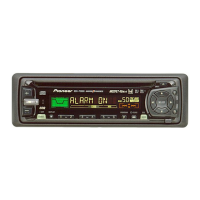
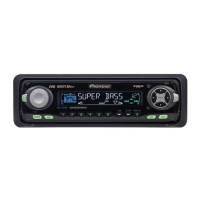
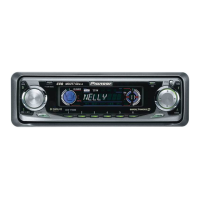
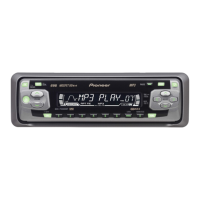
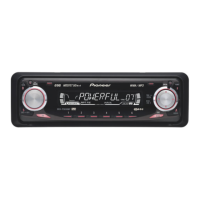
Identification of buttons and controls on the head unit for easy reference.
Instructions for selecting sources, adjusting volume, and basic playback operations.
Instructions for manual tuning, seek tuning, and preset station management.
Instructions for controlling multi-CD players, including track search and display switching.
Instructions for operating the internal CD player, including display switching and disc handling.
How to switch between different equalizer curve presets like NATURAL, VOCAL, and CUSTOM.
Steps to enter and navigate the Audio Menu for adjusting sound quality settings.
Adjusting the front/rear and left/right speaker balance for optimal sound distribution.
Adjusting specific EQ bands (Low, Mid, High) and their curve characteristics.
Adjusting center frequency and Q factor for each equalizer band (Low, Mid, High).
Enhancing low and high frequencies at low volumes by selecting Loudness levels.
Enabling or disabling the sub-woofer output and initial settings.
Adjusting the output level for the sub-woofer when it is enabled.
 General
| CD Playback | Yes |
|---|---|
| MP3 Playback | Yes |
| AAC Playback | No |
| Bluetooth | No |
| Preamp Voltage | 2 V |
| Number of Channels | 4 |
| AUX Input | Yes |
| High-Pass Filter | Yes |
| Low-Pass Filter | Yes |
| Tuner | AM/FM |
| DIN Size | 1 DIN |
| RMS Power Output | 22 W |




 To Next Page