Need help?
Do you have a question about the Pioneer SC-LX58-K and is the answer not in the manual?
Explains Pioneer's dedication to home theater audio quality and its three key steps.
Details the audio and video technologies and capabilities of the receiver.
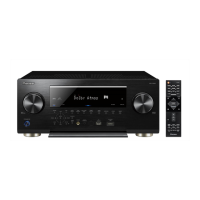
Lists the accessories supplied with the receiver.
Provides guidelines and precautions for physically installing the unit.
Instructions for inserting batteries into the remote control.
Describes the limitations and conditions for remote operation.
Explains the function of each button on the remote control.
Describes the meaning of various indicators shown on the receiver's display.
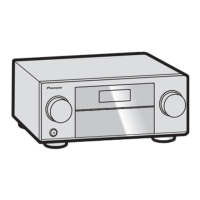
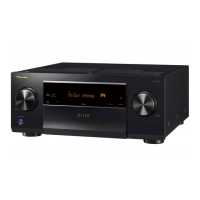
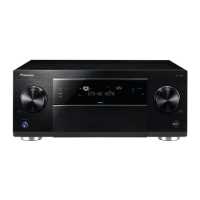
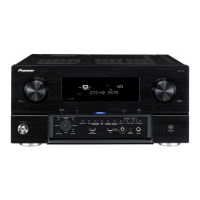
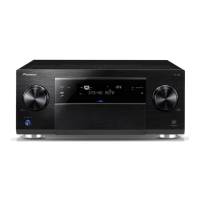
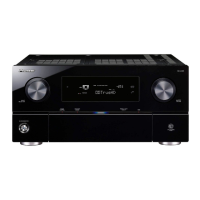
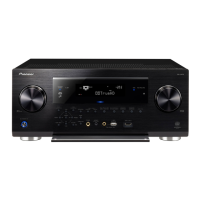
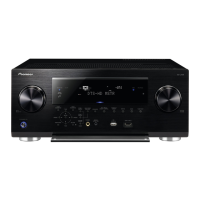
Identifies and explains the functions of the physical controls on the receiver.
Details the various input and output terminals on the back of the receiver.
Guides users on selecting speaker layouts and terminal assignments for optimal surround sound.
Explains how to connect audio sources and video signals, including converter usage.
Details how to connect devices using HDMI for high-quality audio and video transfer.
Covers connecting components like HDD/DVD recorders, satellite boxes, and other video sources.
Explains how to set up and use audio playback in multiple rooms (zones).
Guides on connecting the receiver to a network via LAN or wireless for internet features.
Explains how to connect and play content from iPod, USB devices, and MHL-compatible devices.
Describes connecting external IR receivers and using 12V triggers for component control.
Explains how to use the receiver's web-based setup and operation guide for initial configuration.
Guides on automated acoustic calibration for optimal sound field and speaker settings.
Details how to configure input assignments for connected devices to match remote control functions.
Explains selecting operating modes (Expert/Basic) and changing the display language.
Basic instructions for playing audio or video from connected components like DVD players or TVs.
How to play music and photos from iPod and USB devices using the receiver's controls.
Lists supported audio file formats for network and USB playback, including limitations.
Instructions for tuning and saving FM/AM radio stations, including RDS features.
Guides on connecting and playing music wirelessly via Bluetooth.
Describes different surround sound and playback modes available for various audio sources.
How to choose and manage sound tuning presets for different listening positions or sources.
Explains how phase control enhances audio reproduction by correcting phase distortion.
Overview of network capabilities like Internet radio, PC music playback, and DLNA devices.
Explains playing media files from network-connected DLNA devices and media servers.
Lists supported audio file formats for network playback, including gapless playback details.
Guides on configuring HDMI settings for synchronized control (KURO LINK) of connected components.
Details the Precision Quartz Lock System for jitter-free audio transfer when using HDMI.
Explains automatic audio/video optimization via HDMI for compressed content.
Adjusts various audio parameters like EQ, delay, and surround effects for playback optimization.
Configures picture quality settings such as resolution, noise reduction, and aspect ratio.
Manages speaker terminal outputs and HDMI signal settings, including 4K/60p output.
Explains how to manage audio playback and source selection in different zones (Zone 2, Zone 3, HDZONE).
Details functions for configuring the remote control, including mode changes and code learning.
Teaches how to teach the remote new commands from other component remotes.
Lists preset remote control codes for various AV components like TVs and DVD players.
Detailed automated sound tuning with advanced options for speaker and room acoustics.
Allows manual fine-tuning of speaker levels, distances, and room acoustics for optimal sound.
How to review and verify calibrated acoustic settings and speaker configurations.
Central menu for various system configurations including speaker, input, and network settings.
Detailed manual configuration of speaker parameters like size, distance, and crossover frequency.
Guides on connecting the receiver to a network and configuring IP addresses, proxy, and standby.
Access to various customized receiver settings like auto power down and volume limits.
Addresses common problems like power not turning on, no sound output, or intermittent audio.
Troubleshoots video display problems, no image output, and Bluetooth connectivity issues.
Solves problems related to HDMI connectivity, MHL device interaction, and AVNavigator.
Addresses issues with USB/iPod playback, network access, and wireless LAN connectivity.
Explains surround sound technologies like Dolby and DTS, and general HDMI information.
Details compatibility and features for various devices and wireless technologies.
Explains signal format compatibility and provides guidance on optimal speaker placement.
Defines technical terms and audio formats used throughout the manual.
Lists detailed technical specifications of the receiver's hardware and performance.
Provides remote control codes for various AV components for system control.
 General
| Channels | 9.2 |
|---|---|
| Network Connectivity | Ethernet, Wi-Fi |
| Dimensions (W x H x D) | 435 x 185 x 441 mm |
| Amplification Type | Class D3 |
| 4K Ultra HD Pass-through | Yes |
| HDCP Support | HDCP 2.2 |
| DTS:X | Yes (via firmware update) |
| MCACC Pro | Yes |
| AirPlay | Yes |
| DLNA Certified | Yes |
| Bluetooth | Yes |
| Phono Input | Yes |
| HDMI Inputs | 8 |
| HDMI Outputs | 2 |
| Audio Formats Supported | Dolby TrueHD, DTS-HD Master Audio |
| Multi-room Capability | Yes |
| Streaming Services | Spotify Connect |
| USB Input | Yes |
| Total Harmonic Distortion | 0.08% |
| Frequency Response | 5 Hz - 100 kHz |
| Supported Video Formats | 4K |

 To Next Page