No Diving or Jumping. Observe all Safety Rules.
2-3
Note:
If you want, the patio
stones around the round
ends of the pool may be
round instead of square,
or they can be left out
completely. The patio
stones in the trenches
under the buttresses
along the straight sides
must be used, even if
you don’t have them on
the round ends.
If you want, instead of
using patio stones you
can make use stabilizer.
Dig a 12" x 12" (30 x
30 cm) square hole 2"
(5cm)deepandllthe
hole with stabilizer.
9
13
12
11
10
87
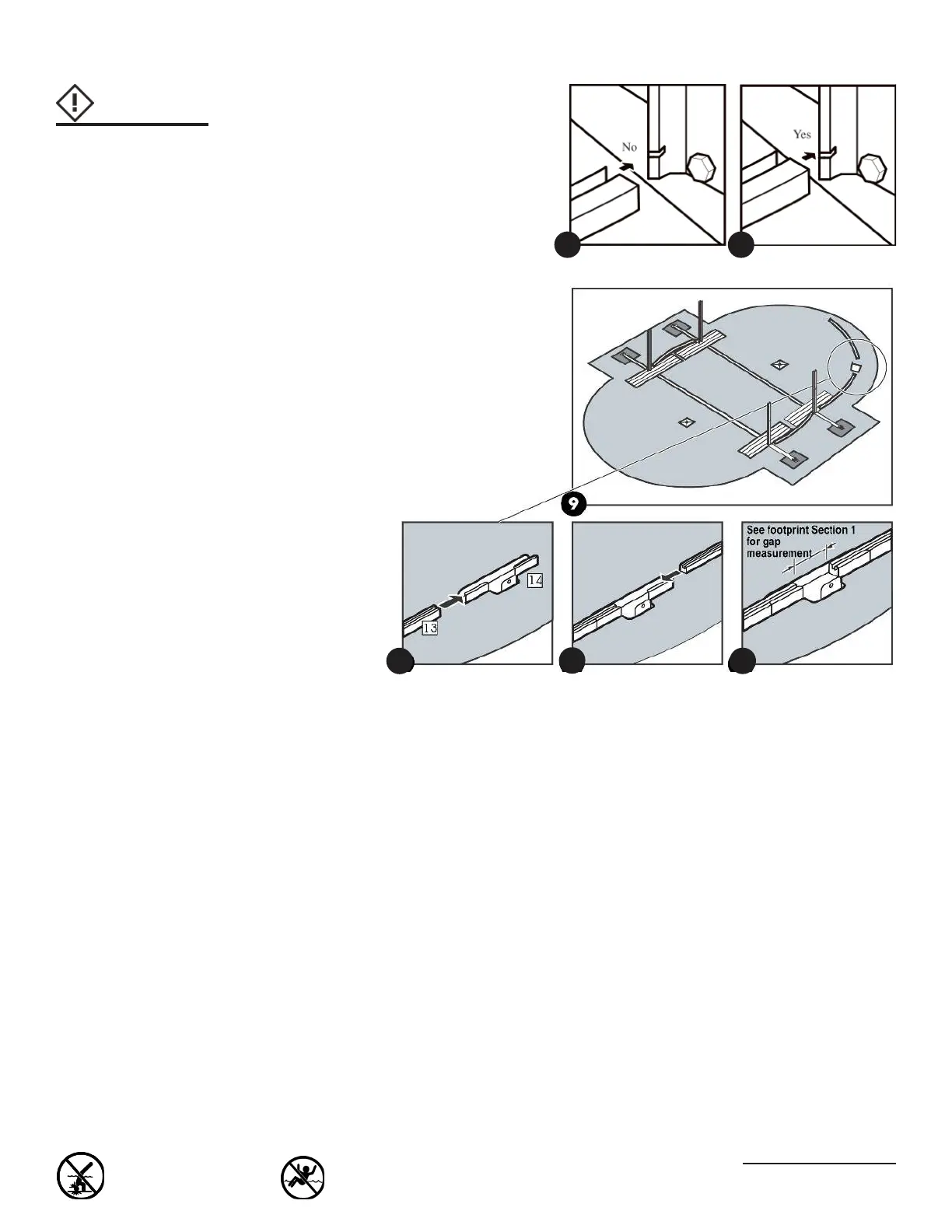
Important: make sure you slide the rail
into the notch so the closed, square
part of the rail is in the notch, not
the open groove part of the rail (see
diagrams 7 and 8).
e. Slide the other end of the transition
A rail together with a base plate (key
14).
f. If you have an 18 x 33 (5,49m x
10,05m) pool, insert the transition B
rails (if you have any other size pool,
skip to step (g). Leave a 1/2" (13mm)
gap between the ends of the rails (see
diagram 1 on page 2-1 for the 18 x 33
(5,49m x 10,05m) pool).
g. Lay out the
end rails and
base plates on
both rounds
ends of the
pool area.
Using a piece of string attached to the centre of stake (A), measure the distance to the
face of each base plate and make sure it is the same as dimension R (Note: this step
will not work on the buttress rails or transition rails.)
h. Insert the end rails. Leave a gap between the ends of the rails, see Section 1 footprint
for gap measurement..
i. Optional concrete patio stones may also be used under each base plate on the round
ends of your pool. Patio stones 12" (30 cm) square or larger will do. They must be
sunkintothegroundsothetopsareushwiththesoilaroundthem.Usethecarpen-
ter’s level to make sure the patio stones are perfectly sure the patio stones are per-
fectlylevelandushwiththeground.Usethecarpenter’slevelanda2-by-4between
patio stones to make sure the stones are level with each other.


 To Next Page
 Loading...