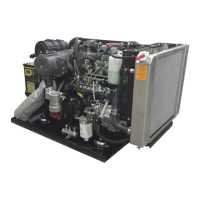
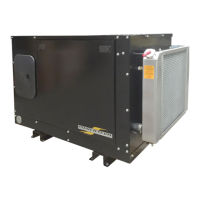
This document is an operator's manual for a Power Technology Southeast generator set, specifically model PTI-25-30-T4F. It provides comprehensive information for the safe operation and maintenance of the device.
The generator set is powered by an industrial Isuzu diesel engine and is part of Power Tech's Tier 4 Final Generator product line, engineered to high-quality standards for long, satisfactory service.
Function Description:
The Power Tech generator set is designed to provide electrical power. It features an exciter type generator with electronic voltage regulation (EVR) to maintain stable output voltage. The generator can be connected to deliver 120/240 volts to a 3-wire grounded neutral system. For three-phase connections, users are advised to contact Power Technology's Tech support.
Important Technical Specifications:
- Model: PTI-25-30-T4F
- Engine Make: Isuzu
- Engine Model: 4LE2X
- EPA Tier: Tier4 Final
- KWM @1800rpm: 49
- Oil type: SAE 10W-40 (API Class)
- Oil capacity: 8.4 qt (8L)
- Air Filter P/N: 04FA2768
- Primary Fuel Filter P/N: 08FF4LE-P
- Secondary Fuel Filter P/N: 08FF4LE-S
- Oil Filter P/N 15-20 KW: 01FO4LEX
- Coolant Capacity: 9.5 Qts (9L)
- Voltage Regulation: Electronic Voltage Regulator (EVR) maintains voltage accuracy at ±2% of the regulated voltage.
- Generator Output: Can deliver 120/240 volts.
Usage Features:
The generator is operated via a PTG Series Controller with an LCD display, which serves as the primary source of information.
- Controller Modes:
- OFF: Engine cannot be remotely started.
- Auto: Engine waits for a start command.
- Running: Controller monitors engine parameters and waits for a stop command.
- Failure: Engine shuts down, displays reason for failure, and requires reset via the OFF button (except for Modbus).
- Menu: Allows changing settings and viewing event history.
- Front Panel Items:
- Off Button: Turns off the engine or exits Auto mode. Not an emergency stop.
- Auto Button: Places controller into Auto mode.
- Run Button: Manually starts the engine. Requires Off button to shut down.
- Up/Down Buttons: Navigate menus, change settings, or scroll parameter pages.
- Enter Button: Enters menu, accepts settings, or locks/unlocks LCD screen.
- Generator LED: Indicates engine status (Green: running, no issues; Amber: running, warnings; Red: shutdown on failure).
- Menu System: Accessed by pressing Enter in OFF mode. Allows navigation, parameter scrolling, screen locking, and viewing event history (up to 150 events).
- Wet Stacking Prevention: Diesel engines operate most efficiently at 70-80% of rated output. Operating below 40% for prolonged periods can lead to "wet stacking" (over-fueling, carbonized injection tips). Load banks or high-load appliances can be used to prevent this. Newer common rail electronic fuel injected engines are less prone to wet stacking, but it remains a possibility.
Maintenance Features:
The manual outlines a detailed engine maintenance schedule.
- Daily Pre-Operational Checks:
- Engine oil level.
- Battery cable tightness and absence of corrosion.
- Coolant level.
- Absence of water in fuel.
- Absence of DTC (Diagnostic Trouble Codes) or failures.
- Absence of excessive fan belt looseness.
- Engine Maintenance Schedule (Intervals):
- Daily: Engine oil level, coolant level, fuel level, fuel leakage, water in fuel, damaged/worn/loose belts, abnormal engine noise, exhaust gas condition.
- 150 Hour Interval: Engine oil change (after first 50 hours, then every 150 hours), oil filter change.
- 500 Hour Interval: Primary fuel filter replacement, secondary fuel filter replacement, air filter replacement.
- 1000 Hour Interval: Coolant change.
- Two Year Intervals: Replace fuel lines/hoses.
- Once a Year/Two Year Intervals: Engine oil change, oil filter change, coolant change, primary fuel filter replacement, secondary fuel filter replacement, air filter replacement, radiator hoses and clamps.
- Engine Oil Maintenance:
- Maintain oil level between "ADD" and "Full" marks on the gauge. Overfilling can cause catastrophic engine damage.
- Use SAE 10W-40 (API Class CJ-4) lubricating oil. Viscosity recommendations vary based on ambient temperature (e.g., SAE 10W-30 for -30°C to 30°C, SAE 10W-40 for -30°C and greater, SAE 15W-40 for -15°C and greater).
- Coolant Recommendations:
- Recommended 1:1 mixture of water/glycol.
- Use mixtures providing protection against the lowest ambient temperature. 100% pure glycol freezes at -23°C (-9°F).
- Ethylene Glycol (50% protection: -36°C/-33°F, 106°C/223°F boil; 60% protection: -51°C/-60°F, 111°C/232°F boil).
- Propylene Glycol (50% protection: -29°C/-20°F, 106°C/223°F boil). Do not exceed 50% Propylene Glycol due to reduced heat transfer.
- Use heavy-duty coolant/antifreeze meeting ASTM D5345 (3000 service hours or two years) or ASTM D4985 (3000 service hours or one year). Do not use automotive light-duty coolants.
- Checking Radiator Coolant Level:
- Check after every 25 hours of operation when the engine is completely cooled. Fill to the bottom of the fill neck.
- Units have a low water shutdown switch; refill radiator/surge tank and clear failure if triggered.
- Cleaning Radiator/Charged Air Cooler Core:
- Visually inspect for obstructions. Use running water to clean between fins.
- Avoid hard objects to prevent damage.
- If equipped with a remote radiator, do not run water through the electric fan; remove the fan before cleaning.
- The charge air cooler requires cleaning only, no other maintenance.
- Safety Checks: Emphasizes observing safety instructions, wearing safety clothing, checking before operation, keeping the area clean, safe handling of fuel/lubricants, exhaust gas/fire prevention, escaping fluids, cautions against burns/battery explosion, keeping hands/body away from rotating parts, and proper disposal of fluids.
- Troubleshooting: A table provides common troubles, possible causes, and suggested actions (e.g., generator not starting, engine not cranking, engine cranks but doesn't start, engine starts but shuts down, genset not producing voltage). For other issues, contact dealers or visit www.powertechgenrators.com.
The manual also includes a service log to record operation hours and performed services.

 Need help?
 General

 To Next Page