The document describes the POWERWIN BT100 12.8V 100Ah LiFePO4 Battery, a robust and long-lasting power solution designed for various applications. This user manual provides comprehensive information on its technical specifications, safe usage, charging methods, connection procedures, storage guidelines, transportation precautions, maintenance, and troubleshooting.
Function Description
The POWERWIN BT100 is a 12.8V 100Ah LiFePO4 battery designed to provide reliable power. It is suitable for applications requiring a stable and high-capacity energy source. The battery can be connected in series or parallel to achieve different voltage and capacity configurations, making it versatile for various power systems. It incorporates a Battery Management System (BMS) for protection, ensuring safe operation and extended service life.
Important Technical Specifications
The BT100 battery boasts impressive technical specifications:
- Model Name: BT100
- Battery Cell: 3.2V/100Ah (LiFePO4)
- Series-parallel Configuration: 4S1P, resulting in 12.8V/100Ah total.
- Rated Power: 1280Wh
- Service Life: 6000+ cycles (to 80% Depth of Discharge - DoD). This indicates a very long operational lifespan.
- Charging Current: 20A
- Charging Voltage: 14.2 - 14.6V
- Charging Mode: Constant Current (CC) followed by Constant Voltage (CV).
- Discharge Current: 50A
- Max. Discharge Current: 100A
- Operating Temperature:
- Charge: 0-45°C
- Discharge: -20-60°C
- Net Weight: 23.8 lbs / 10.8KG
- Size: 13" * 6.8" * 8.5" / 329 * 173 * 216 mm
Charging and Discharging Specs (for manual controller configuration):
- Charging Voltage: 14.6V
- Overvoltage Protection: 14.8V
- Overvoltage Recovery: 14.2V
- Equalizing Current: 2A
- Undervoltage Alarm: 11.6V
- Undervoltage Recovery: 12V
- Low-voltage Protection: 11V
- Low-voltage Recovery: 12.4V
Usage Features
The POWERWIN BT100 battery offers several usage features and guidelines to ensure optimal performance and safety:
Pre-Use and Safety:
- Initial Charge: Fully charge the battery before its first use.
- Environmental Protection: Do not expose the battery to water, rain, fire, or extreme heat. Avoid storing or using near heat sources.
- Terminal Polarity: Ensure positive and negative terminals are not reversed during connection.
- Physical Integrity: Do not puncture the battery housing, hammer, or pedal on the battery pack. Disassembly is strictly prohibited.
- Abnormal Behavior: Discontinue use immediately if any unusual signs (odor, heat, deformation, discoloration) are observed.
- High Temperature: Avoid using in high-temperature environments to prevent overheating and shortened service life.
- Electrolyte Contact: If electrolyte contacts eyes, rinse immediately with water and seek medical help.
Charging Methods:
The battery can be charged using various methods:
-
Battery Charger:
- Use a dedicated 14.6V LiFePO4 battery charger.
- Recommended charging voltage: 14.2V to 14.6V.
- Recommended charging current: 20A (0.2C) for full charge in ~5 hours; 50A (0.5C) for 97% charge in ~2 hours.
- Note: Connect the charger to the battery before plugging into the power outlet to prevent sparks. Disconnect the charger after the battery is fully charged.
-
Solar Panel and Controller:
- Recommended solar panel power: 300W (effective power: 4 hours/day for a full charge).
- Recommended charging mode: 12V (14.6V).
- Recommended charging current: Same as battery charger (20A for ~5 hours, 50A for ~2 hours to 97%).
- Manual controller configuration parameters are provided (Charging Voltage, Overvoltage Protection/Recovery, Equalizing Current, Undervoltage Alarm/Recovery, Low-voltage Protection/Recovery).
-
Alternator / Inverter:
- DC Output: Incorporate a DC-DC charger between the battery and the generator.
- AC Output: Add an appropriate battery charger between the battery and the generator, following the charger's recommendations.
- Recommended charging voltage and current are the same as for the battery charger.
Connection (Series & Parallel):
-
Definition: The battery connects to a total input/output cable, with two copper bars for multiple connecting cables.
-
Step 1: Connect batteries to batteries as per the wiring diagram.
-
Step 2: Connect positive output cables of all batteries to a copper bar. For series connections, do not connect the positive electrode to the copper bar.
-
Step 3: Connect the load to the copper bar, ensuring the cable can support the total input/output current.
-
Connect in Series: Increases voltage while amperage remains the same. Example: Two 12.8V 100Ah batteries in series result in 25.6V and 100Ah.
-
Connect in Parallel: Increases amperage while voltage remains the same. Example: Two 12.8V 100Ah batteries in parallel result in 12.8V and 200Ah.
-
Restrictions: Up to 16 identical batteries can be connected (e.g., 4 in series for 48V (51.2V) and 4 parallel for 400Ah systems in total).
Before Connection (Safety and Balancing):
- Safety Precautions: Always wear insulating gloves. Avoid reversing polarity or short circuits.
- Balancing Voltage (Parallel): Ensure voltages are equal when connecting batteries in parallel. For multiple battery systems, perform voltage equalization every 6 months to address potential voltage differences.
Equalization Steps:
- Charge each battery individually to its full capacity.
- Connect batteries one at a time in parallel and allow them to sit together for 12-24 hours (max 4 groups).
- The battery pack can then be connected in series and parallel.
- Restrictions for Equalization: Use batteries with the same capacity (Ah) and BMS (A), from the same brand, and purchased from nearby sources (within 1 month).
Other Connection Modes:
The manual provides a table for various series-parallel configurations:
- 2S2P: 25.6V/200A, 5120Wh, 200A Max Discharge, 5120W Max Load.
- 4S2P: 51.2V/200A, 10240Wh, 200A Max Discharge, 10240W Max Load.
- 2S4P: 25.6V/400A, 10240Wh, 400A Max Discharge, 10240W Max Load.
Maintenance Features
Proper maintenance ensures the longevity and performance of the POWERWIN BT100 battery:
General Maintenance:
- Power Level: Maintain the battery's power level between 40% and 70%.
- Regular Recharging: For batteries not in regular use, recharge every six months for 1 to 2 hours using the charger.
- No Disassembly: Do not attempt to replace or remove individual batteries from the pack, as this negatively impacts performance. Unauthorized disassembly is strongly discouraged.
Extended Storage:
- Temperature: Store within the specified product temperature range.
- Long-term Storage (over 3 months): Store at 25±5°C and 65±20%RH.
- Pre-Storage Charge: Charge the battery pack to approximately 50-70% of its capacity before storage.
- Location: Store in a dry, well-ventilated area.
- Periodic Maintenance (over 6 months): Periodically cycle through charging and discharging.
- Avoid Exposure: Keep away from corrosive substances, open flames, and heat sources.
Transportation Precautions:
- Packaging: Adequately package the battery to prevent severe vibration, impacts, and compression.
- Protection: Protect from direct sunlight and rain.
- Methods: Can be transported by cars, trains, ships, planes, and other appropriate methods.
Troubleshooting:
The manual includes a troubleshooting guide for common issues:
- Battery has no output:
- Cause: Loose output cable string or dead battery pack.
- Solution: Properly connect cables or charge the battery.
- Charger indicator is off:
- Cause: Incorrect charger output voltage or AC input plug.
- Solution: Use the correct charger and plug into the mains outlet as instructed.
- Battery cannot be charged:
- Cause: Loose charger output plug, incorrect charger voltage, or battery is already fully charged.
- Solution: Check charger output plug/battery set, change charger, or use normally if fully charged.
BMS Protection Reactivation:
If the BMS protection system is triggered:
- Method 1: Disconnect the battery from all devices, wait 30 minutes. The battery should return to normal voltage (above 10 volts).
- Method 2: If Method 1 fails, use a charger with a "0V" function or charge with an 18V-36V solar panel.
The POWERWIN BT100 is a reliable and versatile LiFePO4 battery, designed for longevity and performance, provided the user adheres to the detailed instructions for usage, charging, connection, and maintenance outlined in this comprehensive manual.

 Need help?
 General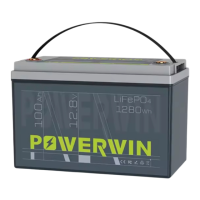

 To Next Page
