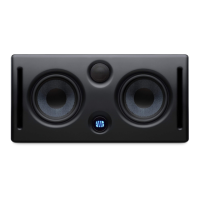
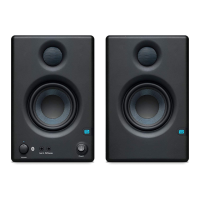
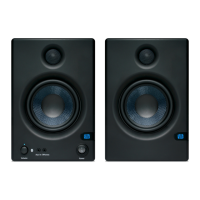
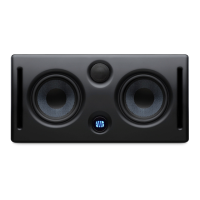
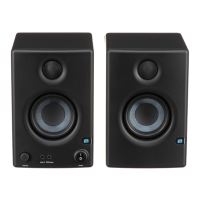
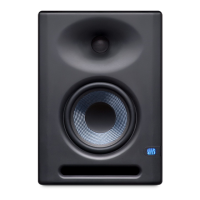
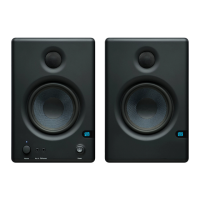
Eris E5 / Eris E8
Active Studio Monitor
By Eli Crews
e rst outboard mic preamp I ever
shelled out for was the PreSonus
MP20 [Tape Op #35], back toward
the close of the previous century. I
only sold it last year to help nance a
cross-country move, and I honestly
kinda regret selling it. For its price, it
really couldn’t be beat. It had solid
build quality and a clean sound; no
frills but a clear aesthetic; and good
ergonomics. All of that praise could
equally apply to the new Eris line of
studio monitors that PreSonus un-
veiled this year.
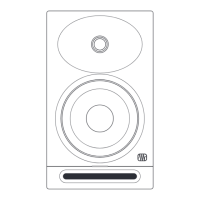
ere are two models - the E5 has
a 5.25’’ Kevlar woofer that charts
down to 53 Hz, and the E8 has an 8’’
woofer that extends down to 35 Hz
on the spec sheet. Both models sport
silk-dome tweeters that reach up to
22 kHz. e speakers are bi-amped
by onboard power ampliers (35+45
watts for the E5, 65+75 watts for the
E8). Both models also possess the
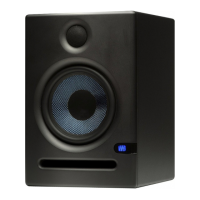
same sleek, incognito look; every-
thing on the front face is completely
black aside from the small glowing
blue logo (no name, just logo) near
the bottom right corner. ey both
have slotted bass ports on the front,
and inputs (RCA, TRS, and XLR) as
well as volume and EQ controls on
the back. e Gain control provides
up to 35 dB of boost for the unbal-
anced input and 31 dB for either bal-
anced input. e High control gives
you a ±6 dB shelf at 10 kHz. e Mid
control gives ±6 dB centered around
1 kHz. And the Low Cuto provides a
12 dB/octave lter at either 80 or 100
Hz, for use with a subwoofer. ere
is also an “Acoustic Space” setting,
which compensates for bound-
ary (wall or corner) bass boosts. A
cute little diagram on the rear of
the speaker shows which setting
should be used based on how your
speakers are set up. is attenua-
tion starts surprisingly (to me) high,
at 800 Hz. All in all, this is a very
impressive amount of control for a
powered speaker in this price range.
Having started mixing primarily at
home just this year, I had set up a pair
of KRK Rokit 5 powered monitors
temporarily, not thinking about them
as a long-term solution. But I started
to really get used to them, and now
that I’ve gured out their quirks, I
really like mixing on them. Since the
Eris E5 is exactly the same price and
roughly the same size, I jumped at
the chance to audition it next to the
Rokit.
e Rokit’s main aw is that it
is pretty tubby in the low-mids. It
accentuates an area around 130 Hz,
at least in my room, that I’ve learned
to work around. I also feel that the
high-end denition is a little lacking,
so I have come to rely on my three
sets of high-quality headphones to
ne-tune the highs. On both of those
counts, I feel like the E5 one-ups the
KRK. Even with the Acoustic Space
control at, the E5 has tighter bass
response. It doesn’t seem to go down
as far — on paper, the KRK goes one
cycle lower to 52 Hz — but there is
more denition around the thud part
of a kick drum’s attack on the E5. In
the high-mid to treble region, I feel
like the E5 exhibits quite a bit more
energy (again at the at position on
the EQ), which can reveal harshness
in cym-
bals and
sibilance
that the Rokit tends to gloss over.
One thing that I did notice is that
the E5 seems to have just a hint of a
smiley-face curve, with a perceived
dip around 1 kHz. Since that’s exactly
where the Mid control is centered, I
boosted it just a bit so as not to acci-
dentally over-emphasize the mid-
range in my mixes.
As expected, the E8 oers a lot
more low end than the E5. It’s been
a treat to hear quite a bit lower than I
was able to with the Rokit pair alone;
authority in the deep bass, there was
actually nothing small-sounding
about the Eris E5s at all. Everything
came over smoothly yet with plenty
of detail; vocals sounded absolutely
pristine, and though the bass lacked
the depths of a larger monitor it still
managed to sound tight and solid.
You can hear right away whether a
pair of monitors is going to tell you
what you need to know while still
being comfortable to work with for
long periods, and it took me only a
few moments to recognise that the
Eris E5s would do the job very nicely.
e imaging was great, the mid-range
clear and well-focussed, and the
highs were detailed without being ag-
gressive — which is often a problem
with cheaper monitors.
In the smaller studio where
monitors capable of too much bass
extension would only provoke the
inevitable room problems, the Eris
E5s would appear to be a great choice
— and I’ve heard speakers costing
twice as much that don’t deliver
nearly such ‘adult’ results. ey ben-
et from being raised above the desk
rather than sitting directly on it, so
some good-quality speaker platforms
(or some cheap foam ones with a
heavy oor tile on top) would make
a worthwhile improvement to their
bass tightness and general focus,
but then this advice applies to most
desktop speakers.
Switching to the E8s reveals, as
expected, greater bass extension and
a little more headroom. ey have
a very similar sound, and, as with
the E5s, the bass is reasonably tight
sounding rather than being boomy
and abby. e larger tweeter still
manages to deliver detailed but
smooth highs, while the mid-range
carries vocals well and provides a
detailed window into instrument
sounds.
Conclusion
Given their pricing, both monitors
deliver great quality, and though
spending more might give you a little
more in the way of delity, the law of
diminishing returns most denitely
applies — and being realistic, unless
you have a really well-treated studio
space, the dierences might well be
lost anyway. e E5s are ideal for
the smaller room where more bass
extension would simply stir up room
problems, while the E8s would be
well suited to a garage-sized studio.
ese are the rst monitors from
Presonus but it would seem that, as
with everything else they build, they
did their homework rst. ■
PROS
• Affordably priced.
• Well-balanced sound that, in the case
of the E5, belies both the price and
physical size.
CONS
• Given the size and cost I can’t find
anything not to like.
SUMMARY
• These are the first PreSonus monitors
I’ve listened to under studio condi-
tions and I have to say that I’m very
impressed by what their designers
have achieved.
TAPE OP
ELECTRONIC MUSICIAN
Placeholder for cover
of magazine if print
or screenshot of web
page
I’d been relying on headphones and
my hi- system to get down into the
30s and 40s and below. I nd the
overall characteristics of the E8 very
similar to the E5, with ample high
end, tight bottom, and a slightly
scooped-sounding midrange. For my
situation, they sounded best with the
full 4 dB of Acoustic Space attenu-
ation, even though they weren’t in
the corners. I still felt robust low-end
energy and could clearly make out
the relationship between the funda-
mentals of the bass guitar and kick
drum.
In the end, I found both of these
monitor models very useful tools for
the imperfect art of home-studio mix-
ing. I wager if you were to put them
up in a very controlled environment,
next to speakers you paid a bunch of
money for, you would probably nd
things here and there about them you
didn’t like - although you may be sur-
prised. Setting them up in my hum-
ble (yet eective) home studio for a
few months helped me hear things I
wasn’t hearing previously and helped
me to provide better mixes for my
clients. At the end of the day, that
matters much more than the price
tag of the speaker or the label on the
front. Job well done, PreSonus. ■
“Job well done, PreSonus.”
PreSonus Eris Monitor Speakers
By Craig Anderton
Eris targets price point—but adds
some novel twists.
My rst car was a used 1966 Beetle,
and it refused to die. But in 2000 it
became almost impossible to nd
certain parts, and guring I owed
Volkswagen some brand loyalty, I
bought a used 2000 Beetle. (I did get
a diesel model, though.) What does
this have to do with speakers? e
Eris is PreSonus’s Volkspeaker. Yes,
they have their Porsche equivalent—
the pricier Sceptre monitors, which
got the buzz at Winter NAMM. But
you don’t need a Porsche to get from
point A to point B, and you don’t
need to spend a bunch o’ bucks for
speakers that let you create solid
mixes.
Sound e E5 has a slight bump
around 100Hz, while the E8 has a
smoother bass and extends down
further. For studio monitors, the E8
is worth the extra bucks (and bigger
footprint). e bass is tight and de-
ned, with solid transient response,
and the highs are accurate. If you’re
really tight for space, the E5 will do
the job; as long as you’re aware of
the E5’s bump, you’ll nd the mixes
translate well to other environments.
But also note the various rear-panel
controls make it easy to emulate car
August 2013
April 2013


 To Next Page
 Loading...