acoustic tracks, details like nger
squeaks on strings and breaths for
phrasing were clear and evident. I
didn’t notice any radical jumps in
level or character around the cross-
over point. Highs were extended and
smooth, without any edgy spikiness
or resonances that leaped out; nger
cymbals and hi-hats were clear and
bright, and when an artist substituted
a sample for the real thing, you could
often tell. Similarly, the edgy artifact-
ing that comes from heavily com-
pressed MP3 encoding was clearly
audible... and annoying, when it was
supposed to be.
I found I enjoyed the E5s most
when working with predominantly
acoustic music at lower listening lev-
els; they do well with rock and dance
music when cranked up loud (if not
too loud, as discussed above), but the
forward midrange did lead to some
very complex rock mixes sounding
cluttered—especially stu that relied
a lot on layered loops for its structure.
Acoustic jazz and country were a
delight, with ngerstyle guitar, hand
percussion, mandolin, violin, and
brush-style drumming standing out
sweet and clear.
Could I mix on these speakers?
Absolutely. And if I was primarily
an acoustic recording engineer who
worked with small groups, I would
appreciate the privilege. It’s true that
for larger rooms, and/or for heavy
rock or electronic music with more
bass, there might be better choices
out there—which leads me to...
Listening to the E8
Our listening setup for the E8 was on
speaker stands well away from walls
and corners in a well-treated room; we
weren’t expecting to need any of the
rear-panel acoustic tweaks, and quick
tests conrmed that fact. As with the
E5, we ended up doing all of our listen-
ing with all rear-panel controls set at.
e highs and mids on the E8
were very similar to the E5; vocals
and midrange instruments tended
to be very far forward, and there was
that tendency for really dense mixes
to sound congested, but not to the
extent we heard in the E5. What truly
distinguished the E8 was its power
handling—it could get very loud
without any of the brittleness of the
E5—and its bass, which was solid,
learnable, and most important, nicely
extended down to where you’re not
missing a whole lot for practical
purposes.
My sentiments about the E8 are
similar to those for the E5 but a bit
more so, if that makes sense; I could
learn these speakers and mix happily
on them in most genres of music,
with no more than the usual recourse
to check-mixes. Perhaps
their greatest value is in let-
ting a starter studio hear real
bass without a subwoofer; a cheap
sub is way worse than no sub, and
for a less-than-optimal room and/
or an engineer who’s inexperienced
at dialing in a sub properly, a pair of
speakers that can deliver the lows on
their own will win every time.
Hail Eris!
Let’s talk price. e E5 costs a bit
more per pair than a set of cheap-ass
desktop computer speakers and a
thumpy little one-note sub, but for
your money you get monitors you
can actually use for real engineering.
e E8 is even more of a no-brainer:
it basically allows recording musi-
cians who want proper full-range
studio monitors, but don’t yet have
the budget for high-end products,
to get into the game without hurting
themselves.
Later this year, PreSonus will ship
the Sceptre monitors, DSP-assisted
coaxial designs. We’ll be very curious
to give them a try when they’re ready,
but in the meantime, the Eris speak-
ers make for a very auspicious debut.
ey bring honest-to-gosh studio
monitoring into the price range of
just about any studio, and they do it
with class. ■
Aordable Upgrades: 5 Studio
Monitoring Improvements Under
$500 — PreSonus Eris Series E8
By Strother Bullins
Over the past year, overachieving
pro audio manufacturer PreSonus
has rolled out some impressive-look-
ing studio monitors, like the bud-
get-priced Eris and premium coaxial
Sceptre lines. Recently received for
review and approximately $250 street
each, the E8 is Eris’ largest oering,
providing what I’d categorize as a
standard two-way powered monitor
with mideld performance in a rela-
tively compact cabinet.
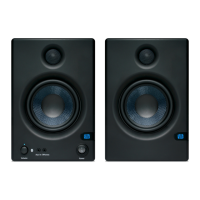
e E8 features an 8-inch Kevlar LF
driver, 1.25-inch silk dome tweeter,
140W of bi-amped power, and RCA,
¼-inch TRS and XLR input options.
Notably, the Eris Series provides
comprehensive frequency-based
parameter adjustments, variable
HF and MF (-6 to +6 dB) “acoustic
tuning,” Flat, 80 Hz and 100 Hz low
cut settings, plus -4, -2 and 0 dB bass
attenuation settings (cutting frequen-
cies below 800 Hz). Specs include a
frequency response of a low 35 Hz
through 22 kHz; 105 dB peak SPL (at
1m); and a 2.2 kHz crossover fre-
quency point. e Eris E8’s cabinet
is sturdily built and relatively free of
cosmetic accoutrements.
Where users may often desire a
subwoofer, especially those work-
ing on bass-heavy material, I found
the E8 to provide notable low-end
response sans sub—full and detailed,
yet punchy. e adjustable HF and
MF parameters are especially help-
ful; considering their lower price
point, these monitors will likely nd
themselves in minimally (or non-)
ducer is driven by a 75 watt class AB
amp while the 1.25-inch silk-dome
high- frequency tweeter gets 65W of
class AB amplication. Besides the
woofer and tweeter there’s a hori-
zontal front port. All connections
and controls reside on the rear panel.
You should have no trouble getting
a signal into the E8 as there are XLR,
balanced TRS jack and unbalanced
RCA (phono) sockets.
E8 EQ
Besides the necessary input gain
knob, the E8 has a range of controls
for tweaking the sound. A pragmatic
approach is taken by a three-position
‘Acoustic Space’ switch to compen-
sate for any increase in bass response
if you have no option but to place
your monitors in corner positions or
too close to a wall. is takes the form
of a second-order low-shelving lter
PRO AUDIO REVIEW
FUTURE MUSIC
Placeholder for cover
of magazine if print
or screenshot of web
page
September 2013
July 2013
treated residential rooms, where the
tweakability will come in particu-
larly handy. Overall, the monitors
are impressively frequency neutral
with great imaging; I nd them to
be an extreme bargain for what they
provide the listener at under $500 per
pair.
PreSonus may have just entered
the studio monitor market, but it’s
doing it with the style and grace of
a veteran. If I needed an eight-inch
powered monitor, I’d be quite happy
with the Eris E8—and even happier
with the money I saved. ■
PreSonus Eris E8 & E5 monitors
PreSonus’ first studio monitors
have plenty of added ingredients.
Trevor Curwen checks out the E
numbers.
PreSonus have been known for
their mixers, audio interfaces and
even monitor controllers but sur-
prisingly monitors have not been in
their roster. at’s all changed now
as the Louisiana-based company
unveiled two distinct new studio
monitor ranges at the NAMM show
back in January. One of those was
the Sceptre, a high-tech oering
that combines a coaxial design with
heavy-duty DSP. e other is the Eris,
their entry level powered monitor for
home and project studios, available
in two versions, the E8 and the small-
er E5. We are taking a look at the E8
but have also checked out the E5 (see
The Jive on the Five at right).
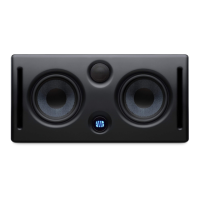
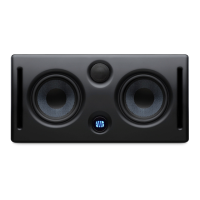
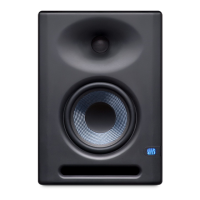
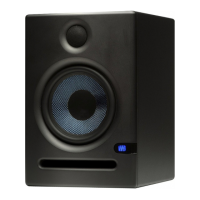
e E8 is quite a large neareld
monitor. Nice-looking in an under-
stated way, the cabinet is vinyl-lam-
inated MDF, all in black but with a
touch of blue in the woven pattern of
the Low Frequency driver’s cone and
with a PreSonus waveform logo that
lights up blue when you turn on the
power.
As is the norm for two-way studio
monitors, the E8 is bi-amped. e
8-inch Kevlar low-frequency trans-
“…notable low end res ponse – sans sub.”
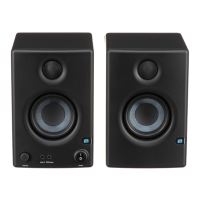
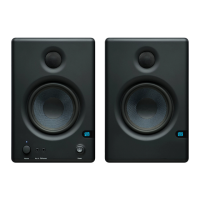
The Jive on the Five
If you’ve put all that eort into design-
ing a monitor, you might as well make
dierent-sized versions of it and in this
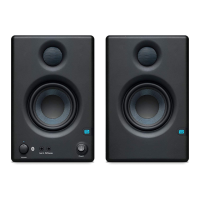
case PreSonus have also released the
E5 (£129 each), which comes equipped
with all of the same rear panel inputs and
tone-tweaking possibilities as its larger
sibling but has a smaller footprint.
At 178 x 260 x 195 mm and weighing
in at just over ten pounds (4.63kg), the
E5 will suit smaller studio spaces and
could be ideally placed on a desktop next
to your computer. A 5.25-inch LF driver
driven by a 45W amp and a 1-inch tweet-
er with a 35W amp is quoted as putting
out a 102 dB SPL peak sound level and
it’s true that these can push out quite a
lot of volume if you want them to.
The overall sound character is pretty
much the same as the E8 although, as
might be expected from a quoted
frequency response of 53Hz to 22kHz,
the bottom end is much lighter. That
being said, once you get familiar with the
E5s, there’s enough there to give you a
reasonable indication of what’s going on
for some types of music but if you are
making bass-heavy dance music, you’ll
probably want to check your mixes on a
bigger system.


 To Next Page
 Loading...